

Книги и слепота: Дар от Бога
Jorge Luis Borges (1899–1986) was an Argentine writer whose short stories and essays redefined 20th-century literature through metaphysical themes and intellectual labyrinths. He gained international prominence after sharing the 1961 Formentor Prize with Samuel Beckett, subsequently influencing a generation of postmodern novelists by blending philosophy with fiction.
Borges’ work focuses on the boundaries between reality and dreams. He avoided long novels, instead mastering the short form. His most significant collections include Ficciones (1944) and The Aleph (1949).
Why is the “Borgesian style” significant?
The “Borgesian style” is characterized by a mathematical precision and intellectual distance. According to the provided text, Borges used fake bibliographies and invented citations to blur the line between fact and fiction.
His narratives often feature labyrinths, mirrors, and non-linear time. These elements create “intellectual labyrinths” where readers explore themes of infinity and alternative identities. David Foster Wallace described Borges as perhaps the greatest bridge between modernism and postmodernism in world literature.
How did blindness shape his creative process?
Borges suffered from a hereditary disease that left him nearly blind by his late 50s. Rather than viewing this as a tragedy, he described blindness as a “way of life” and a “gift” from God.
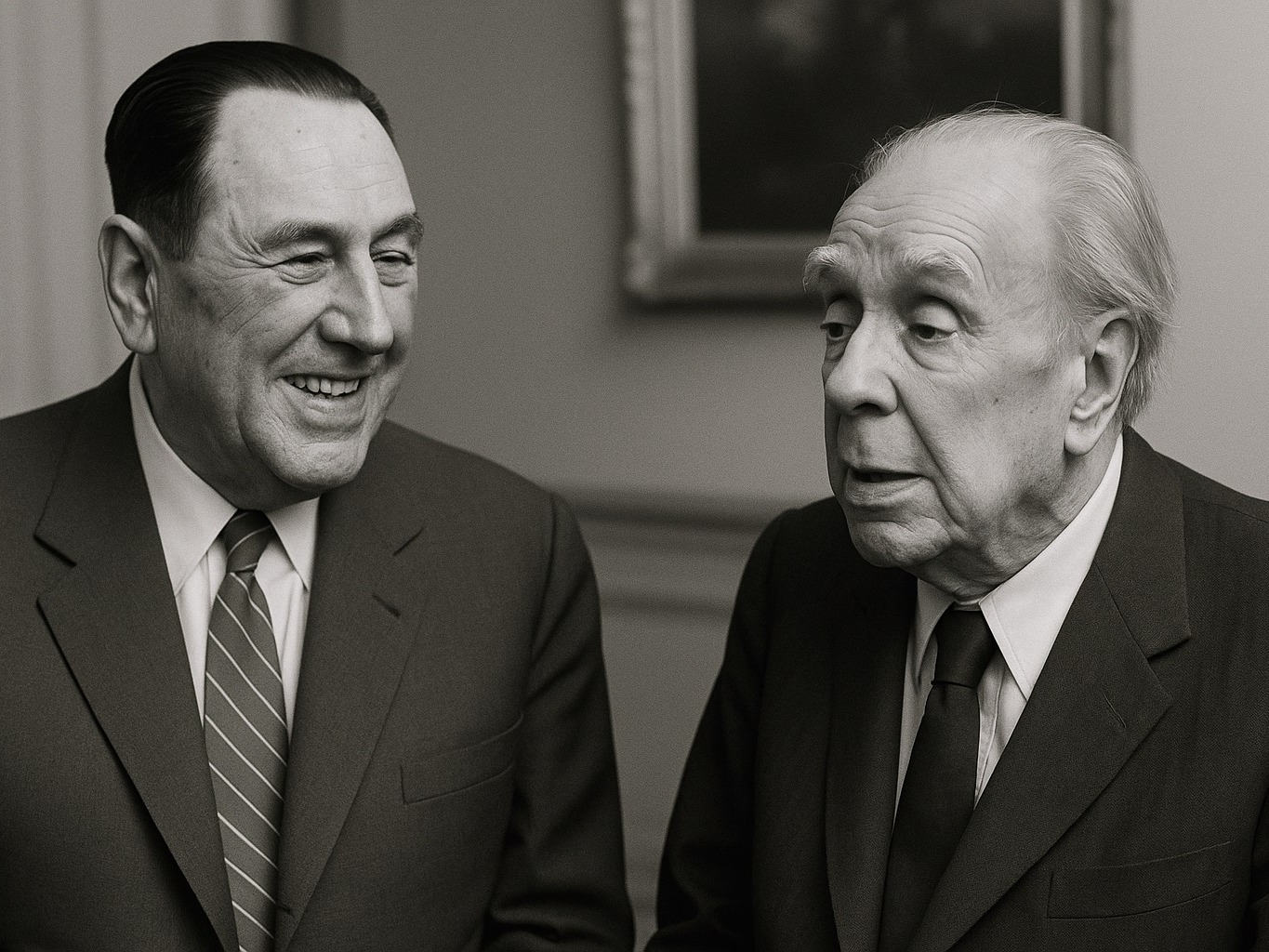
The loss of sight forced him to dictate almost all of his later texts. He claimed this allowed him to “see” literature more clearly by removing visual distractions. In his 1960 “Poem of the Gifts,” he noted the irony of becoming the director of the National Library of Argentina while losing his vision.
What was Borges’ influence on Umberto Eco?
Umberto Eco cited Borges as one of his two greatest modern influences. This is most evident in the 1980 novel The Name of the Rose, which features a blind monk named Jorge de Burgos—a direct tribute to Borges.
Eco adopted several “Borgesian” elements, including the concept of a labyrinthine library and the use of metafiction. The detective plot in Eco’s work also draws from Borges’ story “Death and the Compass.”
What were the professional and political controversies?
Borges never received the Nobel Prize, a fact many consider one of the award’s greatest scandals. He did, however, receive the Cervantes Prize in 1980, the highest honor in Spanish-language literature.

His political history is complex. While he despised the regime of Perón, he initially supported the military junta in the 1970s to stop chaos. He later publicly distanced himself from the junta, leading to significant criticism across Latin America.
Regarding his future legacy, the provided text suggests his ideas on hypertexts and multiverses may continue to resonate as they mirror the structures of the internet and virtual reality.
Frequently Asked Questions
Why is Borges called the father of magic realism?
Though he disliked the label, he is recognized as a father of magic realism because his work exists on the border between reality and dreams, influencing writers like Gabriel García Márquez.
What is “The Aleph”?
It is a central story in his 1949 collection that describes a single point in space containing the entire universe simultaneously.
How did other Nobel laureates view him?
Mario Vargas Llosa called him one of the most exceptional writers of the 20th century and expressed shame at receiving the Nobel Prize when Borges did not.
Do you believe a writer’s political views should influence the evaluation of their literary genius?