
A New Path to Preventing Cancer
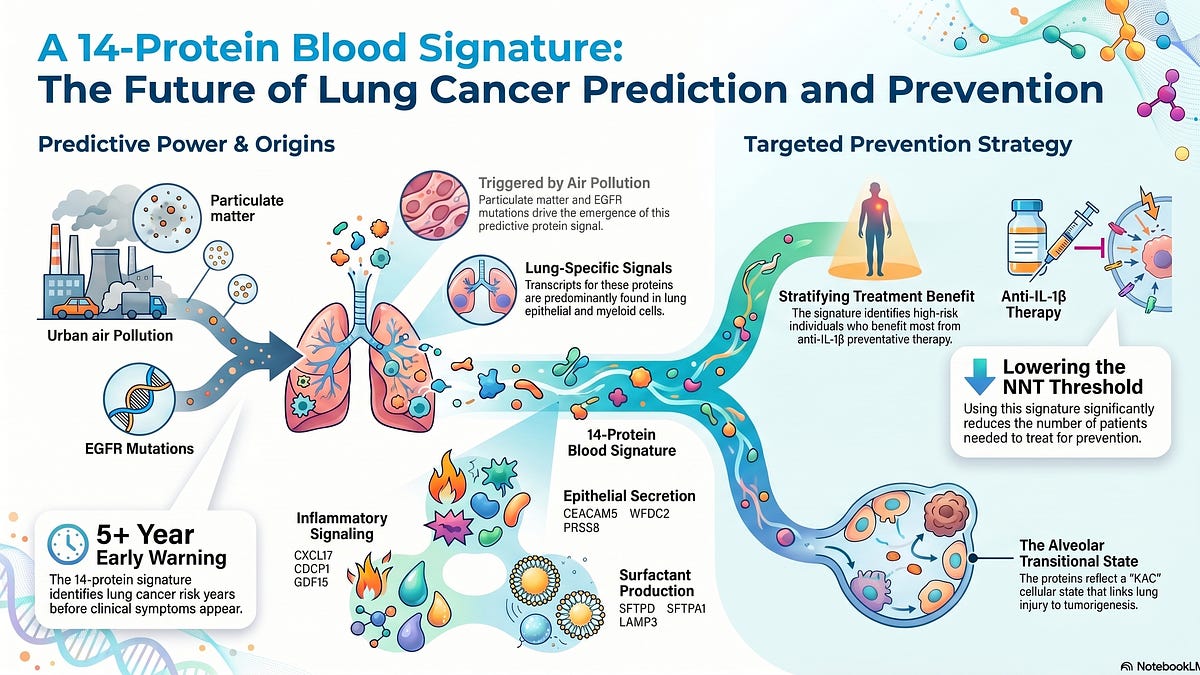
A team of over 80 researchers from four continents has identified a 14-protein blood signature that predicts lung cancer more than five years before diagnosis, according to a study published in the journal Cell. The discovery enables the identification of high-risk individuals who may benefit from specific anti-inflammatory treatments to prevent the disease before it develops.
How does the 14-protein blood test predict lung cancer?
Researchers used machine learning to analyze high-throughput proteomics from more than 48,000 UK Biobank participants. By assessing nearly 3,000 different proteins, the team identified 14 proteins linked to inflammation, lung surfactant production, epithelial cell secretion, and matrix remodeling, according to the Cell report.

These proteins appeared on average 5.6 years before participants developed lung cancer. The 14-protein signature outperformed two existing lung cancer models, LCRAT and LLVP3, which rely on demographics and smoking history.
The findings were validated across eight different cohorts. In a Taiwanese cohort, the signature remained predictive in a group where 93% of participants had never smoked and 81% were women.
Where do these proteins come from?
The 14 proteins do not originate from tumor cells. Data from the TRACERx clinical study showed no reduction in the protein signature after the surgical resection of lung tumors and no correlation with more advanced cancer stages, according to the researchers.
Instead, the proteins are released by healthy “bystander” cells. These wild-type cells sense stress from nearby cells transitioning into a pre-cancerous state known as the KAC state (KRT8+ alveolar intermediate cells).
The study found that particulate matter from air pollution activates macrophages to release interleukin-1β, which drives the production of these 14 proteins. This effect is amplified when combined with a KRAS mutation, a process confirmed using human lung organoids.
How can this discovery prevent lung cancer?
The research connects these biomarkers to the 2017 CANTOS trial, a study of over 10,000 participants with prior heart attacks. While the trial focused on cardiovascular events, it revealed an unexpected reduction in lung cancer and fatal lung cancer among those receiving canakinumab, an interleukin-1β antibody.
At the highest dose, canakinumab led to a nearly 80% reduction in fatal lung cancer. However, the initial “number needed to treat” (NNT) to prevent one case of lung cancer was over 1,000, making the drug impractical for the general population due to the risk of fatal infections.
By applying the 14-protein signature to 2,325 CANTOS participants, researchers found that those with the signature had more than double the risk of lung cancer. In this high-risk group, the NNT dropped from 1,500 in low-risk individuals to 50, according to the study.
What happens next for lung cancer prevention?
The current findings are retrospective. A possible next step is the launch of prospective clinical trials to prove that the combination of the 14-protein biomarker and antibody treatment can reduce lung cancer incidence by 50%.
Researchers suggest that this proteomic approach could be combined with preventive cancer vaccines for people with known pathogenic mutations. Such a combination may increase the effectiveness of primary prevention in high-risk individuals.
The team indicates this work provides a template for identifying similar protein clusters for other types of cancer, potentially predicting various malignancies years in advance.
Frequently Asked Questions
Who can the 14-protein test identify?
The test identifies individuals at high risk for lung cancer, including those who have never smoked, up to 5.6 years before a clinical diagnosis.
What is the role of air pollution in this study?
Particulate matter activates macrophages to release interleukin-1β, which triggers the production of the 14-protein signature and may push dormant mutant cells toward becoming cancer.
Why is the “Number Needed to Treat” (NNT) important?
The NNT shows how many people must receive a treatment to prevent one bad outcome. Reducing the NNT from 1,000 to 50 makes the use of canakinumab more practical and targeted for high-risk patients.
Would you be willing to undergo a blood test to determine your cancer risk five years before a tumor develops?