
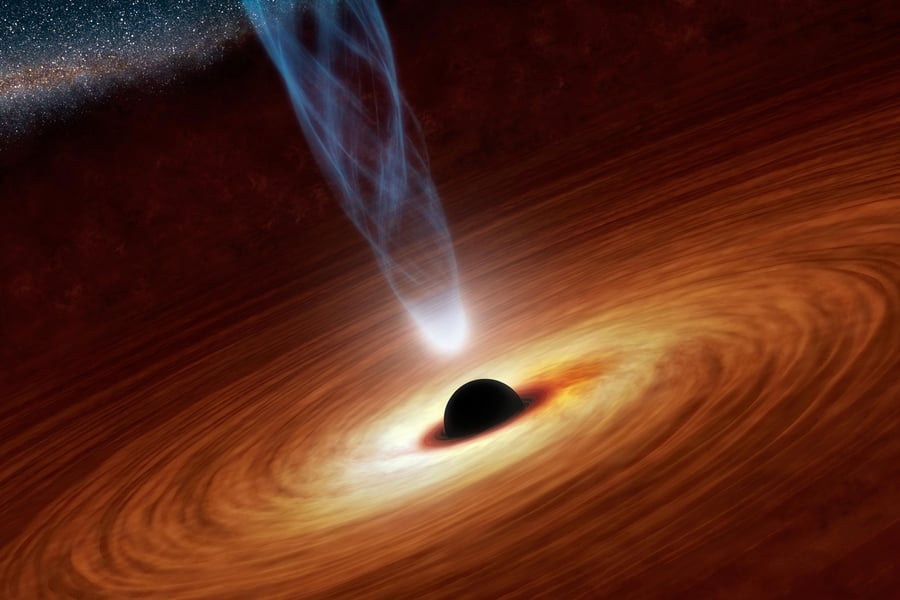
A Quasar at Cosmic Dawn Flickers into View
Astronomers have detected the earliest known flickering quasar, J0439+1634, as it appeared 850 million years after the Big Bang. According to MIT researchers, the object’s flat accretion disk suggests supermassive black holes reached a mature state much faster than previous scientific assumptions predicted.
The discovery identifies a supermassive black hole billions of times more massive than the Sun. Gene Leung of MIT’s Kavli Institute for Astrophysics and Space Research stated this is the first time a flickering quasar has been observed from the cosmic dawn.
Why is the flickering of J0439+1634 significant?
The flickering light reveals that the black hole possesses a flat, pancake-shaped accretion disk. Astronomers previously believed that early black holes would be unsettled systems with puffy, chaotic disks.

A flat disk typically indicates a black hole has settled into a quiescent state. Anna-Christina Eilers, an assistant professor of physics at MIT, said this suggests rapid growth phases happen very early, before objects become bright, luminous quasars.
Eilers noted that this provides direct evidence that feeding processes seen in the nearby Universe existed at very early times, despite different cosmic environments.
How did researchers detect the flicker?
The team used data from the NEOWISE mission, which scanned the sky for about 14 years. To overcome the challenges of distance and redshift, they observed the Universe at redder wavelengths within the infrared spectrum.
J0439+1634 was first identified in a Hubble Space Telescope (HST) image. The image showed a distant galaxy being lensed by a foreground galaxy, providing a view of the quasar as it looked 12.8 billion years ago.
What may happen next in early Universe research?
The appearance of a mature black hole so early raises questions about what triggered this rapid development. Leung stated that “something happened even earlier on” to make these systems look mature.

A possible next step for astronomers is to look further back in history. Researchers may attempt to observe the specific period when the galaxy hosting the quasar first began forming.
Because supermassive black holes play a major role in shaping galactic ecosystems, future observations could clarify how these objects influenced early star formation and galaxy shapes.
Frequently Asked Questions
What is J0439+1634?
It is the earliest detected flickering quasar, observed as it appeared 850 million years after the Big Bang.
Why is the accretion disk’s shape surprising?
It is flat and pancake-shaped, a structure familiar in modern quasars. Astronomers expected early black holes to have puffy and chaotic accretion disks.
What mission provided the data to spot the flicker?
The discovery relied on 14 years of data from the NEOWISE mission, processed to detect infrared wavelengths.
Do you think the discovery of mature black holes in the early universe will force a complete rewrite of cosmic evolution timelines?