
A quieter Federal Reserve could mean volatile markets, higher rates
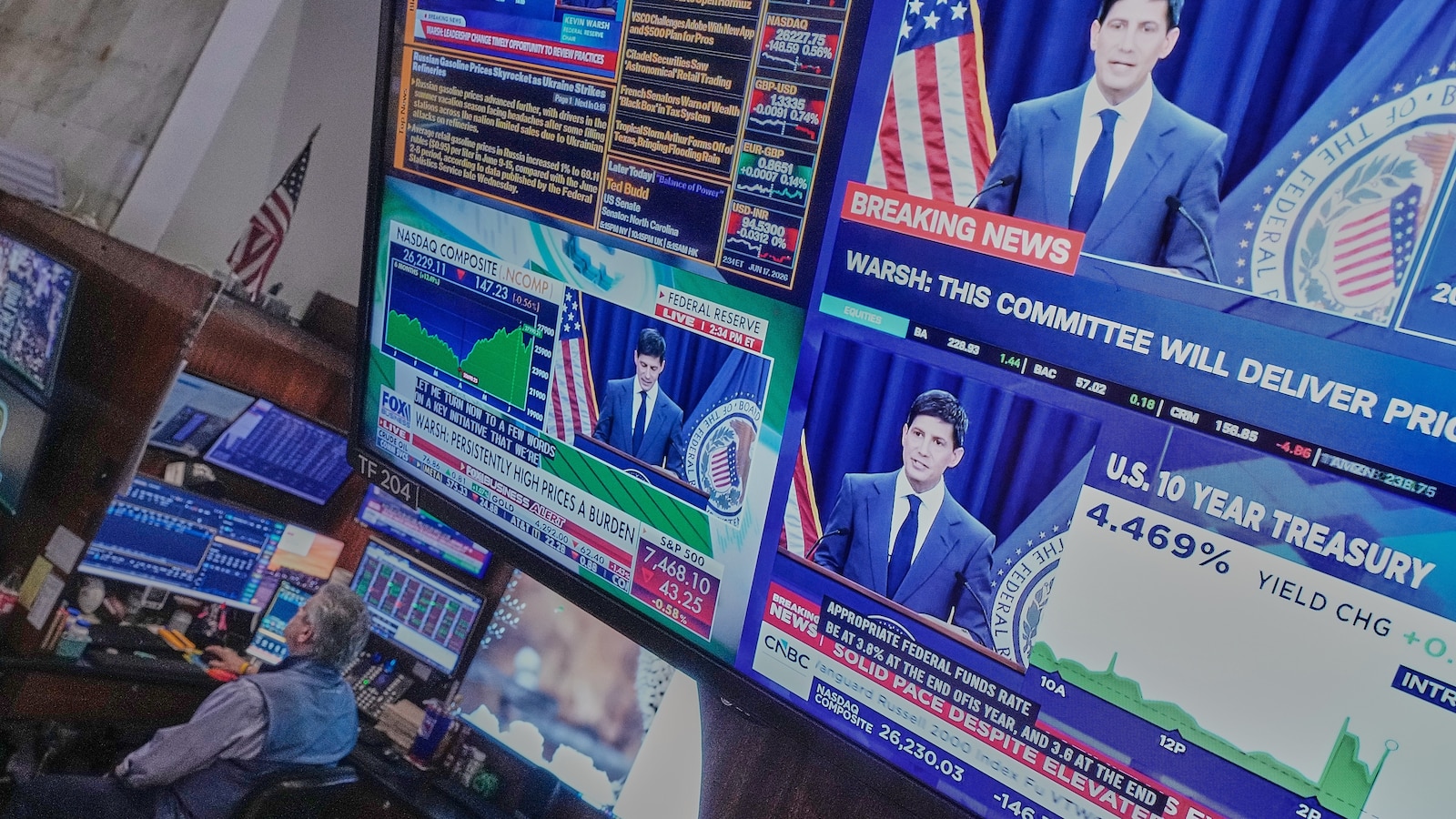
New Federal Reserve Chair Kevin Warsh has begun reducing the central bank’s transparency by eliminating “forward guidance” on future interest-rate moves. According to a Wednesday press conference, Warsh slashed the Fed’s rate-decision statement from 341 words in April to 132 words to reduce market dependency on official guidance.
Financial markets reacted immediately to the shift. The S&P 500 stock index dropped 1.2% Wednesday, while the yield on the 10-year Treasury jumped to 4.49% from 4.43%, according to market data.
The yield on the 2-year Treasury also rose sharply to 4.16% on Thursday, up from 4.05% before the meeting. These fluctuations reflect a departure from the communication styles of previous chairs who signaled moves to help markets anticipate actions.
Why is the Federal Reserve reducing forward guidance?
Warsh believes financial markets have become too dependent on guidance from the Fed. He stated during Wednesday’s news conference that financial market prices are “probably the most important source of information to guide central bankers.”
Warsh wants investors to examine economic data and make independent judgments rather than relying on Fed hints. He argues that providing direction is more effective during economic downturns or financial crises than in stable periods.
The new chair has cited former chair Alan Greenspan as a model. Greenspan, who led the Fed from 1987 to 2005, used circumspect comments that often left investors guessing about the bank’s next steps.
How does this change affect consumers and markets?
Analysts warn that reducing transparency could lead to more violent swings in bond and stock prices. George Pearkes, a global macro strategist at Bespoke Investment Group, stated that forward guidance previously served to anchor market expectations and suppress volatility.
This shift may lead to higher borrowing rates for businesses and consumers. Pearkes noted that mortgage rates could be a quarter-point higher than they would be if the Fed continued its previous guidance strategy.
Matthew Luzzetti, chief U.S. economist at Deutsche Bank, described the move as putting the “train in reverse” regarding the trend toward greater transparency that followed the 2008-2009 global financial crisis.
What other reforms is Kevin Warsh planning?
The reduction in communication is part of a broader reform package. Warsh announced the creation of five task forces to examine the Fed’s operations, including its balance sheet and how it gathers economic data.
Two other task forces will study the impact of AI on jobs and productivity, as well as the frameworks used to analyze inflation. The communications task force may consider changes to press conferences and quarterly economic projections.
This approach contrasts with former chair Jerome Powell, who held press conferences after every meeting, and Ben Bernanke, who introduced them after every other meeting.
What happens next for the Federal Reserve?
The lack of central guidance may empower the other 18 members of the Fed’s rate-setting committee. According to Pearkes, the six governing board members and 12 regional Fed bank presidents may see their public speeches receive more attention as markets hunt for clues.
Economists suggest the strategy could be tested if a sharp financial downturn or crisis occurs. In such scenarios, forward guidance is often used to calm markets, as seen during the COVID pandemic.
David Andolfatto, an economics professor at the University of Miami, suggested that Warsh may need to implement a contingency plan. Andolfatto argued that replacing forward guidance with specific guidelines for reacting to unexpected events, such as the Iran war or Russia’s invasion of Ukraine, would be necessary.
Frequently Asked Questions
What is “forward guidance”?
It refers to the hints or directions the Federal Reserve provides to financial markets regarding its future interest-rate moves.
How did the 10-year Treasury yield react to the news?
The yield jumped to 4.49% from 4.43% on Wednesday, though it fell back during Thursday’s trading.
What are the five task forces established by Kevin Warsh?
The task forces will examine Fed communications, the balance sheet, economic data analysis, the impact of AI on productivity and jobs, and inflation analysis frameworks.
Do you think financial markets are too dependent on central bank guidance?