
A Snapshot of Continental Crust in the Making
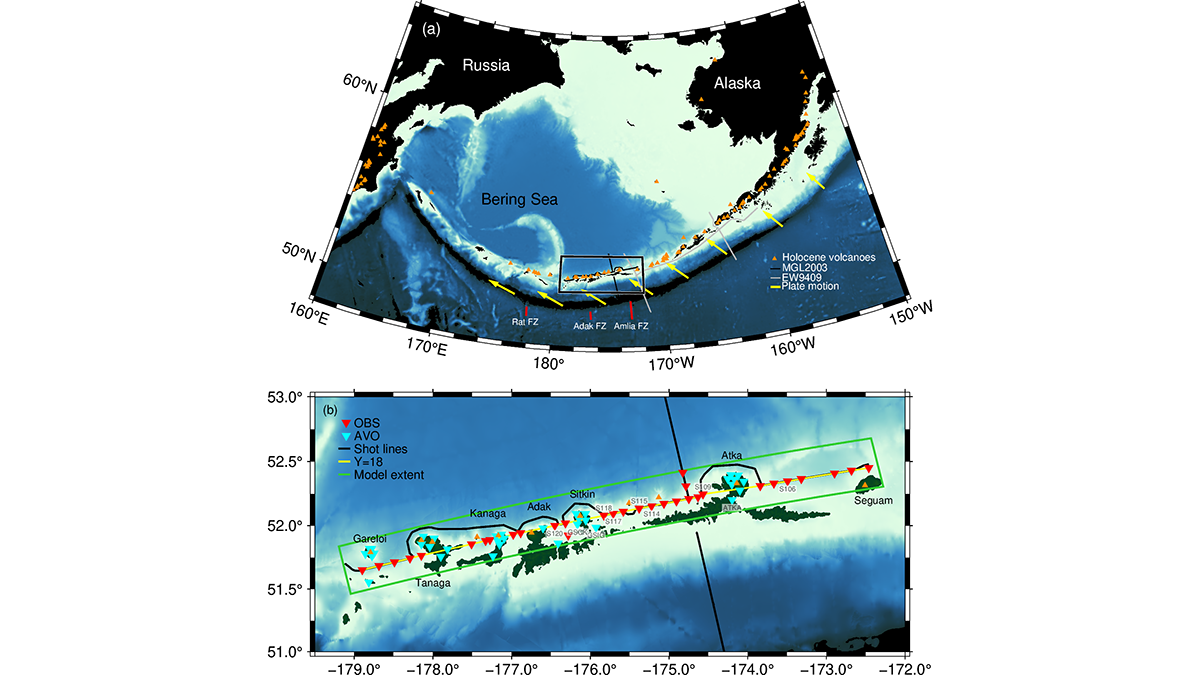
Seismic imaging of the Andreanof segment of the Aleutian Arc indicates that volcanic island arcs remain chemically distinct from mature continental crust, according to research published in the Journal of Geophysical Research: Solid Earth. While these arcs are widely considered the primary source of new continent-building material, current data suggests that additional, complex chemical transformations must occur before this crust matches the composition of existing continents.
Why Are Volcanic Arcs Important to Continental Growth?
Volcanic arcs function as the Earth’s primary "factories" for new crust. As oceanic plates subduct beneath one another, they trigger volcanic activity that brings material to the surface. According to the Journal of Geophysical Research: Solid Earth, scientists have long hypothesized that this process creates the building blocks for continental landmasses. However, a persistent problem remains: modern arc crust is consistently richer in iron and magnesium than the silica-rich, buoyant crust that makes up our stable continents.

What Does the Andreanof Segment Reveal?
The Andreanof segment of the Aleutian Arc serves as a rare natural laboratory because it is an active, relatively intact system. By using seismic waves to image the crustal structure, researchers led by H.F. Mark found that the region is not yet "continental."
According to the 2026 study, the seismic velocity beneath the Atka and Tanaga volcanoes shows localized zones of slower movement. These slow-velocity pockets likely indicate the presence of hotter or more silica-rich material deep in the crust. While this suggests that some maturation is occurring, the study concludes that the transition from a volcanic arc to a continent is a multi-stage process that remains incomplete in the Aleutians.
Did you know?
Most volcanic arcs are heavily disrupted by back-arc spreading, which makes them difficult to study. The Andreanof segment is unique because its relative stability allows geologists to observe crustal evolution in real-time without the interference of complex tectonic tearing.
How Do These Findings Change Our Understanding of Earth Science?
The research highlights a "missing link" in plate tectonics. If volcanic arcs are the source of continents, why is the average arc crust so different from the average continent?
When comparing these findings to the broader study of the Birth, Growth, and Death of Continents, it becomes clear that arc formation is only the beginning. The data from Mark et al. suggest that volcanic material must undergo significant chemical or physical "filtering"—likely involving the removal of iron and magnesium or the addition of silica—before it can be classified as true continental crust.
Pro Tip: Understanding Seismic Velocity
Geologists use seismic waves to "see" inside the Earth. Faster waves typically travel through dense, cold, or iron-rich rock, while slower waves often indicate hotter, partially melted, or silica-rich material. When looking at crustal maps, these velocity variations are the primary evidence used to determine the chemical composition of rock miles beneath our feet.
Frequently Asked Questions
Why is continental crust different from oceanic crust?
Continental crust is generally thicker, older, and more silica-rich than the thinner, denser, and iron-heavy oceanic or volcanic arc crust.
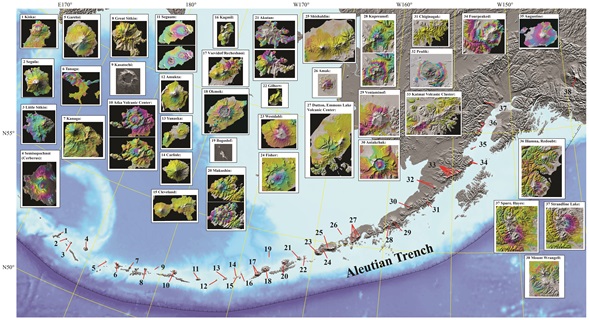
What is the Aleutian Arc?
The Aleutian Arc is a chain of volcanic islands in Alaska formed by the subduction of the Pacific Plate under the North American Plate. It is a key site for studying how new land is generated.
Is all volcanic crust destined to become a continent?
Not necessarily. The process is complex. Much of the crust produced at volcanic arcs remains oceanic in character unless it undergoes specific, localized transformation processes that are still being mapped by researchers.
Are you interested in how the Earth’s surface evolves over millions of years? Subscribe to our newsletter for the latest updates on geophysical research and tectonic discoveries.