
AI-Native Workflows: Solving the Enterprise Productivity Paradox
Enterprise AI deployment may fail to deliver significant productivity gains unless companies redesign their workflows, a pattern mirrored by the early adoption of electricity. According to historical analysis by economist Paul David, industrial productivity only scaled in the 1920s after factories moved beyond replacing steam engines to reorganizing their entire floor plans around electric power.
Many companies currently treat AI as a one-for-one swap of old tools for new ones. They replace existing processes with AI tools while keeping the same organizational structures, a mistake David documented in his 1990 paper, “The Dynamo and the Computer: An Historical Perspective on the Modern Productivity Paradox.”
Why is AI productivity lagging?
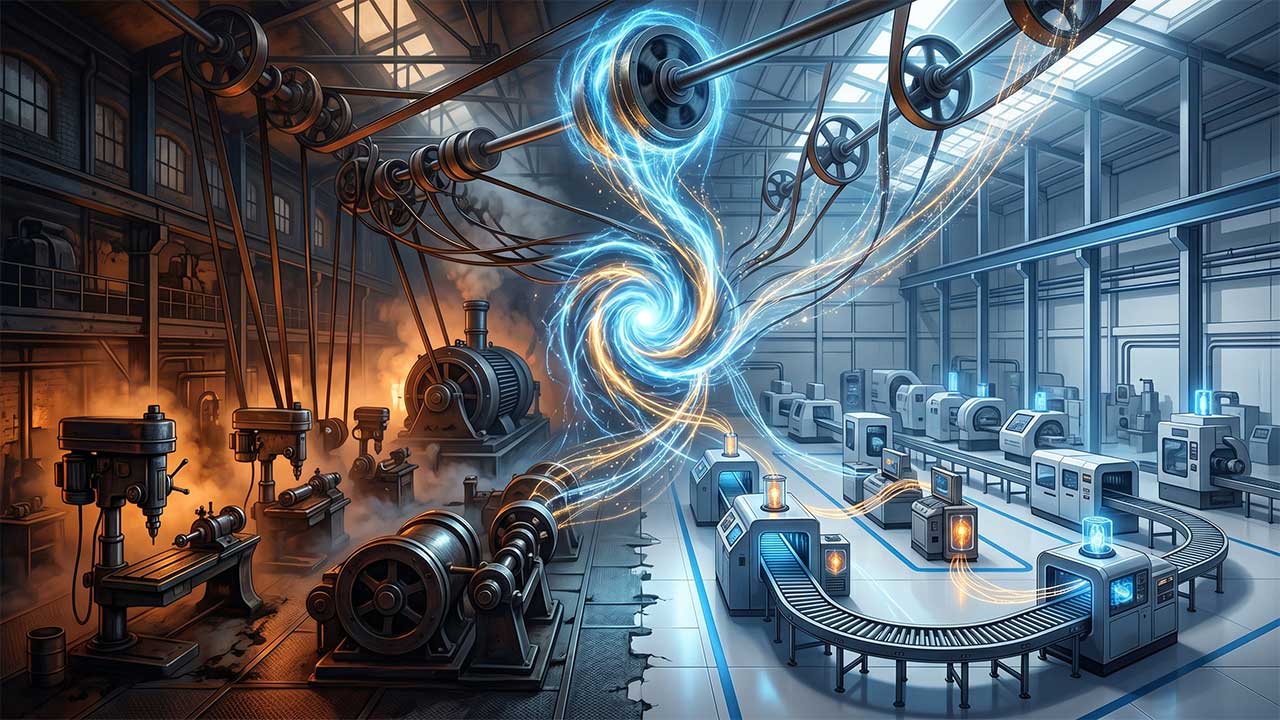
Productivity often stalls when new technology is forced into old architectures. In the 1880s, factories installed electric motors but kept the line shafts and leather belts used for steam engines. This meant the building layout and supervision hierarchy remained unchanged.
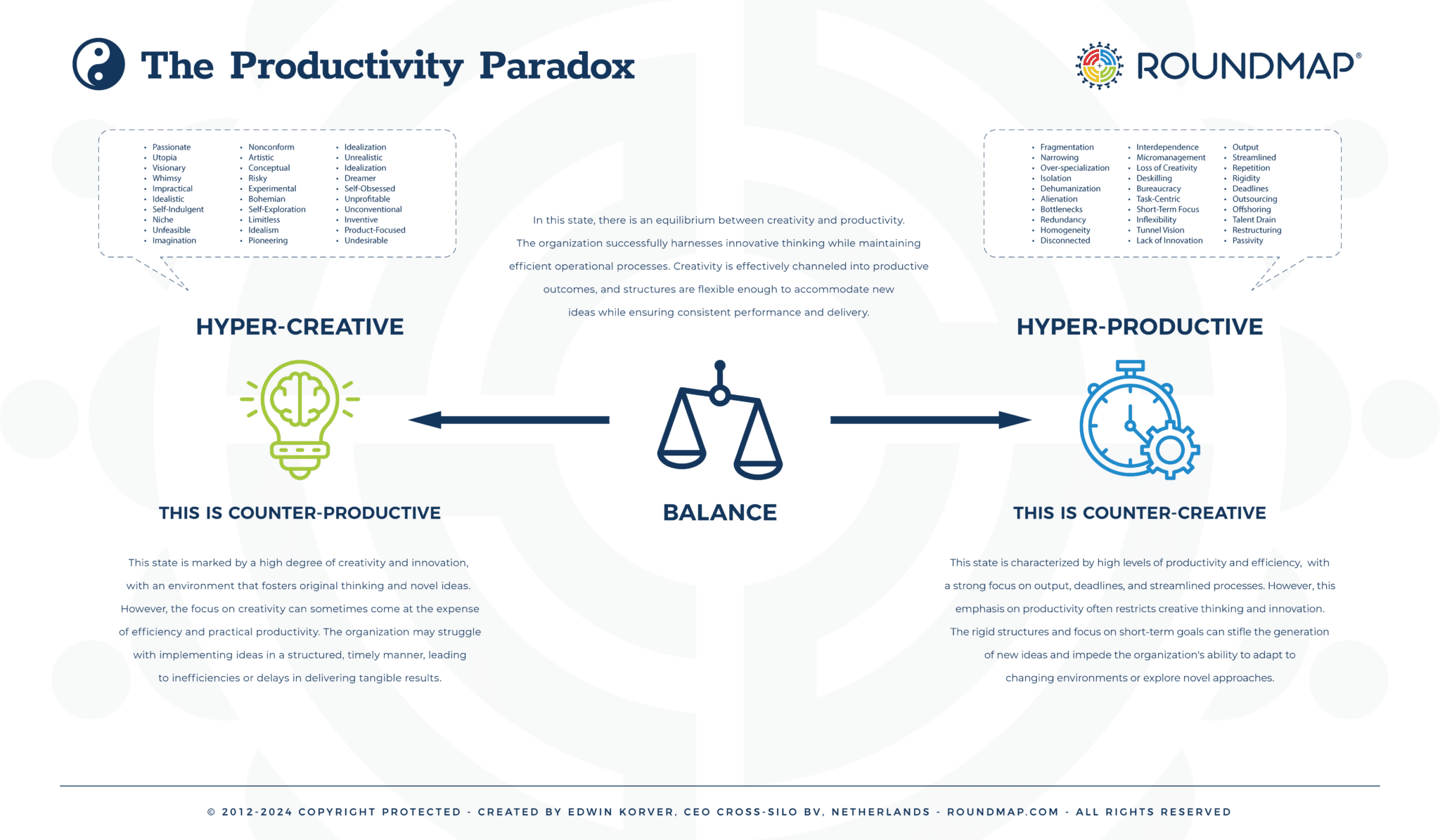
According to David, the biggest productivity gains did not appear for 30 to 40 years. Gains only arrived when owners stopped using electricity to preserve old architectures and instead redesigned the factory for what electricity made possible.
How did the “unit-drive” moment change industry?
The availability of smaller industrial motors after 1900 allowed for a “unit-drive” architecture. Power no longer traveled from a central source through a mechanical drive train; instead, a motor could sit on each individual machine.

This shift allowed owners to place machines based on the flow of materials and the path of the worker rather than the reach of a ceiling shaft. It eliminated friction losses from the drive train and enabled the reorganization of the entire work floor.
What is the risk of the “Chief AI Officer” role?
Current corporate structures often mirror a defunct role described in the 2006 book Television Disrupted: the “Vice President of Electricity.” This role existed when electricity was complex and risky, requiring a specialist to manage fuel, equipment, and reliability for executives who did not understand the system.
The author of Television Disrupted notes that this role disappeared once electricity became a simple utility. Today, many Chief AI Officers or AI Centers of Excellence may be following this same “VP of Electricity” playbook by focusing on procurement, vendor negotiations with OpenAI or Google, and cost-per-token benchmarking.
While governance and security audits are necessary, these tasks do not redesign workflows. If org charts and approval loops still serve a workforce that thinks at human speed, AI may be no more productive than an electric motor connected to a leather belt.
What defines an “AI-native” workflow?
An AI-native workflow is one that could not exist without machine-speed reasoning, cheap large-scale parallelism, and systems without fatigue or status anxiety. It is not a chatbot added to an old process, but a process rebuilt around these capabilities.
George Sivulka of Hebbia argues in his essay, “Institutional AI vs Individual AI,” that while AI has made individuals 10x more productive, companies have not become 10x more valuable. Sivulka attributes this to a failure to redesign the “floor.”
Sivulka identifies seven pillars for redesigning the organization: coordination, signal, bias, edge, outcomes, enablement, and unprompted action. He suggests that while vendors sell “power,” the company must still redesign the factory to earn coordination and edge.
What happens next for corporate value?
The timeline for AI integration may be shorter than the 30-year gap seen during electrification. Given the speed of innovation, the shift toward AI-native workflows could occur before the end of the decade.
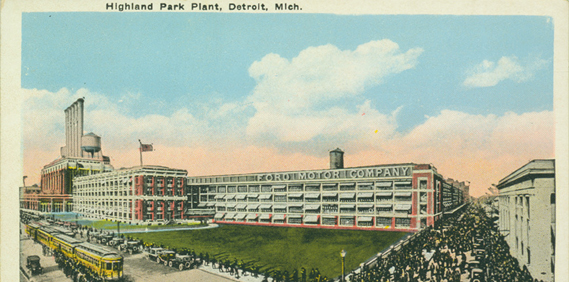
Future corporate value creation is likely to belong to leaders who can overcome cultural debt and remove the metaphorical “drive shafts” of their organizations. Companies that fail to move beyond procurement and governance may find their productivity gains remain immeasurable.
Frequently Asked Questions
What was the productivity paradox described by Paul David?
The paradox was the 30 to 40 year gap between the availability of electricity in the 1880s and the actual scale of productivity gains in the 1920s, caused by factories failing to reorganize their architecture around the new technology.
What is the difference between AI transformation and AI-native workflows?
AI transformation often involves a “one-for-one swap” of old tools for AI tools within existing structures. AI-native workflows are entirely new processes that require machine-speed reasoning and parallelism to function.
Why does George Sivulka believe companies aren’t 10x more valuable despite AI?
Sivulka argues that while individual productivity has increased, companies have not redesigned their institutional “floor”—specifically regarding coordination, signal, and decision-making—to capture that value.
Do you believe your current organizational structure is a “drive shaft” hindering AI productivity?