
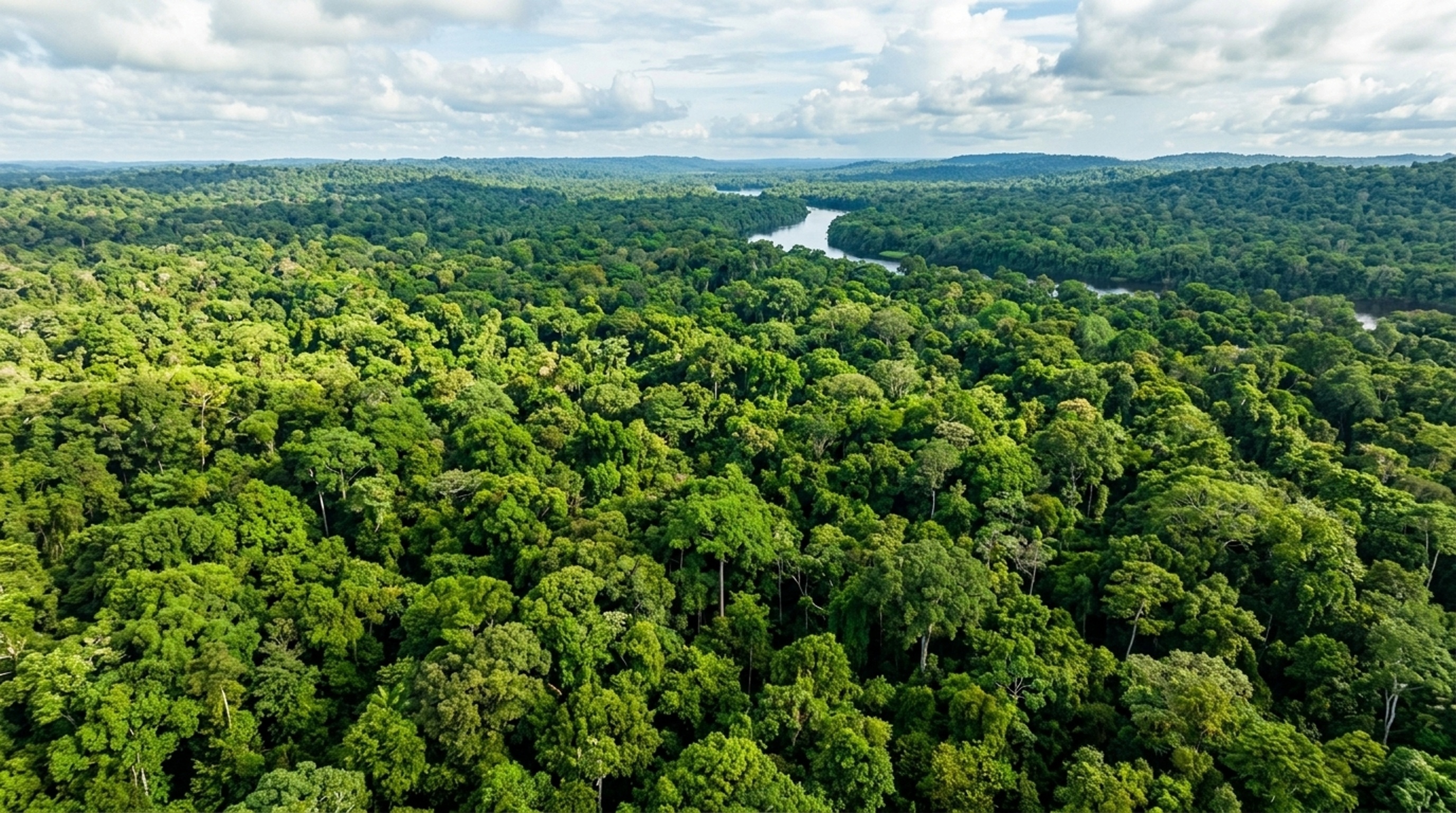
Amazon trees emitted never-before-seen chemicals during drought
The Amazon rainforest is releasing previously undetected molecules, such as beta-eudesmol, as a delayed response to extreme heat and drought. According to researchers from the Max Planck Institute for Chemistry (MPIC), these sesquiterpene alcohols act as distress signals that linger long after rains return, potentially altering cloud formation and regional climate.
For years, the “scent” of the Amazon has been a predictable chemical cocktail. Most of the time, the forest breathes isoprene—the light compound responsible for the blue haze seen over forested mountains. But during the record-shattering droughts of 2023 and 2024, that predictability vanished. Dr. Joseph Byron and his team at the MPIC discovered that when the forest is pushed to its limit, it doesn’t just sweat; it screams in a chemical language we’re only beginning to translate.
Why is the Amazon releasing new chemicals after a drought?
The forest is reacting to a level of stress it hasn’t encountered in recorded history. During the recent El Niño event, canopy temperatures near Manaus, Brazil, spiked from a typical 79°F to nearly 88°F. Humidity plummeted from 90% into the low 60s. This wasn’t just a dry spell; it was a physiological crisis for the trees.
According to the study published in Communications Earth & Environment, the forest responded by doubling its production of sesquiterpenes. While lighter compounds like isoprene stayed steady, these heavier molecules surged. Most surprising was the appearance of beta-eudesmol. This molecule had never been detected in rainforest air before, and it didn’t peak during the heat—it peaked after the rains returned in spring 2024.
This suggests the forest maintains a “chemical memory” of stress. The trees didn’t stop signaling for help the moment the water arrived; they kept producing these sticky, heavy alcohols for weeks, cleaning up the cellular damage left behind by the drought.
How do these “stress signals” actually protect trees?
Heat and drought create a toxic environment inside a leaf. They flood cells with reactive oxygen species—unstable molecules that act like microscopic shards of glass, tearing through plant tissue. To survive, trees have to “mop up” this oxidative stress.

The researchers looked to human medicine for a clue. In human cells, beta-eudesmol is known as an antioxidant and anti-inflammatory agent that switches on genes to clear away destructive molecules. While the MPIC team cautions that plant biology differs from human biology, the hypothesis is clear: the forest is releasing these alcohols to heal itself from the inside out.
What happens to the climate when the forest’s breath changes?
This isn’t just about the health of individual trees; it’s about the weather for the entire South American continent. These heavy sesquiterpene molecules don’t stay as gases for long. They clump together to form tiny organic particles in the air.
These particles serve two critical functions: they scatter sunlight and act as seeds for cloud formation. If the Amazon permanently shifts its chemical output toward these heavier, stickier molecules, it could fundamentally change how clouds form over the basin. This creates a feedback loop where the forest’s distress signals actually alter the very rainfall patterns the forest needs to survive.
For more on how rainforests regulate global weather, see our guide on the Amazon’s “flying rivers” or visit the Max Planck Institute for the latest in atmospheric chemistry.
Will these chemical shifts become permanent?
Currently, the forest’s chemistry returns to normal once the recovery period ends. However, Jonathan Williams, an atmospheric chemist at the MPIC, warns that this “reset” button is wearing out. As the planet warms and El Niño events become more frequent and severe, the window for recovery shrinks.
We are moving toward a future where these stress emissions may no longer be temporary signals, but a permanent feature of the region’s atmosphere. If the forest is constantly in “recovery mode,” the chemical composition of the air above the Amazon will look nothing like what we’ve measured for the last century.
Comparing Forest Emissions: Normal vs. Extreme Stress
| Compound | Normal Conditions | Extreme Drought/Recovery |
|---|---|---|
| Isoprene | Consistent / High | Stable (little reaction) |
| Sesquiterpenes | Low / Predictable | More than doubled |
| Beta-eudesmol | Absent (Zero) | Present (Peaks post-drought) |
Frequently Asked Questions
What is beta-eudesmol?
It is a sesquiterpene alcohol that acts as an antioxidant. While found in some essential oils, it was recently discovered in the Amazon’s air as a response to extreme climate stress.

How do scientists measure these molecules?
Researchers use the Amazon Tall Tower Observatory, using steel towers that rise above the canopy to sample air directly from the treetops using automatic samplers and cartridges.
Does this mean the Amazon is dying?
Not necessarily, but it shows the forest is under unprecedented strain. These molecules are the forest’s way of fighting back and recovering from heat and drought.
Do you think we can save the Amazon’s “breath”?
Join the conversation in the comments below or subscribe to our newsletter for more deep dives into the science of our changing planet.