

AMD Acquires Mext to Boost Memory Expansion With AI
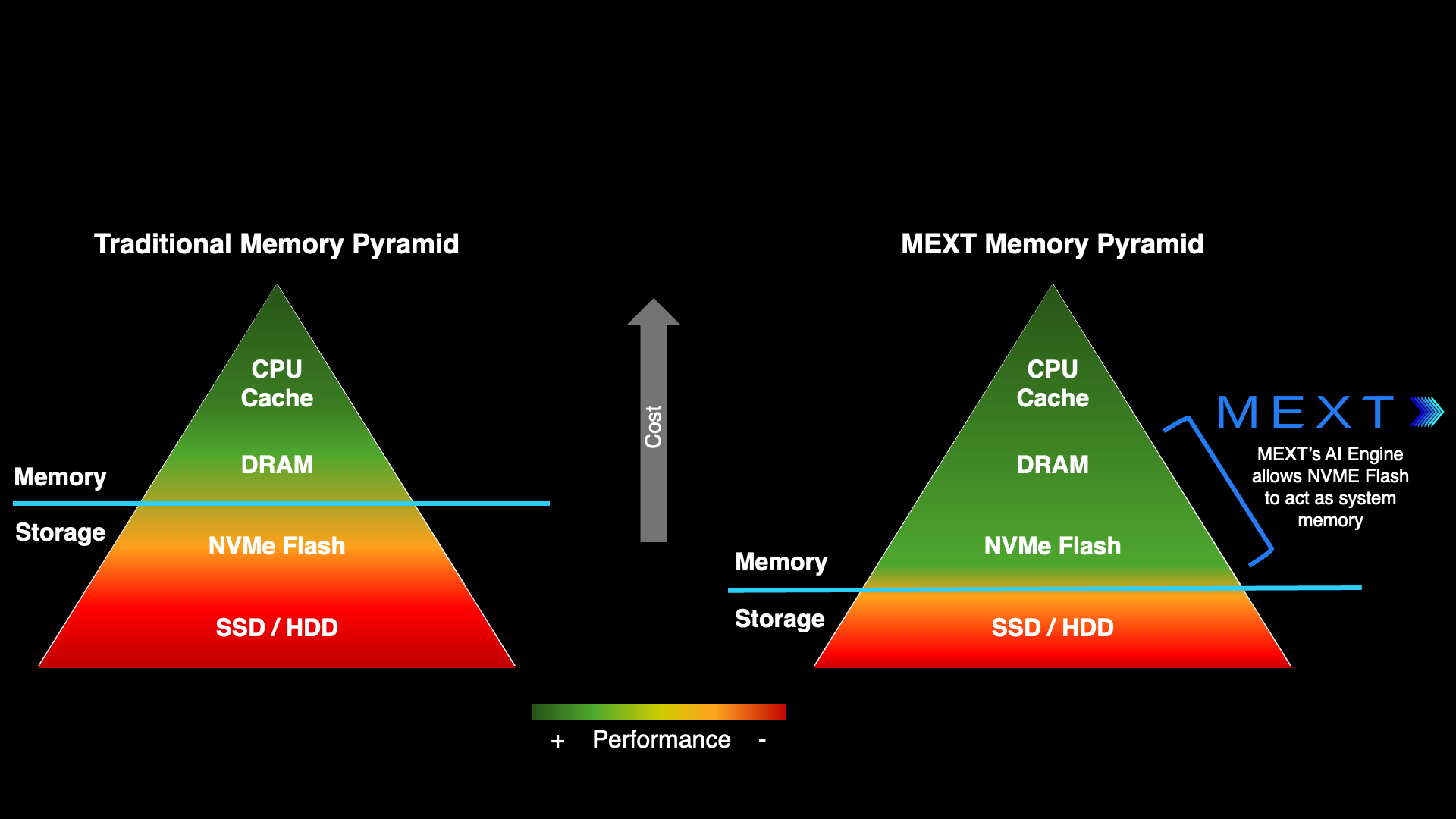
AMD has acquired Mext, a predictive memory startup, to integrate machine learning into system memory management. According to company officials, Mext uses ML algorithms to proactively move “cold” data from RAM to cheaper flash storage, which the company claims can expand a system’s effective memory capacity by two to four times.
Why did AMD acquire Mext for memory expansion?
AMD is targeting the ongoing “memory crunch” caused by the surge in AI workloads. Because DRAM is expensive and limited in supply, the company is betting on AI to manage the hardware more efficiently. By using predictive algorithms, systems can store less-frequently used data on flash storage without the typical performance hit associated with disk swapping.
Dan McNamara, SVP of AMD’s compute and enterprise AI business, stated in a company blog post that this approach aims to reduce infrastructure costs and improve resource utilization. This allows enterprises to scale general-purpose and AI workloads more effectively without purchasing massive amounts of expensive physical RAM.
How does Mext’s predictive memory technology work?
The Mext platform operates as a proactive memory tiering system. Instead of waiting for a memory shortage to trigger a swap to disk, it uses machine learning to predict which data will be needed next. It identifies “cold” memory—data not currently in use—and offloads it to flash storage before the system actually runs out of space.
According to Mext, the system doesn’t rely on a single model. It employs a combination of learned heuristics, Long Short-Term Memory (LSTM) networks, and modern transformer architectures. The platform selects the specific combination that yields the best results for the given data access pattern.
From an implementation standpoint, this flash memory is presented to the operating system as regular memory. This is achieved by running a specific daemon called Mextd, which handles the background migration of data.
How does this compare to previous memory tiering?
Memory tiering isn’t a new concept, but the method of execution has shifted. Previous attempts often relied on specialized hardware or basic software rules. For example, Intel Optane persistent memory used 3D XPoint technology, co-developed with Micron, to bridge the gap between DRAM and NAND flash.
Mext differs by focusing on the predictive layer. Rather than relying on a new type of physical memory cell, it uses AI to mimic a branch predictor—a technology AMD already uses extensively in its CPU designs—to shuffle data between existing memory tiers.
| Feature | Traditional Swapping | Mext Predictive Memory |
|---|---|---|
| Trigger | Reactive (Memory full) | Proactive (AI-predicted) |
| Latency | High penalty during swap | Reduced via pre-fetching |
| Capacity | Physical RAM limit | 2x to 4x effective expansion |
What happens to AI workloads and MoE models?
The acquisition has significant implications for how Large Language Models (LLMs) are served. Many modern AI systems use a “Mixture of Experts” (MoE) architecture. In these models, only a subset of “experts” (sub-models) is activated for any given token prediction.

Because some experts are used frequently while others are rarely accessed, there is a massive opportunity for optimization. Using Mext’s algorithms, AMD could potentially offload infrequently used experts from high-bandwidth memory (HBM) to slower system memory.
This would allow enterprises to run larger, more capable models on hardware with less HBM, reducing the total cost of ownership for AI infrastructure. While AMD has not officially confirmed this specific application, the technical alignment between MoE patterns and Mext’s predictive offloading is clear.
Frequently Asked Questions
What is predictive memory?
Predictive memory is a system that uses machine learning to forecast which data will be needed soon, moving it from slow storage (flash) to fast storage (RAM) before the CPU requests it.
How much memory can Mext actually add?
Mext claims its platform can expand the effective memory of a system by 2 to 4 times by utilizing flash storage more efficiently.
Is this a hardware or software solution?
It is primarily a software-driven approach. It uses a daemon (Mextd) and ML models to manage existing hardware tiers, making the flash storage appear as regular memory to the OS.
Will this affect consumer PCs?
While the current focus is on enterprise and AI workloads, the underlying technology of proactive memory offloading could eventually migrate to consumer-grade operating systems to improve multitasking on devices with limited RAM.
What do you think? Will AI-managed memory replace the need for massive RAM upgrades in the data center, or is the latency penalty still too high? Let us know in the comments below or subscribe to our newsletter for more deep dives into hardware architecture.