
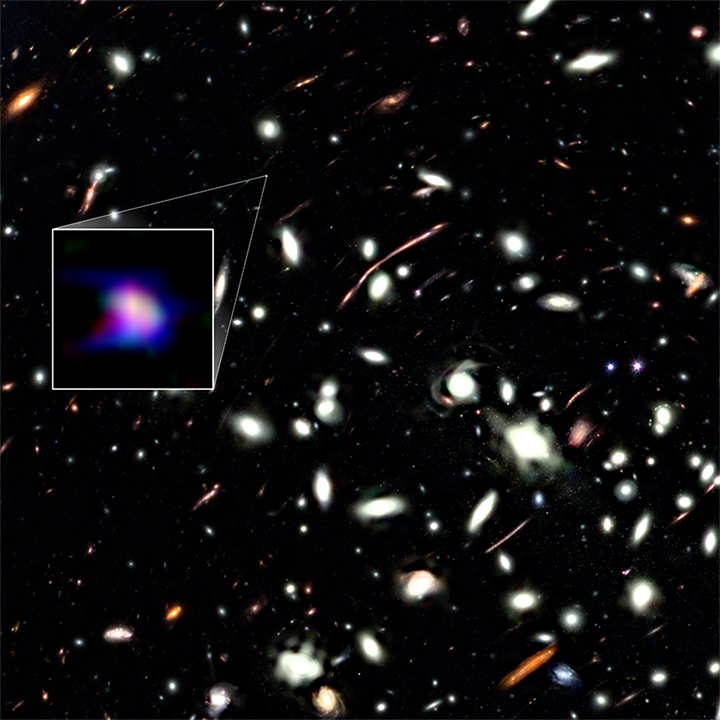
Astronomers Observe the Most Chemically Primitive Galaxy in the Early Universe
The James Webb Space Telescope has pushed the boundaries of astronomy by observing galaxies that existed during the early Universe, specifically within the first billion years after the Big Bang. In a significant discovery, an international team of astronomers has used the telescope’s advanced infrared instruments to characterize LAP1-B, an ultra-faint galaxy that existed 800 million years after the Big Bang.
Uncovering the Most Metal-Poor Galaxy
The research team, led by Associate Professor Kimihiko Nakajima of Kanazawa University, identified LAP1-B as the most metal-poor galaxy in the early Universe observed to date. Through deep spectroscopy, the team revealed a record-low oxygen abundance, measuring just 1/240th that of the Sun.
This chemical signature suggests the galaxy is a primordial object caught shortly after its formation. The findings indicate that LAP1-B inherited chemical building blocks created by Population III stars, the first generation of stars that seeded the Universe with heavier elements after the Big Bang.
The discovery was made possible through 30 hours of observations and the use of a gravitational lens. An intervening galaxy cluster acted as a lens, magnifying the light from LAP1-B by a factor of 100, allowing scientists to peer through the neutral hydrogen of the Epoch of Reionization.
Linking Cosmic Fossils to Their Ancestors
Beyond its chemical makeup, LAP1-B is incredibly light, weighing less than 3,300 Solar masses. This suggests that the majority of the galaxy consists of a dark matter halo, making it a near-perfect match for Ultra-Faint Dwarf galaxies (UFDs) found near the Milky Way today.
Professor Masami Ouchi of NAOJ and the University of Tokyo noted that UFDs are often described as “fossils of the universe” due to their ancient stars and lack of heavy elements. The discovery of LAP1-B provides the direct link astronomers previously lacked, confirming that these ancient galaxies are the ancestors of the cosmic fossils seen today.
The study, which involved collaborators from institutions including Caltech’s IPAC, the Cavendish Laboratory, and the National Astronomical Observatory of Japan, was published on May 13th in the journal Nature.
Future Implications for Galactic Mapping
This breakthrough provides astronomers with a new method to map the formation of the Universe’s oldest structures and the birth of heavier elements. The findings align with theoretical predictions regarding the material dispersed by Population III star explosions.

A possible next step for the team involves using existing JWST data to search for even more chemically primitive objects. This research may eventually lead to the identification of the very first galaxies ever formed.
Frequently Asked Questions
What is LAP1-B?
LAP1-B is an ultra-faint, chemically primitive galaxy observed 800 million years after the Big Bang, identified as the most metal-poor galaxy in the early Universe seen to date.
Why is the oxygen abundance in LAP1-B significant?
The galaxy has a record-low oxygen abundance—1/240th that of the Sun—which serves as a chemical signature of a primordial galaxy and matches predictions for material dispersed by the first generation of stars.
How does LAP1-B relate to galaxies near the Milky Way?
Due to its low mass (less than 3,300 Solar masses) and unique chemical makeup, LAP1-B is considered a progenitor to the Ultra-Faint Dwarf galaxies (UFDs) found near the Milky Way today.
How does the discovery of these “ancestor” galaxies change your perspective on the origins of the elements that make up our world?