
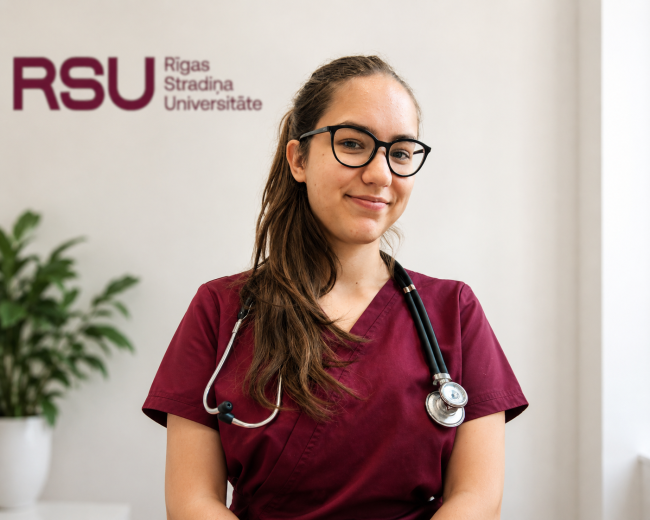
Balancing Medicine and Music: A Medical Student’s Journey at RSU
The pursuit of high-level medical expertise often demands total immersion, yet emerging professionals are demonstrating that interdisciplinary engagement can actually enhance professional efficacy. Lauma Māra Vikmane, a sixth-year student at the RSU Faculty of Medicine, exemplifies this balance by integrating rigorous clinical studies with a commitment to the RSU mixed choir in Riga.
Vikmane’s trajectory highlights a strategic approach to human capital development, where the discipline of choral music serves as a counterweight to the intensity of medical training. This synergy is supported by institutional mechanisms, including the RSU fund scholarship, which provides both financial assistance and professional validation.
The Synergy of Science and Art
The intersection of medicine and music is not merely a matter of personal interest but a framework for developing critical professional competencies. Vikmane identifies teamwork as the primary commonality between the two fields.
In a choir, diverse voices must synchronize to create a unified sound. similarly, in medicine, various professionals collaborate toward the single goal of patient treatment. This parallel suggests that artistic discipline can cultivate the collaborative mindset necessary for complex healthcare environments.
The Economic and Psychological Value of Institutional Support
Institutional scholarships often serve a dual purpose: mitigating immediate financial pressures and providing psychological reinforcement. For Vikmane, the RSU fund scholarship facilitated practical needs, such as transportation costs and co-payments for international choir trips.
Beyond the monetary value, the scholarship functions as a marker of recognition. This validation of a student’s efforts and results can act as a powerful motivator, reinforcing the value of their contribution to both the academic and cultural community.
Developing the Modern Professional
The transition from student to practitioner involves a shift toward specialization. Vikmane is currently preparing for residency, a phase lasting four to five years where learning and professional practice occur simultaneously.
While many peers have already selected a path, Vikmane is considering internal medicine. This broad field, covering various organ systems including the kidneys and gastrointestinal tract, allows for a wider professional scope before committing to a narrower specialty.
This approach to education suggests that a multidisciplinary background may produce more adaptable professionals. The ability to focus on “small wins” to overcome overwhelming workloads is a cognitive strategy that Vikmane applies to both her research—which has been published in a Lithuanian international journal—and her clinical studies.
Future Professional Outlook
As Vikmane nears the completion of her degree, her experience suggests that the “whole-person” approach to education could lead to more effective leadership in clinical settings. The discipline required for a three-hour choir rehearsal may translate into the sustained attention required for complex medical procedures.

This proves likely that the skills acquired through this balance—concentration, accountability, and teamwork—will influence her approach to residency. A possible next step in her career could involve utilizing these soft skills to navigate the hierarchical structure of medical residency more effectively.
Frequently Asked Questions
How does choral singing specifically benefit a medical student’s professional growth?
It fosters essential teamwork and collaboration skills, as both choral singing and medicine require individual roles to work in harmony to achieve a collective goal, such as a musical performance or patient recovery.
What practical impact does the RSU fund scholarship have on students?
The scholarship helps cover daily expenses, including monthly transport passes and additional funding for choir trips, while providing critical emotional validation and recognition of the student’s hard work.
What is the intended path after the six-year medical program?
Upon graduation, students apply for residency, which lasts an additional four to five years. This stage allows the physician to work while specializing in a specific field, such as internal medicine.
Do you believe that pursuing arts and culture during professional training enhances a person’s ability to perform in high-stress careers?