
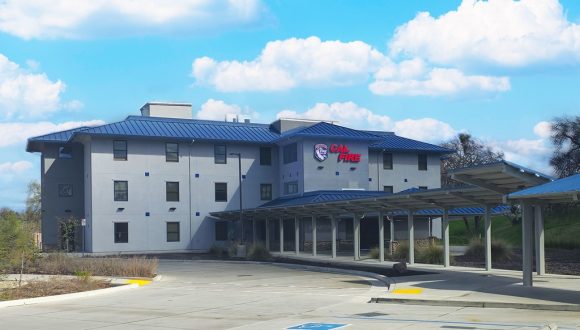
Cal FIRE Upgrades Training Center with Extron AV Systems
The California Department of Forestry and Fire Protection (Cal FIRE) has modernized its 170-hectare training campus near Ione, California, by integrating advanced AV-over-IP and automated signal management systems. According to the project’s systems integrator, AV Structural, the upgrade features Extron DTP signal distribution, live annotation tools, and partition-sensing technology designed to automate classroom configuration for fire service personnel.
How Automated AV Systems Improve Training Efficiency
Modern training facilities are increasingly moving toward “zero-touch” environments to minimize technical distractions for instructors. At the Cal FIRE campus, the installation of partition-sensing technology allows auditoriums to automatically adjust their AV configuration based on the physical state of the room. When a divider is opened or closed, the system recalibrates signal routing without manual intervention, according to reports from Extron. This shift reduces the “tech-setup” time that often plagues large-scale educational environments, allowing personnel to prioritize emergency response training over hardware troubleshooting.
The Role of Annotation in Technical Instruction
Live annotation is becoming a standard requirement in high-stakes training environments where visual precision is necessary. By integrating Extron Annotators, Cal FIRE instructors can overlay digital markings on live video feeds in real time. Teo Nguyen, Senior Systems Engineer at AV Structural, noted that this capability makes system operation “intuitive,” enabling users to maintain focus on the instructional content. This represents a broader industry trend where hardware is being designed to disappear into the background, prioritizing the user interface over the underlying signal architecture.
Standardizing Infrastructure with Shielded Twisted Pair (STP)
A primary challenge in large, sprawling campuses is maintaining signal integrity over long distances. The Cal FIRE project utilized Shielded Twisted Pair (STP) cabling to create a unified infrastructure capable of handling high-resolution signal switching. By centralizing signal distribution in a dedicated technical room, the facility ensures consistent performance across five classrooms, multiple meeting spaces, and two auditoriums. This approach contrasts with older, decentralized models that often suffer from signal degradation and disparate control protocols, making centralized IP-based management the preferred choice for modern government and educational facilities.
Frequently Asked Questions
- Why use partition sensors in AV design? They eliminate the need for manual presets, ensuring audio and video signals are routed correctly regardless of whether a room is being used as one large space or two smaller, independent areas.
- What is the advantage of centralized signal distribution? It allows IT staff to monitor and troubleshoot the entire campus from a single location, significantly reducing maintenance downtime.
- How does live annotation benefit fire training? It allows instructors to highlight specific details on maps, structural diagrams, or live feeds during complex scenario drills.
Did you know?
The Cal FIRE facility in Ione is one of the oldest and largest of its kind in California, serving as a critical hub for statewide emergency preparedness and wildland fire training.
Are you looking to modernize your facility’s AV infrastructure? Share your experiences with automated room control in the comments below, or subscribe to our newsletter for more case studies on high-performance technical environments.