

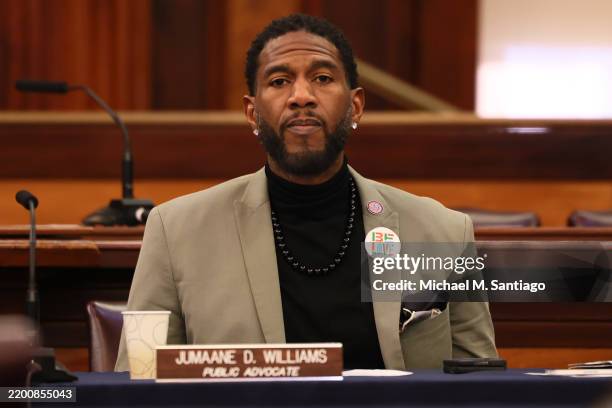
Can New York City provide affordable internet for all? Public Advocate Jumaane Williams thinks so.
Public Advocate Jumaane Williams has proposed the creation of a city-owned fiber-optic network designed to deliver affordable high-speed internet to every household in New York City. The proposal follows a report released Wednesday detailing how previous efforts by the city and private telecom corporations failed to meet expectations.
Addressing the Digital Divide
According to Williams, the “digital divide” in New York is not merely generational, but is deeply geographic, and economic. He noted that lower-income neighborhoods, primarily Black and Brown communities, often pay the highest rates for the slowest internet speeds.
Many residents in these areas rely solely on mobile phones for connectivity or forgo internet service entirely. In some neighborhoods, up to one-third of households lack standard internet access.
Internet as a Municipal Utility
Williams argues that the city should treat internet connectivity as a municipal utility, similar to electricity, gas, or water. He stated that reliable internet is essential for accessing society in 2026 and should not be treated as a private luxury.

Currently, private corporations maintain the underground network of fiber optics and cables. Williams contends this structure limits competition among Internet Service Providers (ISPs), leading to higher costs that exclude low-income New Yorkers.
By building its own infrastructure, the city could open the market to nonprofits, small ISPs, and community-owned broadband organizations. This increased competition may lower the cost of this essential service.
A History of Failed Oversight
The Public Advocate’s report highlights several instances where major providers failed to meet contractual obligations. A 2015 audit found that Verizon shirked its commitment to provide access to all requesting residents, leaving tens of thousands of requests pending for over a year.
This led to a 2017 lawsuit that settled in 2020, with Verizon agreeing to extend fiber optics to an additional half a million households, including all NYCHA residents.
Similarly, the New York State Public Service Commission found that Charter Communications, owner of Spectrum, intentionally misrepresented its network accessibility following its 2016 merger with Time Warner Cable. The company reportedly counted existing infrastructure as part of a mandatory expansion.
Future Implementation and Costs
The proposed plan suggests a staged approach that could take more than a decade to complete. Initial steps may include increased oversight, enforcement of existing ISP contracts, and audits of current service practices.
The report suggests the city could build its own infrastructure by reactivating “long-dark connections” using abandoned and unused underground fibers.
While a current exact cost was not provided, a 2020 report from the de Blasio Administration estimated the price tag at $2.1 billion. Due to inflation, the current cost is likely to be higher.
Frequently Asked Questions
What is the primary goal of Jumaane Williams’ proposal? The goal is to build a city-owned fiber-optic network that provides affordable high-speed internet to every household in New York City, treating it as a municipal utility. Why is the current system considered unfair for low-income residents? Private corporations control the infrastructure, which creates a lack of competition. This results in higher prices and slower speeds, particularly in Black and Brown, lower-income neighborhoods. What past ISP failures are mentioned in the report? The report cites Verizon for shirking contractual commitments to provide access to all residents and Charter Communications for misrepresenting its network expansion after merging with Time Warner Cable.
Do you believe high-speed internet should be managed as a public utility like water and electricity?