
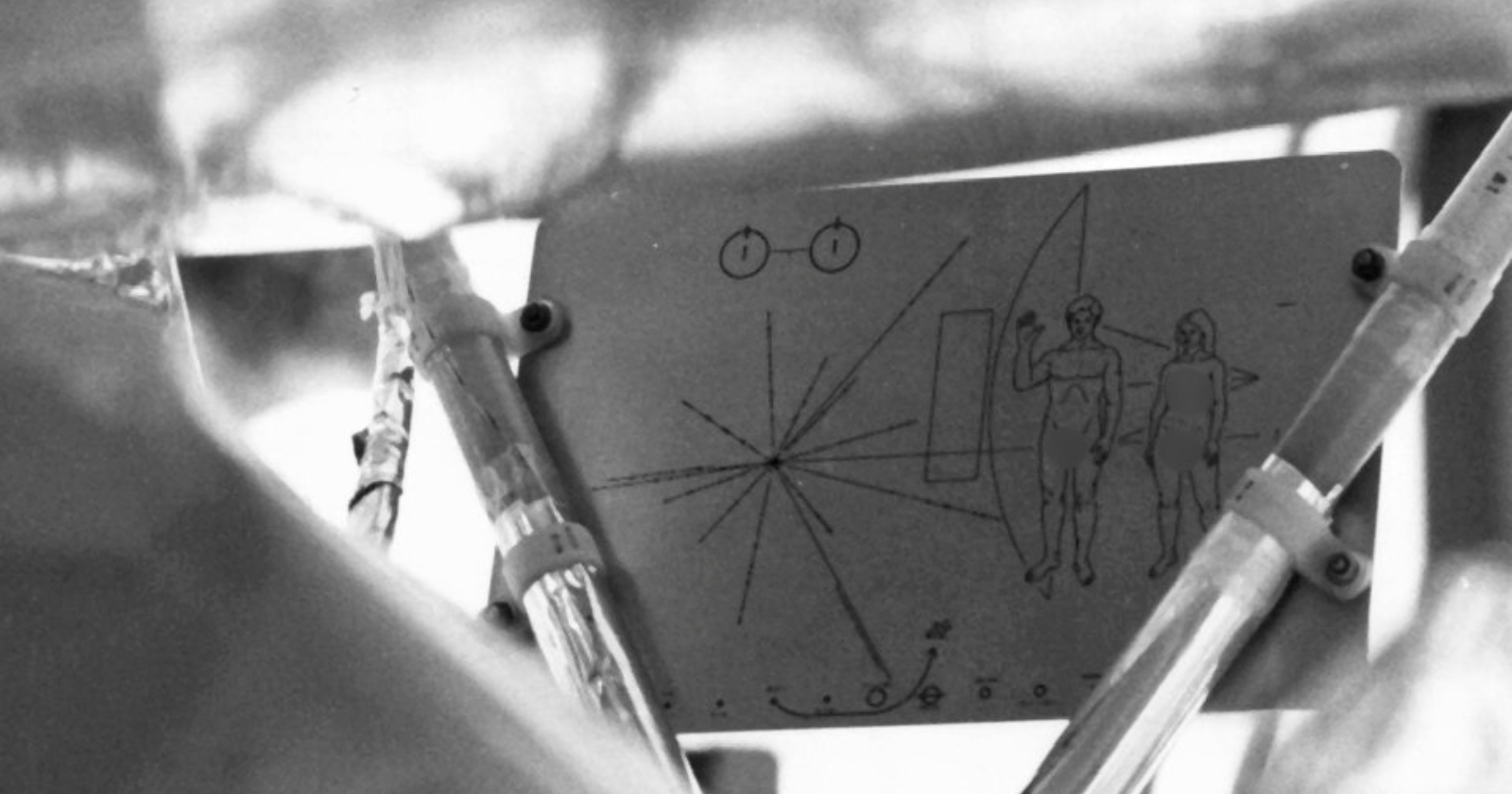
Carl Sagan’s team considered sending a nude photograph of a man and a pregnant woman on the Voyager Golden Record, but after the controversy over the nude Pioneer plaque, the final record used a silhouette instead
In the high-stakes environment of interstellar communication, the line between scientific data and public perception can shift rapidly. When Carl Sagan, Frank Drake, and Linda Salzman Sagan were tasked with creating the Pioneer 10 plaque in 1971, they had just three weeks to design a message for extraterrestrial discovery. The resulting gold-anodized aluminum plaque, featuring a line drawing of two nude humans, was intended to be an anatomically accurate representation of our species.
The Conflict of Public Perception
The mission’s intent faced immediate friction upon its return to Earth’s public discourse. When newspapers published images of the plaque, various outlets took it upon themselves to airbrush the human figures, removing genitals and nipples. This reaction highlighted a significant disconnect between the scientific goal of universal biological accuracy and the prevailing cultural sensitivities of the era.
Did You Know? The Pioneer plaque was bolted to the spacecraft’s antenna support struts and included a hydrogen atom, a pulsar map locating the Sun, and a diagram of the Solar System to provide context for any potential discoverer.
The Evolution of Interstellar Messaging
When NASA began preparations for the Voyager 1 and 2 missions five years later, the committee faced a challenge in balancing scientific rigor with institutional risk management. While the team proposed including a photograph of two unclothed humans to show what our species actually looks like, the agency ultimately vetoed the image. The final version sent into space utilized silhouettes and diagrams to convey human biology, effectively stripping away the photographic detail that had previously caused controversy.
Expert Insight: The transition from the Pioneer plaques to the Voyager records illustrates a classic corporate and governmental challenge: how to maintain a project’s core integrity while navigating the external pressures of public relations. The decision to favour silhouettes over photographs likely reflects a strategy to ensure the primary mission remained focused on scientific data without the interference of social controversy.
What May Happen Next
As Voyager 1 approaches a distance of 26 billion kilometers from Earth, it continues its trajectory as the most distant human-built object. Because these records are designed to remain playable for up to a billion years, their contents represent a permanent, unchangeable legacy. If an extraterrestrial intelligence eventually recovers these craft, they will interpret our species through these silhouettes and diagrams. The lack of original photographic detail may influence how a future finder perceives human biology, as they will be limited to the edited imagery approved by the committee.

Frequently Asked Questions
Why were the human figures on the Pioneer plaque drawn in the nude?
Linda Sagan designed them as nude figures because any choice of clothing would have represented only certain cultures, whereas an anatomically accurate human was considered more useful to an alien biologist.
What was the primary difference between the Pioneer and Voyager messages?
The Pioneer message was a small engraved aluminum plate, while the Voyager message was a 12-inch gold-plated copper phonograph record containing music, sounds, 55 languages, and over 100 images.
Did any anatomically accurate human images make it onto the Voyager record?
Yes, a Diagram of Vertebrate Evolution drawn by Jon Lomberg was included, which featured an anatomically correct man and woman, as it was categorized as scientific context rather than a photograph.
How do you think future civilizations will interpret the specific choices made in these interstellar messages?