
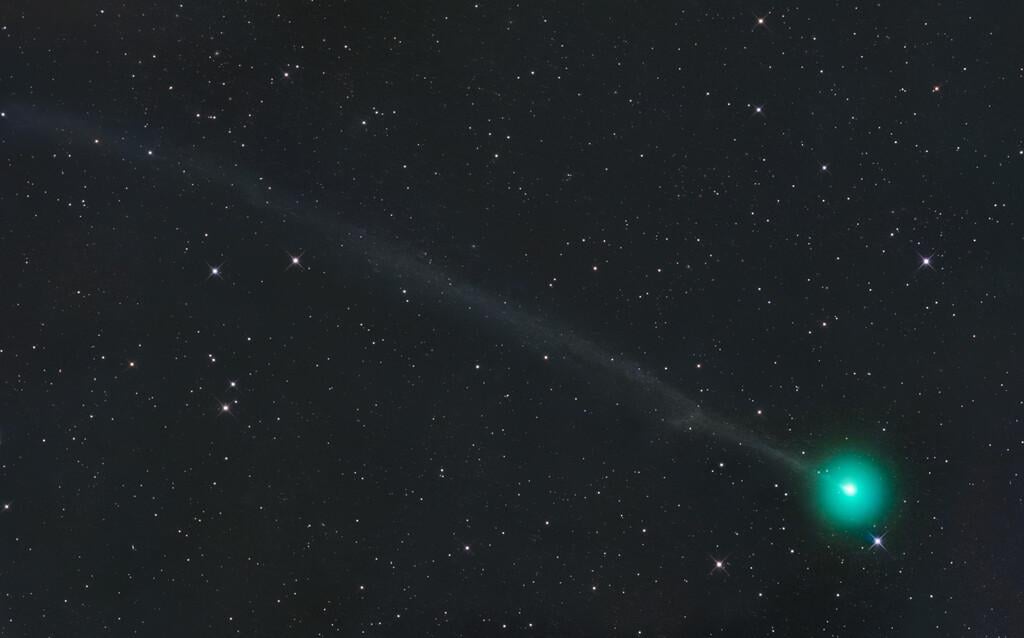
Catch Comet 220P McNaught in Outburst
Comet 220P McNaught recently exhibited a massive outburst, brightening by up to 8,000 times (9 magnitudes) according to data from the Zwicky Transient Facility. This event underscores a growing trend in “surprise” cometary activity, where automated sky surveys detect sudden volatility in periodic comets well before they reach their closest approach to the Sun.
Why do comets like 220P McNaught suddenly brighten?
Cometary outbursts happen when volatile ices beneath the surface sublimate rapidly, creating pressure that eventually ruptures the comet’s crust. According to the European Space Agency’s (ESA) Rosetta mission, which provided an unprecedented look at Comet 67P/Churyumov-Gerasimenko, these events are essentially the comet “blowing its top.”
In the case of Comet 220P, the brightness jump was staggering. Observer Mike Kelley first spotted the change via the Zwicky Transient Facility, noting an initial 7-magnitude increase. Later data suggested the comet peaked at +8th magnitude. That’s a massive shift from its usual state as a +17th magnitude “smudge,” as first recorded by Robert McNaught in 2004.
How automated surveys are changing comet hunting
We’re moving away from the era of the lone observer scanning the skies with a telescope. The detection of Comet 220P’s outburst by the Zwicky Transient Facility (ZTF) proves that automated, wide-field surveys are now the primary “tripwires” for celestial events. These systems scan the sky systematically, allowing astronomers to catch volatility in real-time.
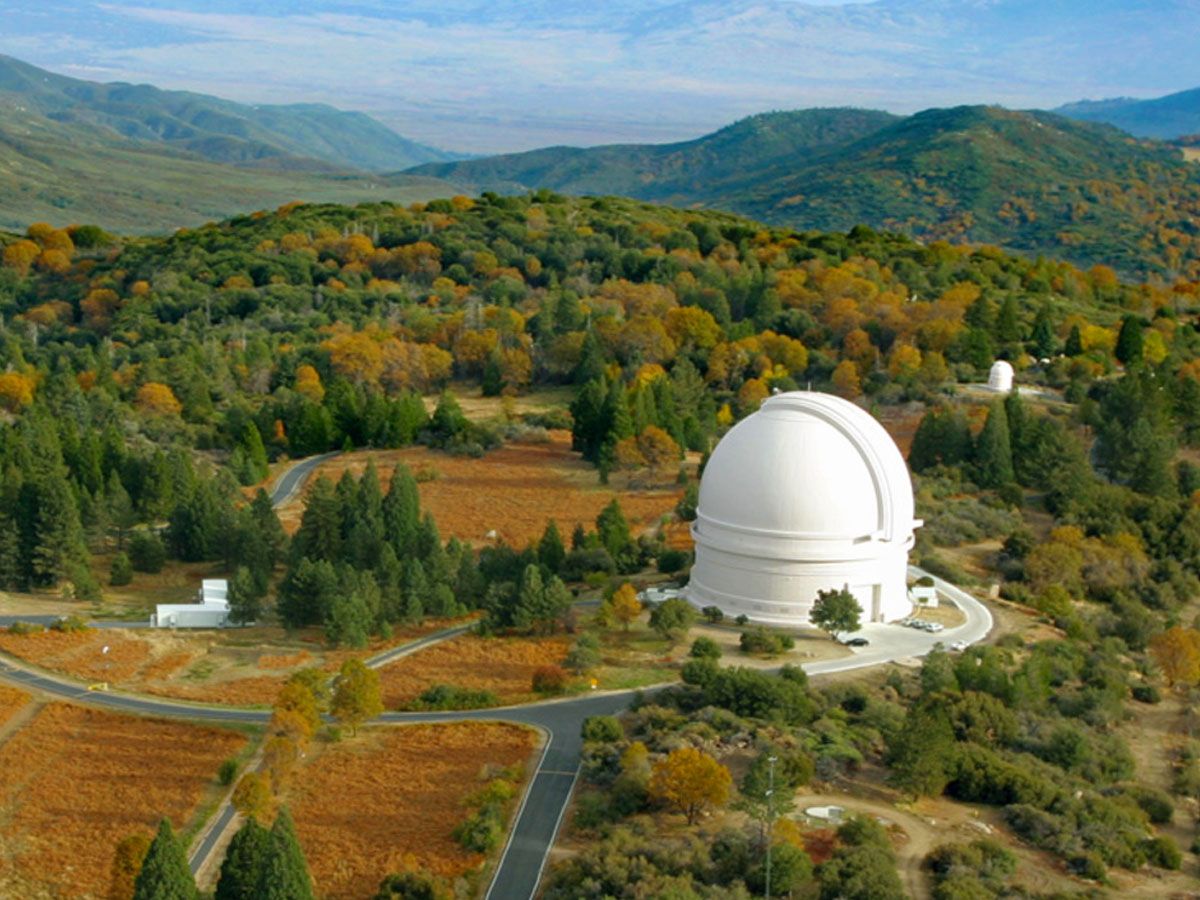
This shift means we’ll likely identify more “lesser-known” periodic comets before they become visible to the naked eye. By the time a comet like 220P hits its perihelion—which for this object occurs at 1.6 Astronomical Units (AU) from the Sun—the community already has a data trail of its behavior.
For more on how these surveys work, check out the Zwicky Transient Facility official site.
Can amateur astronomers still find these objects?
Yes, but the tools have changed. While Robert McNaught used the Siding Spring Observatory to find 220P in 2004, today’s hobbyists are using “smartscopes.” The use of devices like the DwarfMini allows users to pull objects directly from a database using a simple ID like ‘220P’ and let the hardware handle the tracking.
The challenge for the modern observer isn’t finding the object—it’s the timing. Because Comet 220P is an early morning object in the constellation Pisces, observers in the northern hemisphere have to balance the comet’s rise above the eastern horizon against the rapidly approaching dawn.
Comparing the biggest cometary outbursts
Not all outbursts are created equal. When we look at the data, Comet 220P sits in an elite group of volatile periodic comets. Here is how it compares to other major events:
- Comet 17P/Holmes (2007): The gold standard of outbursts. It jumped to +3rd magnitude, becoming visible to the naked eye almost overnight.
- Comet 220P/McNaught (Recent): A 9-magnitude jump, making it a prime target for binoculars and small telescopes.
- Comet 289P/Blanpain (2013): A significant event, but surpassed in total magnitude change by the recent 220P activity.
These events are often linked to the comet’s orbit. Comet 220P shares a 2:1 resonance with Jupiter, meaning the gas giant’s gravity likely influenced its capture and current orbital path.
What happens next for periodic comets?
The trend is moving toward more precise predictive modeling. By combining the “surprise” data from ZTF with the physical blueprints provided by the Rosetta mission, scientists can better predict which comets are prone to these eruptions. We’re learning that the “clockwork Universe” has pockets of unpredictability that provide vital clues about the composition of the early solar system.

Keep an eye on the ecliptic. As comets like 220P pass near planets—such as its close approach to Saturn—the gravitational interactions can lead to further instability and potential second outbursts.
Frequently Asked Questions
Can I see Comet 220P with the naked eye?
Generally, no. While it brightened significantly, it remains in the range of binoculars or small telescopes (around +8th magnitude).
What is a periodic comet?
A periodic comet is one that orbits the Sun on a regular, repeating schedule. Comet 220P has an orbit of approximately 5.5 years.
What is perihelion?
Perihelion is the point in a comet’s orbit where it is closest to the Sun, often the time when it is most active and visible.
Do you have a telescope or a smartscope? Have you managed to spot 220P in the dawn sky? Share your photos and observations in the comments below, or subscribe to our newsletter for real-time alerts on the next big celestial outburst!