

CDC Vital Signs: Community Factors Linked to Lower US Suicide Rates
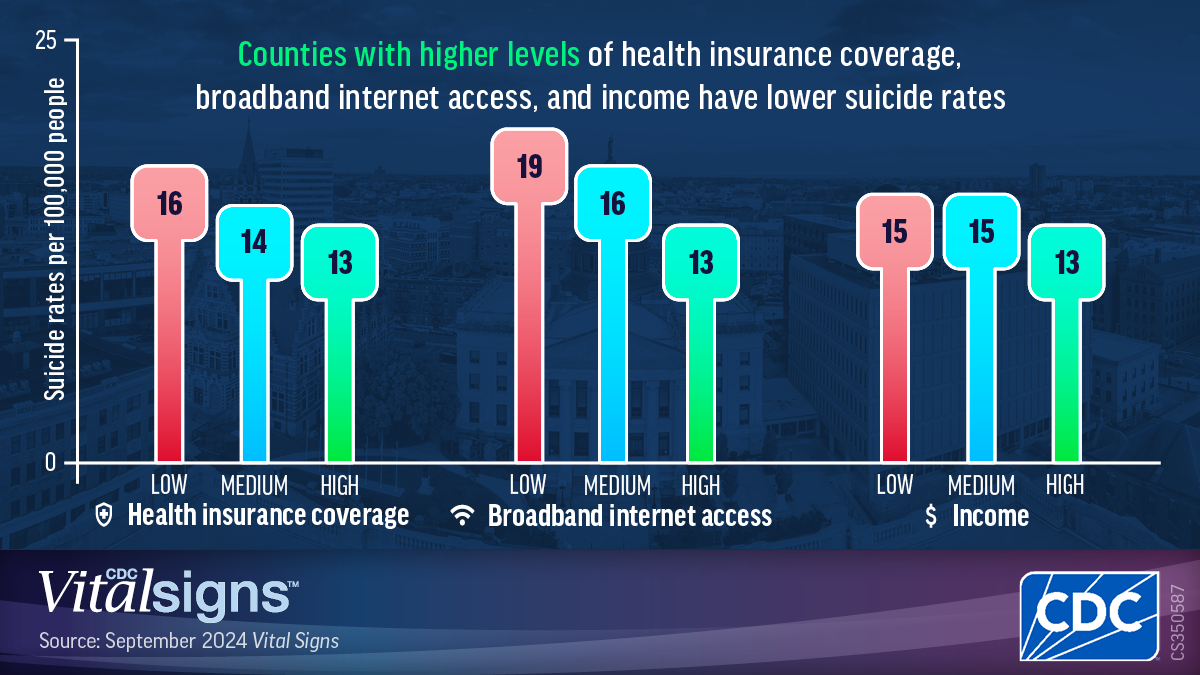
A new CDC Vital Signs report finds that suicide rates in the U.S. are significantly lower in counties with higher levels of health insurance coverage, broadband internet access, and household income. According to Dr. Alison Cammack, lead author and CDC Health Scientist, suicide rates were 44% lower in counties with the most broadband access compared to those with the least.
How do community factors influence suicide rates?
The CDC study analyzed county-level factors and their relationship to 2022 suicide rates. Dr. Cammack reported that suicide rates were 26% lower in counties with the highest health insurance coverage and 13% lower in counties with the highest household income levels.

These three factors are linked to protective resources. Health insurance facilitates access to primary care and mental health treatment, while broadband connects individuals to telehealth, job opportunities, and family. Higher income helps families secure basic needs like food and housing, according to Dr. Cammack.
Which populations are most at risk?
Suicide rates have increased over the last 20 years. Dr. Debra Houry, CDC Deputy Director for Programming Science and Chief Medical Officer, stated that more than 49,000 people died by suicide in 2022. Provisional data for 2023 shows a similar figure at 49,315 deaths.
Certain groups face higher risks. Dr. Houry noted that males have higher suicide rates than women, and rural communities have higher rates than urban ones. The highest suicide rates occur among non-Hispanic American Indian and Alaska Native people, followed by non-Hispanic white people.
What policies could reduce suicide risk?
The CDC is focusing on programs that improve the conditions where people live, work, and age. Dr. Houry said the agency currently invests in 28 sites across the U.S. to reduce suicide risk and supports organizations working with veterans and tribes.
Future efforts may include policies that improve housing stability, economic security, and healthcare delivery. The CDC also co-led the 2024 National Suicide Prevention Strategy, which seeks to address underlying risk factors and support long-term recovery, according to Dr. Houry.
Recognizing the warning signs
Dr. Houry urged the public to recognize signs of increased risk, such as isolation, expressing hopelessness, increased substance use, or sleeping too little or too much. Help is available 24/7 through the free and confidential 988 lifeline or its online crisis chat.
Frequently Asked Questions
Which community factors are most strongly associated with lower suicide rates?
Broadband internet access showed the strongest association, with a 44% lower suicide rate in high-access counties. Health insurance coverage followed at 26% lower, and household income at 13% lower, according to Dr. Alison Cammack.
Who is most impacted by these community-level factors?
The associations were most consistent and strongest among males, white persons, individuals aged 25 to 44, and American Indian and Alaska Native persons, according to Dr. Cammack.
What is the CDC’s approach to preventing suicide crises?
The CDC approach focuses on increasing factors that promote resilience and reducing factors that increase risk to prevent people from ever reaching a crisis, according to Dr. Debra Houry.
Do you think increasing broadband access in rural areas could significantly impact community mental health?