
China’s Humanoid Robot Boom: 78% Global Market Share Projected by 2030
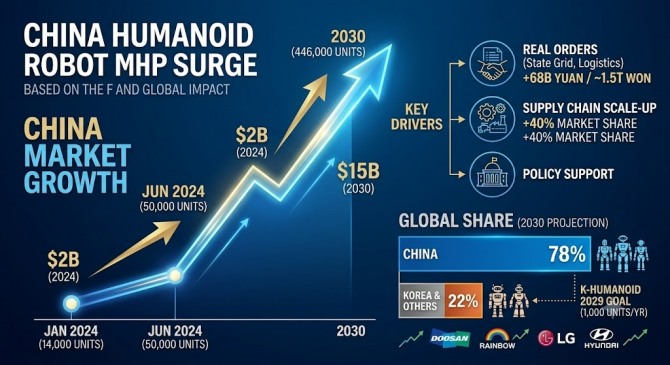
Morgan Stanley raised its 2024 shipment forecast for Chinese humanoid robots to 50,000 units, a three-fold increase from its January estimate. The investment bank predicts China will control 78% of the global humanoid market by 2030, with market value reaching $15 billion, according to reporting from CNBC.
Why is China’s humanoid robot market accelerating?
The shift from “exhibition models” to “factory deployment” is driven by massive commercial contracts. Morgan Stanley reports that the acceleration stems from faster commercial verification, stronger policy support, and positive supply chain feedback.

Concrete orders prove the trend. China’s State Grid signed a procurement deal in the first half of the year totaling 6.8 billion yuan (approximately $940 million). This order includes 500 humanoid robots, 3,000 dual-arm robots, and 5,000 quadruped robots.
Logistics firms are also integrating these machines into daily operations. SF Express and China Post have deployed humanoid robots from manufacturer Robotera in their logistics centers to handle repetitive sorting and transport tasks.
How does China’s production capacity compare to the US and Korea?
China currently dominates the hardware supply chain. LeaderDrive, listed on the Shanghai Stock Exchange, increased its monthly harmonic reducer production from 50,000 units in Q1 to 70,000 units currently. The company aims for 100,000 to 120,000 units by year-end.
In the ball screw sector, Hengli Hydraulic is expanding its Mexico plant to support a production capacity for 100,000 robots annually by the end of the year. Morgan Stanley expects LeaderDrive to hold a 40% global market share in harmonic reducers this year.
Market research firm Omdia reports that Chinese companies occupied all of the top five spots for global humanoid shipments last year. In contrast, U.S.-based Figure AI ranked seventh and Tesla ranked ninth.
| Region/Entity | Production/Shipment Target | Timeline |
|---|---|---|
| China (Overall) | 50,000 units | 2024 |
| K-Humanoid Alliance | 1,000+ units/year | 2029 |
This gap is stark. While South Korean giants like Samsung, LG, and Hyundai Motor are investing in “Physical AI,” their mass production goals for 2029 are dozens of times smaller than China’s current 2024 targets.
What geopolitical risks face the robot industry?
Rapid growth doesn’t mean a clear path. Jonathan Fan, COO of Seer Intelligent, identifies geopolitical uncertainty and U.S.-China trade tensions as the primary obstacles to expansion. Seer Intelligent, which operates in over 65 countries, is currently diversifying its regional presence to reduce dependence on any single market.

Despite these tensions, the sheer volume of deployment is unprecedented. Joe Ngai, a senior partner at McKinsey for Greater China, stated at the Davos Summer Forum in Dalian that robots are more prevalent in Chinese factories than anywhere else in the world.
Frequently Asked Questions
What is the projected market size for Chinese humanoid robots?
According to Morgan Stanley, the market is expected to reach $2 billion this year and grow to $15 billion by 2030.
Which companies are leading the hardware supply chain?
LeaderDrive (harmonic reducers) and Hengli Hydraulic (ball screws) are key players scaling production to meet demand.
How does China compare to Tesla in robot shipments?
Omdia data indicates that Chinese firms dominate the top five global shipment rankings, while Tesla currently ranks ninth.
Will China’s lead in robotics hardware be offset by U.S. software advances?
Share your thoughts in the comments below or subscribe to our newsletter for the latest updates on AI and robotics.