
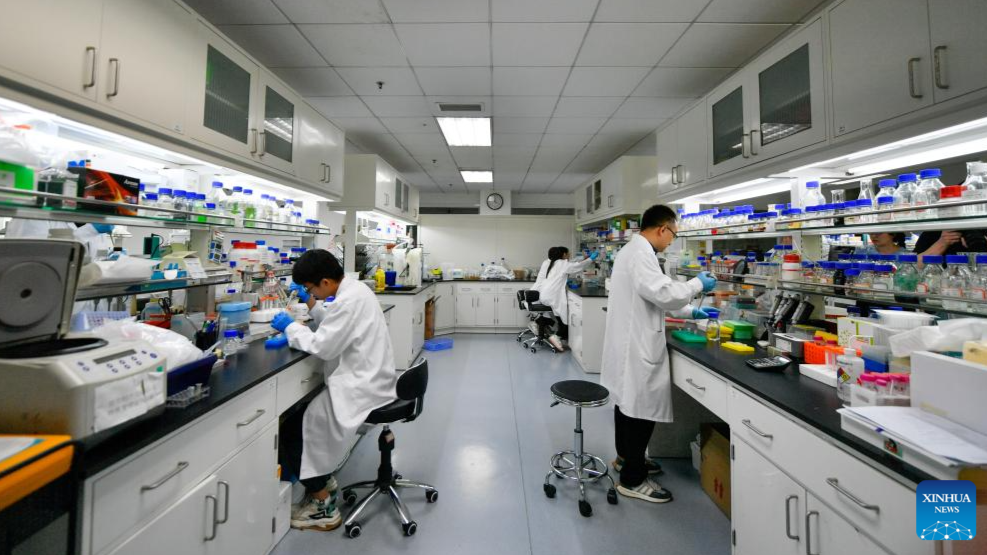
Chinese researchers unveil formation of global seamounts
What Drives the Formation of Seamounts? A New Model Challenges Old Theories
Chinese scientists have developed a self-developed model that traces the origin of global seamounts, revealing how thermal activities in the Earth’s asthenosphere, driven by mantle plumes, shape these underwater features. According to a study published in *Nature Geoscience*, over 40,000 seamounts exist across ocean basins, yet traditional hotspot theories fail to explain their distribution.
“The conventional hotspot hypothesis can’t account for the scale and randomness of seamounts,” said Liu Lijun, a researcher at the Chinese Academy of Sciences’ Institute of Geology and Geophysics. “Our model shows that mantle plumes generate secondary hotspots, expanding the classical theory.”
How Mantle Plumes Shape Seamount Chains
Mantle plumes—columns of hot material rising from the core-mantle boundary—were long thought to create linear seamount chains like the Hawaiian Islands. However, only 50 such chains exist, far fewer than the observed 40,000 seamounts. The new research suggests that mantle plumes split within the Earth’s mantle, creating secondary plumes that spawn additional seamounts.
In the Pacific, for example, early plume activity generated a thermal anomaly beneath the young Pacific plate. Over time, these plumes split, producing shallow hotspots that fueled seamount formation. This mechanism explains how a few primary plumes could generate thousands of seamounts globally.
Why This Discovery Matters: A Shift in Geoscience
The study’s implications are profound. By linking seamount formation to deep mantle processes, it offers a unified framework for understanding intraplate volcanism. This could refine predictions about tectonic activity and improve models for natural hazards like underwater eruptions.
“This isn’t just about seamounts,” said Dr. Emily Carter, a geologist at the University of California, Berkeley, who was not involved in the study. “It’s a paradigm shift in how we view mantle dynamics and plate tectonics.”
Did You Know? The Role of Supercomputing in Geoscience
The research relied on simulations run on China’s Tianhe supercomputer, one of the world’s most powerful systems. These calculations allowed scientists to map mantle plume evolution over 270 million years, a feat impossible with earlier technology.
“Without high-performance computing, we couldn’t visualize the complex interactions between plumes and the asthenosphere,” said Liu Lijun. “This is the future of geological research.”
How Does This Compare to Previous Theories?
The new model contrasts with the 1960s-era hotspot theory, which assumed seamounts formed exclusively from stationary mantle plumes. While the old theory explained features like Hawaii, it struggled to account for isolated seamounts or scattered chains.
“Our findings show that mantle plumes are dynamic, not static,” said co-researcher Dr. Zhao Wei. “This explains why seamounts appear in unexpected locations.”
Pro Tips: What’s Next for Seamount Research?
– Global Mapping: Scientists plan to integrate data from deep-sea drilling projects to validate model predictions.
– Climate Impacts: Researchers are exploring how seamounts influence ocean currents and marine ecosystems.
– Space Analogs: NASA is studying seamount-like features on Mars and Europa to understand planetary geology.
“This is just the beginning,” said Liu Lijun. “We’re uncovering Earth’s hidden history, one plume at a time.”
FAQ: Answers to Common Questions
Q: How many seamounts are there?
A: Over 40,000 seamounts have been identified, with many more likely undiscovered.
Q: What is the asthenosphere?
A: A semi-fluid layer of the Earth’s mantle, located beneath the lithosphere, where mantle plumes originate.
Q: Why is this research important?
A: It provides a new framework for understanding plate tectonics, volcanic activity, and Earth’s internal dynamics.
Explore More: Related Articles
Stay Informed: Subscribe for Updates
Want to dive deeper into Earth science and technological breakthroughs? Subscribe to our newsletter for the latest insights and research updates.
