

Climate Tech Bets on Space
The New Gold Rush: From Satellites to Orbital Infrastructure
For decades, the “space race” was about flags, footprints, and government prestige. Today, the narrative has shifted. We are witnessing a transition from simple exploration to the construction of a full-scale industrial economy in orbit.
The numbers tell a staggering story. The global space economy hit $613 billion in 2024, but that is just the baseline. Projections from firms like PwC suggest the sector could balloon to $2 trillion by 2040. This isn’t just about more satellites; it’s about the infrastructure required to support them.
We are moving past the era of “launch and leave.” The future is about building permanent, scalable systems—power grids, data centres, and energy hubs—that operate entirely outside our atmosphere to optimize life on the ground.
The Power Paradox: Why Space Needs a Grid
There is a fundamental disconnect in current satellite design. Most satellites rely on onboard solar arrays, but these are limited by the size of the rocket that carries them. As Andrew Rush, CEO of Star Catcher, puts it, the average satellite generates about 1,500 watts—roughly what a high-end gaming PC uses.
However, the next generation of orbital assets—AI-driven sensors, global cell towers, and edge computing hubs—require tens or hundreds of kilowatts. You cannot simply add more panels; the spacecraft would become too massive and expensive to launch.
The Rise of Laser-Based Energy Beaming
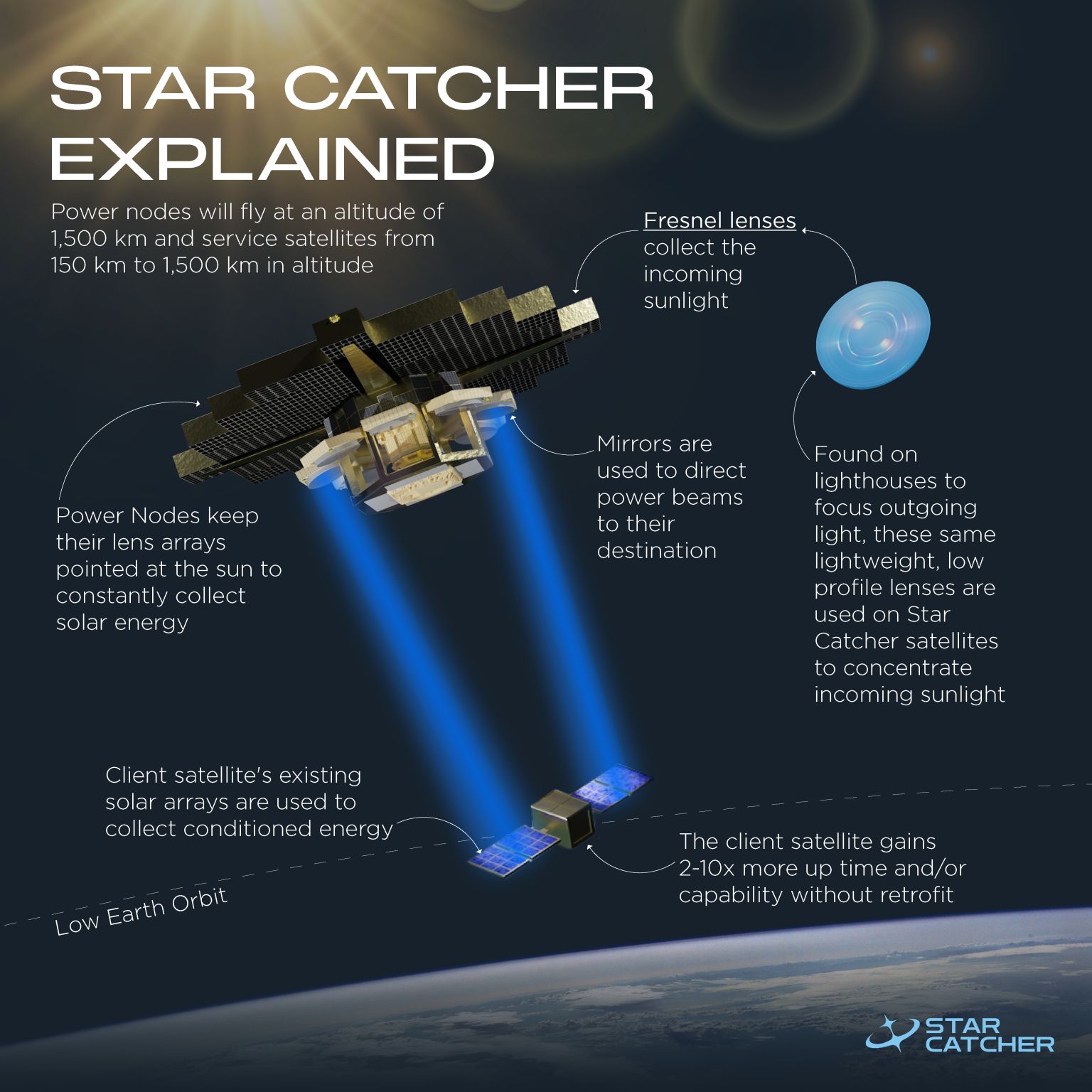
This is where the concept of an “extraterrestrial power grid” comes in. Startups like Star Catcher are developing constellations of power nodes. These nodes harvest sunlight and beam it via concentrated, near-infrared lasers to other satellites.
By delivering energy directly to solar arrays, these systems can increase a satellite’s power capacity tenfold. This allows operators to shrink the physical size of their spacecraft, reducing launch costs and complexity while dramatically increasing performance.
Cloud Computing 2.0: The Rise of Orbital Data centres
The most ambitious frontier in this boom is the orbital data centre. The goal is to move AI inference and data processing from Earth-based server farms into Low Earth Orbit (LEO).
Why do this? Terrestrial AI growth is currently hitting a wall of “physical constraints.” Local opposition to massive data centres, limited power grid capacity, and the astronomical water requirements for cooling are slowing down hyperscalers.
Turning Rocket Debris into Compute Power
Some companies are taking a radical approach to efficiency. Cowboy Space is designing a system where the rocket’s upper section—which is normally discarded and burned up in the atmosphere—is transformed into a 1-megawatt data centre packed with Nvidia GPUs.
By integrating the launch vehicle and the data centre into a single system, they aim to bypass the logistical nightmares of traditional satellite deployment. This creates a “compute layer” in space that reduces latency for global users and leverages the natural radiative cooling of the vacuum of space.
The Starship Variable: The Catalyst for a Copernican Shift
Much of this vision hinges on a single piece of hardware: SpaceX’s Starship. While the Falcon 9 revolutionized launch costs, Starship aims to move the needle from “affordable” to “negligible.”
With a payload capacity five to eight times larger than previous rockets, Starship could enable the launch of massive, industrial-scale infrastructure that was previously mathematically impossible. If fully reusable rockets become the norm, the cost to put a ton of hardware into orbit drops precipitously, making orbital data centres economically viable.
However, the risk remains high. As SpaceX noted in its recent filings, these initiatives involve “unproven technologies” and significant technical complexity. The industry is currently in a high-stakes bet: the infrastructure is being built on the assumption that the transport system will eventually work perfectly.
Why This Matters for Earth’s Climate and Energy
Beyond the profit margins, the shift to orbital infrastructure has profound implications for terrestrial sustainability. Space-based solar power could eventually beam clean energy down to Earth, bypassing the intermittency of weather and the limitations of land-based solar farms.
moving the most energy-intensive AI workloads into orbit—where they can be powered by the “greatest fusion reactor known to humankind” (the sun) and cooled by the void of space—could significantly reduce the carbon footprint of the AI revolution.
Frequently Asked Questions
It’s a server farm located in space that processes data in orbit rather than sending it back to Earth. This reduces latency and leverages solar energy and radiative cooling.
Specialized satellites collect solar energy and focus it into a narrow laser beam, which is then directed at the solar panels of another satellite to provide an instant boost in power.
While many startups are in the venture-capital phase, the plummeting cost of launches and the explosion of satellite internet (like Starlink) have created a proven commercial market for orbital services.
Join the Conversation
Do you believe the future of AI is in orbit, or is the technical risk too high? We want to hear your thoughts on the space economy.
Leave a comment below or subscribe to our newsletter for the latest insights into the frontier of technology.