
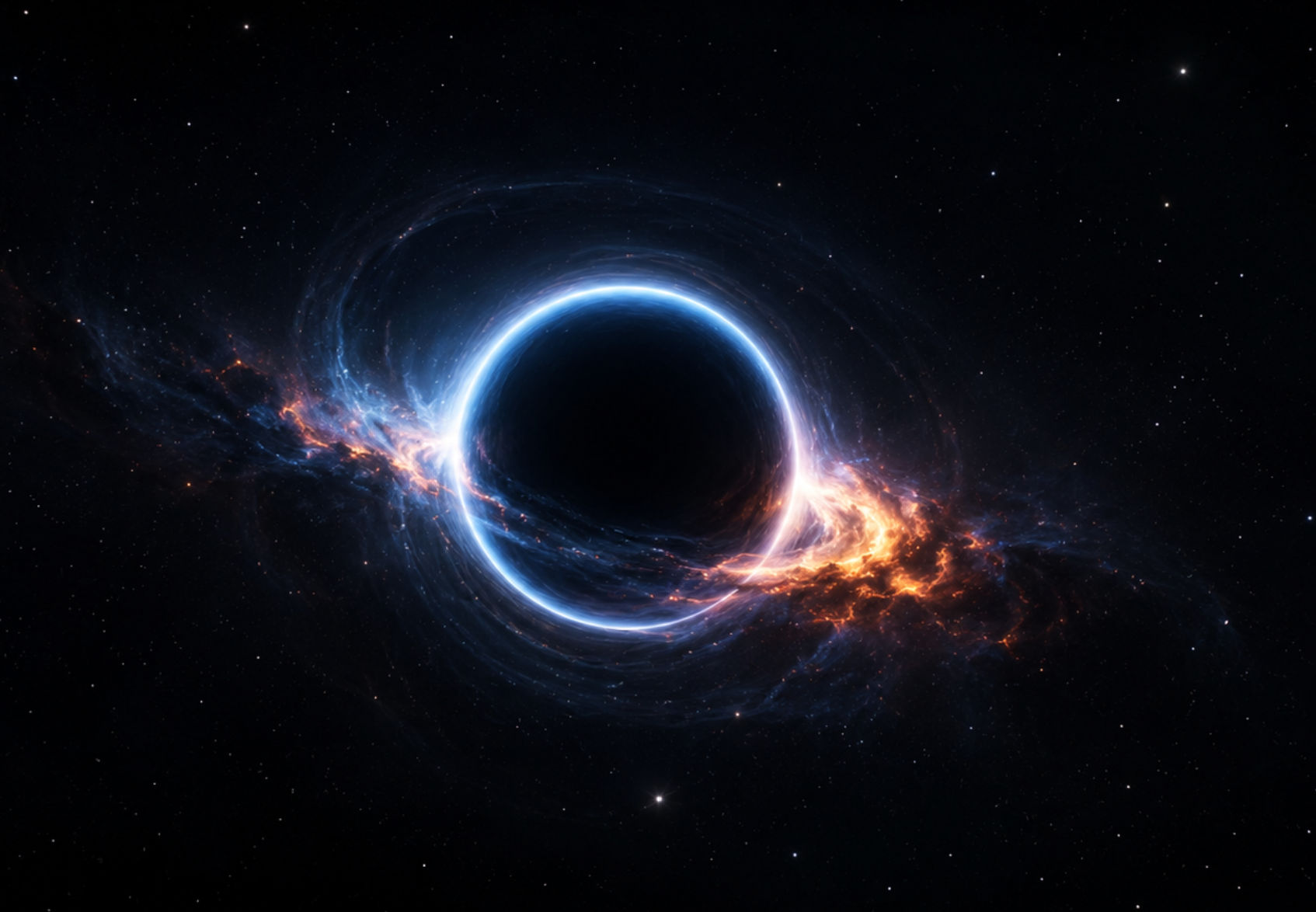
Collapsing stars could form gravastars instead of black holes
Physicists Daniel Jampolski and Luciano Rezzolla of Goethe University Frankfurt have developed a theoretical model demonstrating that a collapsing star can form a “gravastar” instead of a black hole. According to their research published in Physical Review D, an expanding bubble of vacuum energy can halt a stellar collapse before a singularity or event horizon ever forms.
How does a gravastar stop a black hole from forming?
A gravastar, or gravitational vacuum condensate star, replaces the black hole’s singularity with a core of dark-energy-like vacuum energy. In the model presented by Jampolski and Rezzolla, a collapsing cloud of dust triggers the birth of a “de Sitter bubble” at its center.
This inner region acts like a miniature Big Bang. Jampolski stated that the extreme compression of matter allows for these new effects to emerge late in the collapse. The bubble’s outward pressure eventually grows strong enough to counteract gravity, freezing the collapse into a stable, static object.
Unlike a black hole, this object has no event horizon. It consists of a vacuum-energy interior and an outer shell of ordinary matter. The shell keeps the interior from expanding indefinitely, while the interior prevents the shell from collapsing further.
What are the mathematical limits of this model?
The researchers found that gravastars don’t form easily. The model requires “infinitely tuned” starting conditions, meaning the energy density and spatial curvature of the inner region must be precisely balanced.

According to the paper, there are three possible outcomes for a collapsing star in this framework:
- The formation of a standard black hole.
- A nonequilibrium state that never becomes static.
- The formation of a stable gravastar, which occurs only on a narrow boundary between the other two results.
The study also establishes a strict limit on how compact a star can be to avoid becoming a black hole. The authors derived a maximum compactness of 3/8, or 0.375. If a star is more compact than this, the de Sitter bubble cannot expand fast enough to stop the collapse, and a black hole forms regardless.
Why do black holes remain the scientific default?
Despite the mathematical possibility of gravastars, Rezzolla maintains that black holes are still the most likely outcome of stellar collapse. He described black holes as the “most natural and simplest solution,” noting that his work isn’t intended to create skepticism toward them.
The current research is a theoretical proof of concept rather than an observational discovery. It proves that general relativity allows for a way to avoid singularities, but it doesn’t claim that the black hole candidates astronomers see in the sky are actually gravastars.
For now, the primary value of the model is foundational. It provides a framework for physicists to test whether black hole alternatives can arise from actual gravitational collapse rather than remaining as static thought experiments.
What happens next for black hole research?
The model used by Jampolski and Rezzolla relied on an idealized setup: spherical symmetry and dust with no pressure. Future research must determine if gravastars can survive more realistic conditions, such as off-center bubble formation or non-spherical shapes that might destabilize the outer shell.
If these models hold up, future gravitational-wave signals from colliding compact objects could reveal subtle differences that distinguish a gravastar from a black hole. This would move the discussion from the realm of equations to empirical evidence.
Frequently Asked Questions
What is a gravastar?
A gravastar is a theoretical alternative to a black hole. It features a core of vacuum energy (similar to dark energy) and a thin shell of matter, avoiding the singularity and event horizon found in black holes.
Does this prove black holes don’t exist?
No. According to Luciano Rezzolla, black holes remain the simplest and most natural explanation for gravitational collapse. This research simply shows that other mathematically consistent options exist.
Can we see a gravastar with a telescope?
Not currently. Gravastars would look very similar to black holes in electromagnetic observations. Distinguishing them would likely require analyzing gravitational waves or specific perturbations.
What do you think? Could the universe be filled with “mimics” instead of true black holes? Let us know in the comments or subscribe to our newsletter for more updates on theoretical physics.