
Cryptocurrency Usage in the US: Partisan Gaps and Demographic Trends
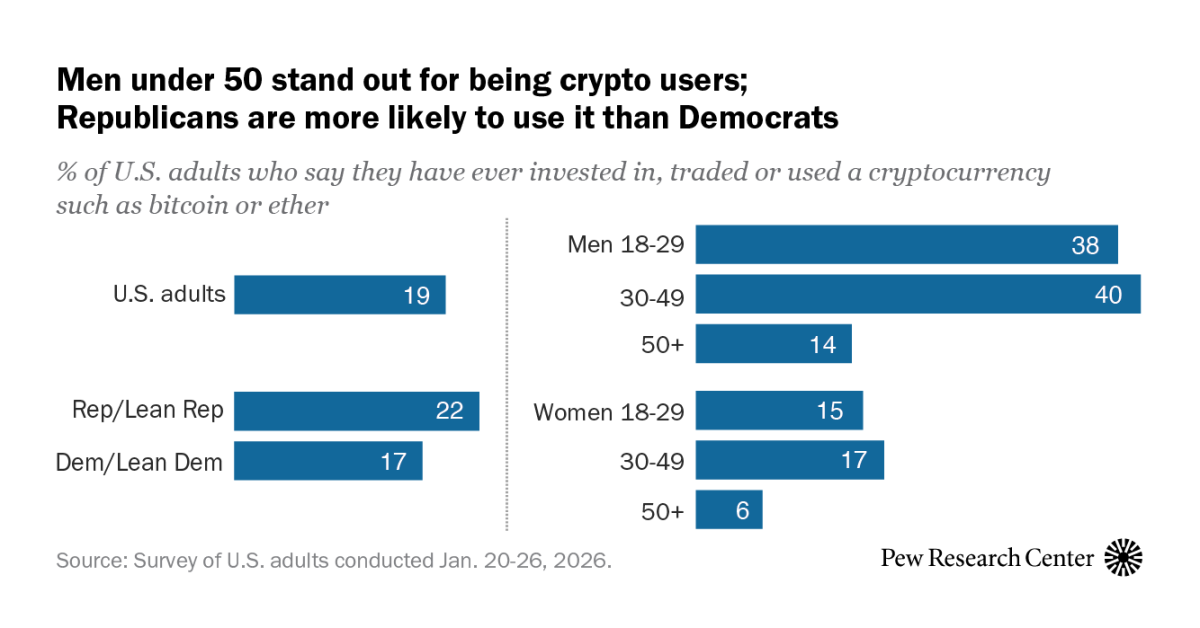
Approximately 19% of U.S. adults have invested in or used cryptocurrency, according to a January 2026 Pew Research Center survey. While overall adoption remains stable compared to 16% in 2021, a new partisan divide has emerged, with Republicans now more likely than Democrats to use digital assets.
Why is there a partisan gap in cryptocurrency use?
For the first time, a clear political split has appeared in crypto adoption. Republican use climbed from 16% in 2021 to 22% today, while Democratic use has remained steady at 17%.
This shift coincides with cryptocurrency entering the national political conversation. The Trump administration has actively pursued a goal to make the United States the “crypto capital of the world,” which includes steps to let crypto firms operate as banks.
Which demographics are the most frequent crypto users?
Gender and age remain the strongest predictors of use. Men under 50 stand out significantly; 40% of men aged 30 to 49 and 38% of men aged 18 to 29 have used crypto.
In contrast, adoption among women in those same age groups is much lower, at 17% for those aged 30 to 49 and 15% for those aged 18 to 29. Use among men 50 and older has also increased since 2021.
Income levels also play a role. Upper-income households show the highest adoption at 27%, a steady climb from 17% in 2021 and 23% in 2024. Middle-income use sits at 20%, while lower-income use has stayed flat at 16%.
What may happen next for cryptocurrency in the U.S.?
The push to establish the U.S. as a global crypto hub could lead to further integration of digital assets into the traditional financial system. A possible next step is the realization of the administration’s plan to allow crypto firms to become banks.

If current trends continue, the gap between upper-income and lower-income users may widen, as the former group has shown consistent growth since 2021. Adoption among Democrats is likely to remain stagnant unless there is a shift in the political conversation surrounding the technology.
Frequently Asked Questions
What percentage of U.S. adults have used cryptocurrency?
About 19% of U.S. adults say they have invested in or used a cryptocurrency.
How does crypto use differ between Republicans and Democrats?
Republicans are more likely to use crypto at 22%, compared to 17% of Democrats.
Which ethnic group has the highest rate of crypto use?
Asian adults report the highest usage at 25%.
Do you think the ability for crypto firms to become banks will change how you view digital assets?