
Datacenter Water Consumption: Global Trends and Transparency Gaps
The Thirst of the Cloud: Why AI is Pushing Datacenters to a Water Breaking Point
For years, the conversation around datacenters focused almost exclusively on electricity. We talked about carbon footprints, renewable energy certificates, and the hum of massive cooling fans. But there is a quieter, more liquid crisis brewing beneath the surface: water consumption.
If you look at the sustainability reports from the “Big Tech” giants, you’ll see impressive promises. However, a closer look reveals a troubling lack of transparency. The industry often blurs the line between water withdrawal (taking water from a source) and water consumption (water that is evaporated or contaminated and not returned to the source).
As we pivot toward a world dominated by Generative AI, this distinction isn’t just a matter of accounting—it’s a matter of ecological survival.
The AI Catalyst: Why LLMs Are Thirstier Than Traditional Cloud
Training a Large Language Model (LLM) isn’t just a computational challenge; it’s a thermal one. The GPUs required for AI—like those from NVIDIA—run significantly hotter than standard CPUs. To keep these chips from melting, datacenters rely heavily on evaporative cooling.
In these systems, water is evaporated to cool the air circulating around the servers. This water is “consumed” because it enters the atmosphere as vapor rather than returning to the local watershed. As companies race to build larger models, the volume of water required to keep these “digital brains” cool is skyrocketing.
We are seeing a shift where the Water Usage Effectiveness (WUE) metric is becoming as critical as PUE (Power Usage Effectiveness). For those unfamiliar, WUE measures the annual water usage per kilowatt-hour of IT equipment energy.
The Geographic Conflict
The real tension arises when these thirsty facilities are placed in water-stressed regions. When a datacenter competes with local agriculture or residential drinking water for the same aquifer, the “sustainability” of the cloud becomes a local political battleground.
Future Trends: Moving Beyond Evaporative Cooling
The industry knows the current model is unsustainable. We are entering an era of “Water-Less” or “Water-Smart” infrastructure. Here are the trends that will define the next decade:
1. The Rise of Direct-to-Chip Liquid Cooling
Instead of cooling the entire room with chilled air, engineers are piping coolant directly to the processor. This is far more efficient than air cooling and drastically reduces the need for massive evaporation towers. We expect to see this become the standard for all AI-dedicated clusters by 2027.
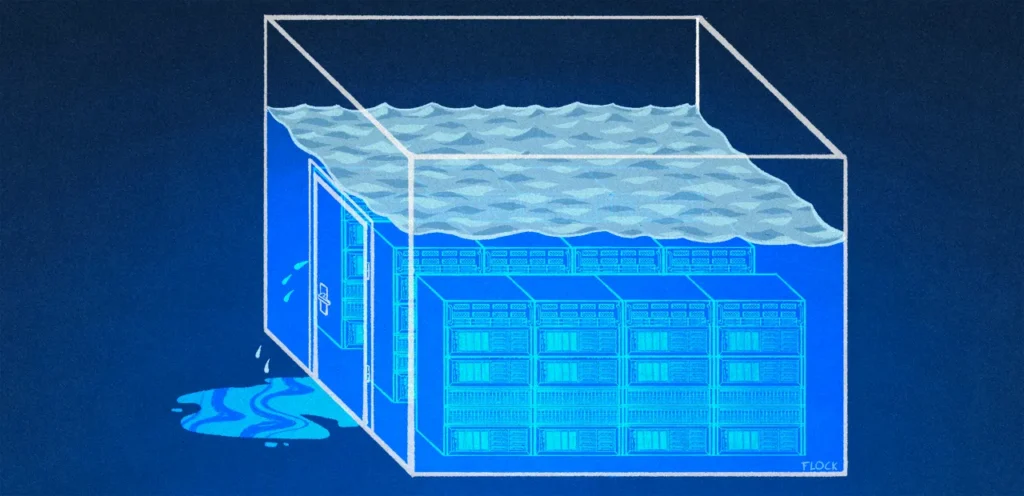
2. Immersion Cooling: The “Digital Aquarium”
Imagine submerging an entire server in a non-conductive, dielectric fluid. This fluid absorbs heat far more effectively than air or water. Because it operates in a closed loop, the water consumption is nearly zero. While currently expensive to implement, the scale of AI demands this leap.
3. Transitioning to Non-Potable Water
Using drinking water to cool a server is an ecological absurdity. The trend is moving toward industrial recycled water, treated sewage effluent, or even seawater. However, this requires expensive filtration systems to prevent corrosion and biofouling in the cooling pipes.
The Regulatory Wave: From Voluntary to Mandatory Disclosure
For too long, “Sustainability Reports” have been treated as marketing brochures. We are now seeing a shift toward mandatory, audited reporting. Regulatory bodies in the EU and North America are beginning to demand granular data on where water is taken from and what the quality of the discharged water is.
The “Net Water Positive” pledge—where companies like Microsoft and Google claim they will replenish more water than they use—is under heavy scrutiny. Critics argue that “offsetting” water in one basin doesn’t help a drought-stricken community in another. The future will likely move toward Local Water Stewardship, where companies must prove they aren’t harming the specific watershed they occupy.
Frequently Asked Questions
Q: Why do datacenters need so much water?
A: Most datacenters use evaporative cooling to remove heat from servers. Water is evaporated into the air to cool the facility, which consumes billions of litres globally.
Q: Is AI really worse for the environment than regular cloud computing?
A: Yes, in terms of intensity. AI chips generate more heat and require more dense compute power, leading to higher electricity and water demands per rack of servers.
Q: Can datacenters operate without water?
A: Yes. Closed-loop liquid cooling and immersion cooling can virtually eliminate water consumption, though they require higher initial investment and different infrastructure.
Join the Conversation
Is the convenience of AI worth the hidden environmental cost? Do you think tech giants should be forced to move their datacenters to colder climates to save water?
Share your thoughts in the comments below or subscribe to our newsletter for deep dives into the hidden costs of the digital age.