
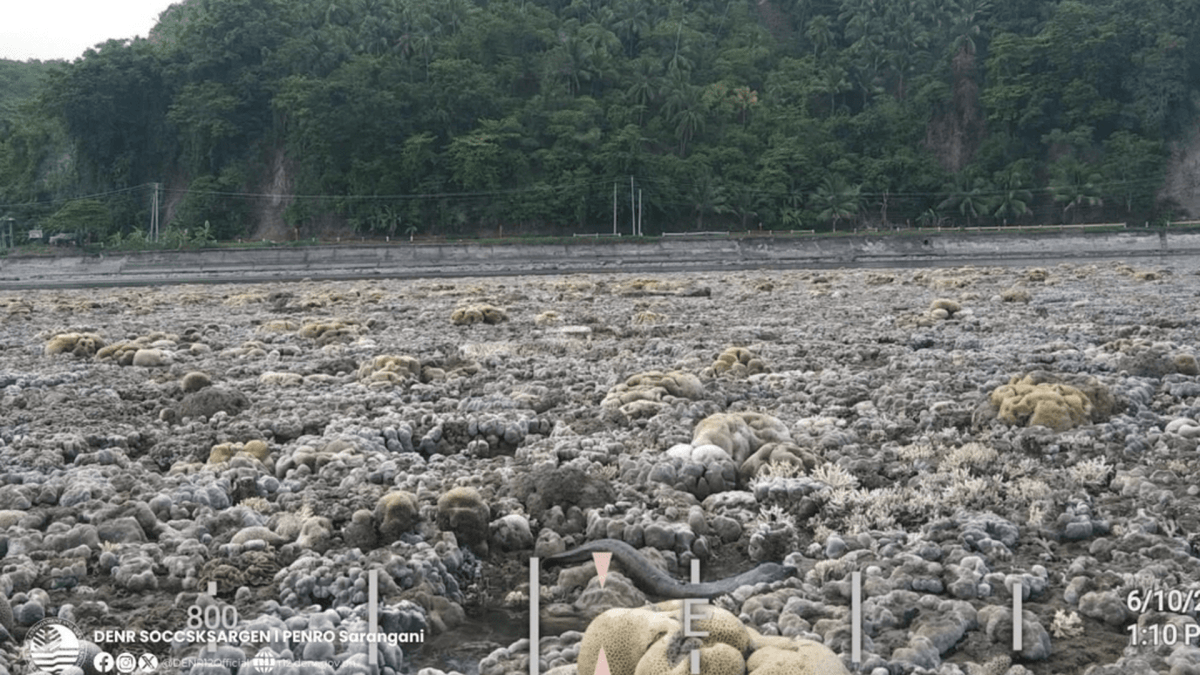
Deadly Philippines earthquake raised seabed by up to 2 metres, exposing coral and killing marine life
A 7.8-magnitude earthquake off southern Mindanao caused “coastal uplift,” raising the seabed by up to 2 meters and extending shorelines by 200 meters, according to Philippine authorities. The Philippine Institute of Volcanology and Seismology attributed the shift to the Cotabato trench, which exposed and killed critical coral reefs and seagrass beds.
How does coastal uplift impact marine ecosystems?
Coastal uplift occurs when tectonic shifts push the ocean floor upward, instantly transforming submerged habitats into dry land. In the wake of the Mindanao quake, the environment department reported that long stretches of coral reefs and seagrass beds were exposed to the air. Because these organisms rely on saltwater immersion to survive, they began dying immediately.
The biological collapse extends beyond the plants. The environment department found dead fish, eels, clams, and shells lying on the newly exposed seabed. This creates a sudden void in the local food chain, as these reefs serve as primary nurseries for regional fish populations.
What are the public health risks of sudden shoreline expansion?
Rapid changes in geography create immediate sanitation and health concerns. Residents in Sarangani and Davao Occidental provinces reported concerns regarding fumes emanating from the newly exposed land. These odors result from the mass decay of aquatic life—fish, mollusks, and seagrass—now trapped above the tide line.
The decomposition of organic matter on a scale of 200 meters of new shoreline can release hydrogen sulfide and other gases. While the disaster agency focuses on the 40 people still missing and the 61 confirmed dead, the long-term management of these “decay zones” becomes a secondary public health priority for local governments.
Managing organic decay in disaster zones
Future disaster response trends suggest a need for rapid “biological cleanup” teams. When thousands of kilograms of marine life die simultaneously due to uplift, the resulting anaerobic decomposition can contaminate local air quality and attract pests, complicating the recovery efforts for surviving residents.
How do seismic events reshape coastal geography long-term?
The shift in the Cotabato trench demonstrates how a single event can permanently alter provincial borders and land use. By extending the shoreline by as much as 200 meters, the earthquake has created new, unplanned land masses in Sarangani and Davao Occidental.

According to the Philippine Institute of Volcanology and Seismology, this is a direct result of the trench pushing the coastline upward. This creates a conflict between geographical reality and legal land titles. Future trends in coastal management will likely require updated mapping protocols to handle “new land” created by tectonic activity.
Comparison: Physical Gain vs. Biological Loss
The Mindanao event presents a stark contrast between geological expansion and ecological destruction. While the region technically “gained” land, the cost was the immediate loss of the protective barriers provided by coral reefs.
- Geological Change: Shorelines extended by up to 200 meters; seabed raised by 2 meters.
- Ecological Change: Total loss of exposed seagrass beds and coral colonies; mass mortality of reef fish and eels.
This trade-off means that while there is more land, the coast is now more vulnerable to storm surges and erosion because the natural reef buffers have been destroyed.
Frequently Asked Questions
What is coastal uplift?
Coastal uplift is the vertical elevation of the shoreline caused by tectonic activity, such as the shifting of a trench during an earthquake, which exposes previously submerged land.
Why did the fish die in the Mindanao earthquake?
The fish died because the seabed was pushed upward, leaving them stranded on dry land without access to water.
Can coastal uplift happen without a tsunami?
Yes. While often associated with large quakes that cause tsunamis, uplift is a result of vertical crustal movement and can occur independently of a wave event.
Do you live in a coastal area prone to seismic activity? Share your experiences or ask a question in the comments below. For more updates on geological shifts and disaster preparedness, subscribe to our newsletter.