
Deep Brain Stimulation Effects on Gait in Parkinson’s Disease
Deep brain stimulation (DBS) significantly impacts gait variability and motor function in patients with Parkinson’s disease, though its long-term effectiveness remains a subject of ongoing clinical evaluation. Researchers have identified that while stimulation of the subthalamic nucleus (STN) can provide acute improvements in motor symptoms, outcomes regarding gait stability and the potential for long-term deterioration vary across patient populations, according to studies published in Movement Disorders and Neurology.
Did You Know? Research indicates that while subthalamic nucleus stimulation can improve bradykinesia by regularizing pallidal activity, gait variability in some patients has been linked to the atrophy of the nucleus basalis of Meynert, a condition that may remain resistant to standard DBS therapy.
The Impact of Stimulation Frequency on Gait
The frequency of electrical stimulation is a primary factor in how patients respond to DBS. Research by Moreau et al. and subsequent trials suggest that adjusting stimulation to lower frequencies can specifically influence freezing of gait. While standard high-frequency settings are effective for overall tremor and rigidity, some studies indicate that low-frequency stimulation may offer distinct benefits for specific gait disorders and swallowing difficulties, as noted by Xie et al. in the Journal of Neurology, Neurosurgery & Psychiatry.
Clinical Outcomes and Long-term Considerations
Long-term data from five-year and ten-year follow-up studies reveal a complex picture of disease progression. While bilateral stimulation of the subthalamic nucleus remains a standard for advanced Parkinson’s, some patients experience postoperative gait deterioration, a phenomenon documented by van Nuenen et al. Experts suggest that the success of these interventions often depends on a patient’s baseline tremor severity and the total duration of their symptoms prior to surgery, according to findings in Brain Communications.
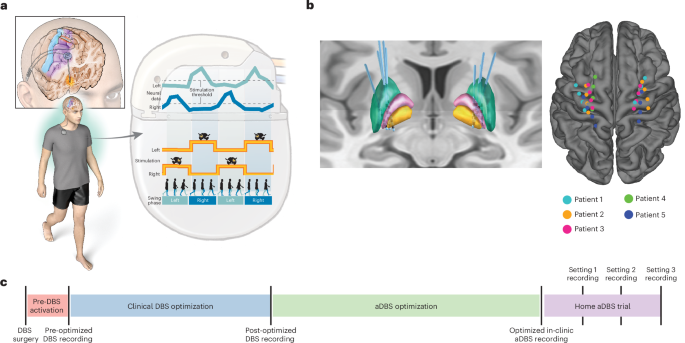
Expert Insight: The transition from conventional, “always-on” stimulation to adaptive, closed-loop systems represents a critical shift in how we manage motor fluctuations. By utilizing real-time neural recordings—such as beta oscillatory power—to trigger stimulation only when necessary, clinicians may eventually mitigate the side effects of chronic stimulation, like dyskinesia, while preserving long-term gait stability.
Future Directions in Adaptive Neuromodulation
A possible next step in DBS technology is the widespread implementation of adaptive deep brain stimulation (aDBS). Unlike traditional systems, aDBS uses implanted sensors to monitor local field potentials, allowing the device to adjust stimulation parameters in response to the patient’s real-time brain activity. Research by Oehrn et al. suggests that these systems could provide a more personalized approach to treatment, potentially reducing stimulation-induced side effects and improving overall quality of life.

Frequently Asked Questions
Does deep brain stimulation cure Parkinson’s disease?
No, DBS is a treatment for symptoms rather than a cure. It is used to manage motor symptoms such as tremors, rigidity, and bradykinesia in advanced stages of the disease.
Why do some patients experience gait issues after surgery?
Gait deterioration after surgery may be linked to the underlying progression of the disease, specific anatomical targets, or the atrophy of brain regions like the nucleus basalis of Meynert, which may not be fully addressed by subthalamic stimulation.
What is the difference between conventional and adaptive DBS?
Conventional DBS provides constant electrical stimulation. Adaptive DBS, or “closed-loop” stimulation, monitors brain signals in real-time and adjusts the stimulation output based on the patient’s immediate neural state.
How might the integration of wearable sensors and real-time neural data change the way patients manage their mobility at home?