
Did Life Start When Impacts Created Vast Hydrothermal Systems in Earth’s Crust?
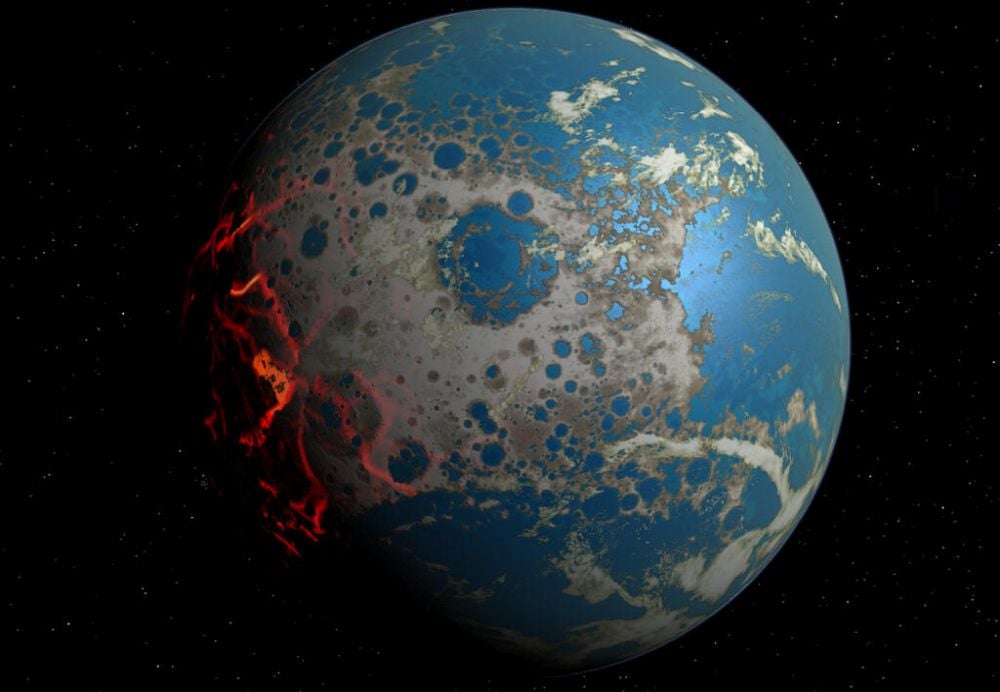
Asteroid impacts during Earth’s Hadean and Archean eons created vast, permeable hydrothermal systems in the crust that may have sparked the origin of life, according to research led by Amanda Alexander of the Southwest Research Institute (SwRI) and published in AGU Advances.
How did asteroid impacts create environments for early life?
Asteroids and comets delivered prebiotic molecules, including amino acids, to the young Earth. When these impactors struck, they released enormous energy that shattered the crust, creating subterranean regions of porous rock. These zones allowed hot water to flow through the crust, forming what researchers describe as a “hydrothermal honeycomb.”
According to the study “Widespread Impact-Induced Crustal Permeability on the Early Earth,” these networks acted as chemical kitchens. In these environments, minerals, hot water, and delivered organic chemicals interacted to potentially form the first living cells. Amanda Alexander, a planetary scientist at SwRI, stated in a press release that while impacts are often viewed as catastrophic, they were likely critical for creating prebiotic chemistry environments.
How large were these ancient hydrothermal systems?
The scale of impact-generated systems dwarfs modern hydrothermal fields. The researchers compared these ancient systems to Yellowstone National Park in the USA, which has a hydrothermal volume of approximately 10,000 cubic kilometers. By contrast, the Chicxulub impactor—the asteroid that wiped out the dinosaurs—created a permeable volume of about 1 million cubic kilometers.
The study’s simulations show that larger impactors (50, 100, and 250 km) generated permeable volumes two to four orders of magnitude larger than the Chicxulub system. This suggests that repeated bombardments may have fundamentally altered the Earth’s crust on a global scale.
| System | Approximate Volume |
|---|---|
| Yellowstone (Modern) | 10,000 cubic km |
| Chicxulub (Impact) | 1,000,000 cubic km |
| Large Impactors (50km+) | 2-4 orders of magnitude > Chicxulub |
When did the Earth’s crust become highly permeable?
The researchers focused on the Hadean and Archean eons, spanning from 4.5 to 2.5 billion years ago. Using shock physics code, the team estimated that the upper 8-kilometer shell of the Earth’s crust became highly permeable by 4.3 billion years ago (Ga). A significant portion of this permeable volume likely remained active until 3.5 Ga.
Alexander noted that these results demonstrate how impacts drove hydrothermal changes to the near-surface environments, which had significant consequences for the geochemical evolution of the planet.
What factors limited or increased permeability?
The presence of water changed the outcome of these strikes. According to the authors, striking an ocean rather than exposed crust “stunts the development of permeable space.” In simulations involving a 5-kilometer-deep ocean, the fragmentation of the crust was less intense and covered a smaller region.
The researchers also acknowledged limitations in their current modeling. The study did not include compaction, meaning the duration of permeability might be an overestimate. Conversely, the model did not account for shearing caused by the collapse of a crater’s central uplift. The authors explain that this grinding effect would create smaller rock fragments, which would actually increase overall permeability.
Frequently Asked Questions
Did asteroids cause the origin of life?
The research suggests impacts created the necessary hydrothermal environments and delivered prebiotic molecules, but it does not claim asteroids “caused” life; rather, they provided the “crucibles” where life could emerge.

How does this differ from the dinosaur extinction?
While the Chicxulub impact caused mass extinction 66 million years ago, the bombardments 4 billion years ago occurred when Earth was prebiotic. In that context, the destruction served to create habitable chemical zones.
What is the significance of the Hadean eon?
The Hadean eon (4.5 to 4.0 billion years ago) was characterized by extreme heat and frequent impacts. This study shows that this volatile period was instrumental in shaping the crust’s permeability.
Join the conversation: Do you think the origin of life was an inevitable result of cosmic bombardment, or a rare chemical fluke? Let us know in the comments or subscribe to our newsletter for more updates on planetary science.