
Does Writing Have a Past? A Conversation with Martha Schwendener – Notes
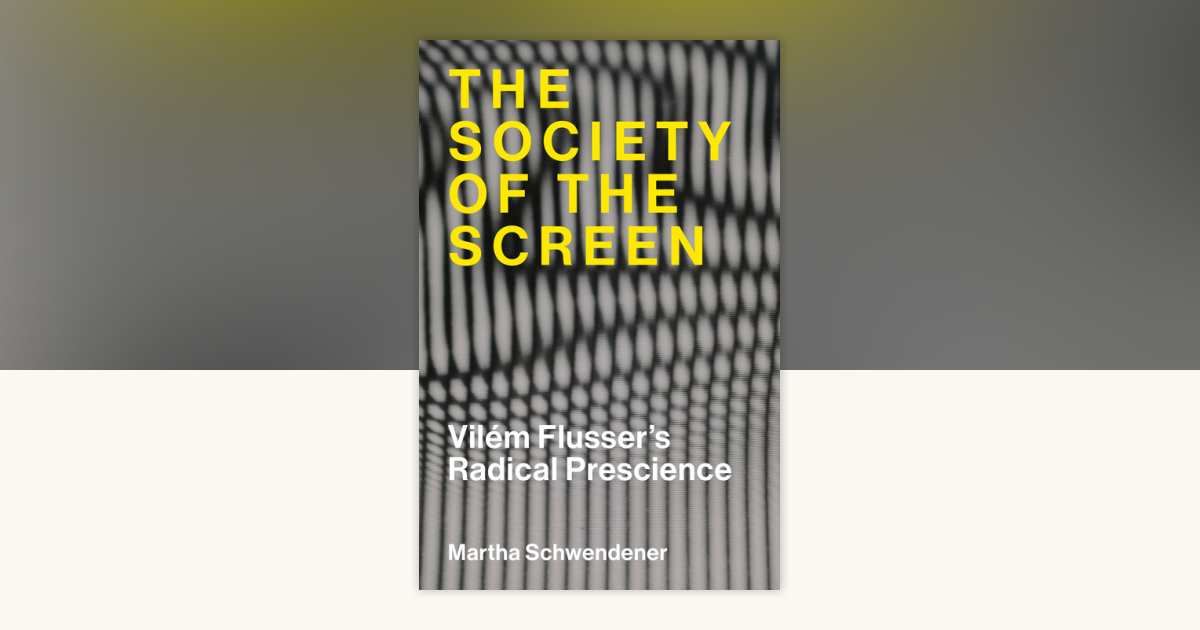
Art historian Martha Schwendener argues in her book The Society of the Screen: Vilém Flusser’s Radical Prescience (2026) that the shift toward synthetic images and AI automation risks turning humans into “functionaries” of an opaque algorithmic apparatus. According to Schwendener, the only way to maintain freedom is to understand the underlying program well enough to work against it.
What is the difference between technical and synthetic images?
The distinction lies in the level of human control and the nature of the apparatus used to create the image. According to Schwendener, “technical images” are those produced by a technological apparatus but still tied to a human operator, such as those created via film, television, or a camera. Artists like Joan Fontcuberta exemplify this relationship.
Synthetic images, by contrast, belong to the era of computers and automation. These images are generated by programs where the human is no longer necessarily at the controls. Schwendener points to the work of Harun Farocki, whose focus on automation aligns with Flusser’s theory of the synthetic. While a technical image is a result of a human using a tool, a synthetic image is a result of a program executing a code.
- Technical Images: Driven by camera and operator; involves a human “triggering” the apparatus (e.g., traditional photography).
- Synthetic Images: Driven by computation and automation; the apparatus can generate the image—and the prompt—independently.
How does AI turn users into “functionaries” of an apparatus?
Users become functionaries when they operate within a system without understanding its program. Schwendener states that if a person isn’t aware of how social media or AI algorithms work, they simply respond to the program’s inducements—buying, liking, or hating based on algorithmic prompts.

This creates a state of “automatic totalitarianism.” According to Flusser’s 1984 essay “Photo Criticism,” the danger isn’t just the image itself, but the “complex co-implications between man and apparatus.” In the context of modern Large Language Models (LLMs), this is compounded by the fact that training data is overwhelmingly Western and English-centric, baking specific cultural and political biases into the “black box” of the code.
Can artists prevent “automatic totalitarianism” in AI?
Yes, provided they act as programmers who create “improbable situations.” Schwendener notes that Flusser saw artists as those best equipped to work against the program of the apparatus. Rather than just using a tool, the artist challenges the logic of the tool itself.
Schwendener cites the work of Mira Schendel, particularly her “Graphic Objects” and typewriter drawings from the 1960s and ’70s. Schendel created what Flusser called “pre-texts”—fragments of letters that exist before they cohere into linear writing. By treating language as a spatial surface rather than a linear instrument, artists can break the “linear track of history” that traditional writing imposes.
In the current era of “vibe-coding,” where language prompts replace traditional programming, the role of the artist shifts. The goal is no longer just to produce a creative output, but to expose the machinery of the prompt and the apparatus.
Why is the “black box” of LLMs a risk to freedom?
The “black box” refers to the opacity of algorithmic coding. When the logic of an AI is hidden, users cannot challenge the outputs or understand why certain conclusions are reached. Schwendener warns that we are entering a “post-truth” moment where algorithms may convince users that the black box is actually transparent.
She identifies a progression in how AI transparency is framed:
- Black Box: Completely opaque coding.
- Gray Box: Partially obscured logic.
- Glass Box: Theoretically transparent.
- Lightly Frosted Glass Box: A state where users see the “shadows” of inputs and outputs, but the actual coding remains hidden.
According to Schwendener, this opacity leads to a “ritual hallucination.” While AI researchers use the term “hallucination” to describe factual errors, Flusser used it to describe the bewitching quality of technical images that lure humans back into a state of magical, uncritical thinking.
Will dialogue survive in systems designed to simulate it?
Dialogue is one of the few remaining tools for resisting algorithmic automation. Schwendener argues that dialogue is not secondary to the system but is a primary method for remaking inherited codes. While AI can simulate a conversation, true dialogue involves a collision of codes that produces something new.

The risk is that we continue asking “hermeneutic” questions—asking if an AI’s text is “accurate” or “creative”—rather than asking what apparatus produced it and what program it serves. By shifting the focus from the content of the AI’s response to the program behind it, users can reclaim agency.
Frequently Asked Questions
What is a “synthetic image” in AI terms?
A synthetic image is one generated by a computer program or algorithm without the direct, manual operation of a camera or human-led technical tool.
Who is Vilém Flusser?
Flusser was a philosopher and theorist who studied the relationship between humans, apparatuses, and the evolution of images and writing.
How can someone “work against the program” of an AI?
According to Schwendener and Flusser, this involves understanding the software’s logic and intentionally creating improbable or non-linear outputs that challenge the system’s intended function.
Join the conversation: Do you feel like a “functionary” of your social media algorithms, or have you found ways to work against the program? Share your experience in the comments below or subscribe to our newsletter for more insights on the intersection of art and technology.