
Enterprise-grade AI image generation in 2 seconds is here: Krea 2 Raw and Turbo available as open weights under custom license
Krea has released Krea 2 Raw and Krea 2 Turbo, two open-weight AI image models designed to eliminate “AI slop” by allowing enterprises to customize visual outputs. According to Krea, the Turbo version generates high-resolution imagery in two seconds, while the Raw version provides an unaligned foundation for custom training. Both models, built on a 12-billion parameter Diffusion Transformer, are now available for public download on Hugging Face.
Why did Krea release open-weight models to fight “AI slop”?
Many enterprises report that AI-generated visuals have become monotonous and non-distinct, a trend often described as “AI slop.” Krea aims to reverse this by offering models that prioritize visual variety and high prompt accuracy over a standardized “house style.”

The company provides two distinct checkpoints to solve this. Krea 2 Raw serves as a “blank canvas” without post-training alignment or RLHF, making it ideal for structural training. Krea 2 Turbo is a distilled variant optimized for speed and immediate execution. This “train on Raw, generate with Turbo” workflow allows studios to bake specific brand assets or architectural styles into a LoRA using the Raw model and then deploy those styles in the high-speed Turbo environment.
How does Krea 2 Turbo compare to other AI image generators?
Krea 2 Turbo positions itself as one of the fastest open-weight options available. Data from Artificial Analysis, Krea, and MindStudio shows a fragmented latency landscape among top-tier models.
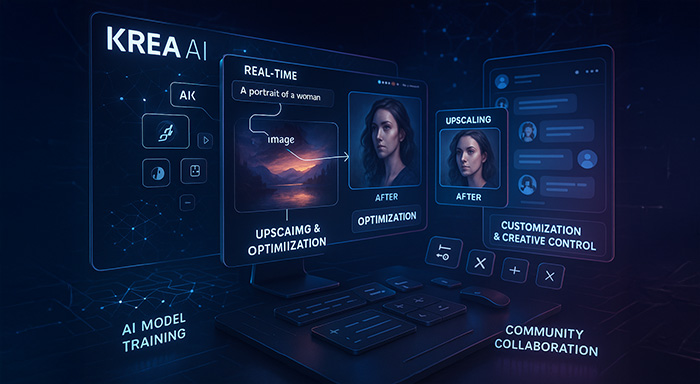
Krea 2 Turbo hits a 2.0-second median generation time. This is slower than FLUX.1 [schnell], which reaches 0.5 seconds via Prodia, and Z-Image Turbo at 1.8 seconds. However, it significantly outperforms Midjourney v8.1 in Turbo Mode (3–6 seconds) and the professional-grade FLUX.2 [pro] (11.1 seconds).
| Model | Avg. Gen Time | Licensing |
|---|---|---|
| FLUX.1 [schnell] | 0.5s | Apache 2.0 |
| Krea 2 Turbo | 2.0s | Community/Enterprise |
| Midjourney v8.1 (Turbo) | 3–6s | Proprietary |
| GPT-Image-2 | 200.8s | Proprietary |
What are the technical specifications of the Krea 2 architecture?
Krea built the model from scratch using a Diffusion Transformer scaled to 12 billion parameters. The engine uses a single-stream transformer block where attention and MLP layers are shared between text and image tokens, according to Krea’s technical documentation.
To increase efficiency, the team implemented a SwiGLU MLP layer with a 4x expansion factor and Grouped-Query Attention (GQA). They also replaced traditional per-block MLP modules with a lightweight tunable bias term, which Krea claims reduced block modulation parameters by 20% to 30%.
The training data mix avoids synthetic images to prevent quality degradation. Krea used DINOv3 and SigLIP-2 architectures to purge synthetic data at scale. Instead of standard aesthetic filters, they trained a Sparse Autoencoder (SAE) on SigLIP-2 embeddings to remove visual artifacts without stripping away artistic intent like motion blur.
Who can use Krea 2 for commercial purposes?
The models operate under the Krea 2 Community License Agreement. Individual creators and small companies can use the open weights to build apps or monetize imagery without royalty fees. Krea explicitly states it does not claim copyright over user-generated content.
The license changes for larger organizations. Any entity requiring more than 50 seats, Single Sign-On (SSO), or custom Data Processing Agreements (DPAs) is classified as an Enterprise and must negotiate a paid contract. API access remains a separate paid service billed in microdollars per generation.
Unlike permissive MIT or Apache 2.0 licenses, Krea mandates that all self-hosted deployers implement technical safeguards. The contract requires active filters to prevent the generation of child sexual abuse material (CSAM), non-consensual intimate imagery (NCII), or defamatory assets. Failure to do so constitutes a breach of contract, giving Krea the right to revoke access.
How has Krea evolved from a tool provider to a model lab?
Founded in 2022 by Víctor Perez and Diego Rodriguez Prado, Krea began as a UI layer for third-party AI engines. The San Francisco startup has since raised $83 million from investors including Andreessen Horowitz and Bain Capital Ventures.
The company shifted toward proprietary research to reduce dependence on upstream providers. This evolution included the July 2025 release of a custom FLUX.1 checkpoint and the October 2025 launch of Krea Realtime 14B. As of June 2026, the company reports a user base of 30 million people across 191 countries.
Krea’s enterprise adoption is already visible in professional sectors. The creative services platform Superside reportedly routes 80% of its AI production through Krea. Additionally, the firm partnered with architecture studio Henning Larsen to develop design tools compliant with the EU AI Act.
Frequently Asked Questions
What is the difference between Krea 2 Raw and Turbo?
Raw is an unaligned base model used for training custom styles (LoRAs). Turbo is a distilled version used for fast, high-quality image generation.
Is Krea 2 free for commercial use?
Yes, for individuals and companies with fewer than 50 seats under the Community License. Larger enterprises require a paid contract.
Where can I download the Krea 2 weights?
The weights are available for public download on Hugging Face.
How fast is Krea 2 Turbo?
It generates native 2k resolution imagery in approximately 2 seconds on standard consumer hardware.
Do I have to implement safety filters if I host the model?
Yes. The Krea 2 Community License legally binds deployers to implement classifiers that block illegal or harmful content.
What do you think about the shift toward “unaligned” models for creative work? Does the 50-seat limit for free commercial use feel fair? Let us know in the comments or subscribe to our newsletter for more AI infrastructure updates.