
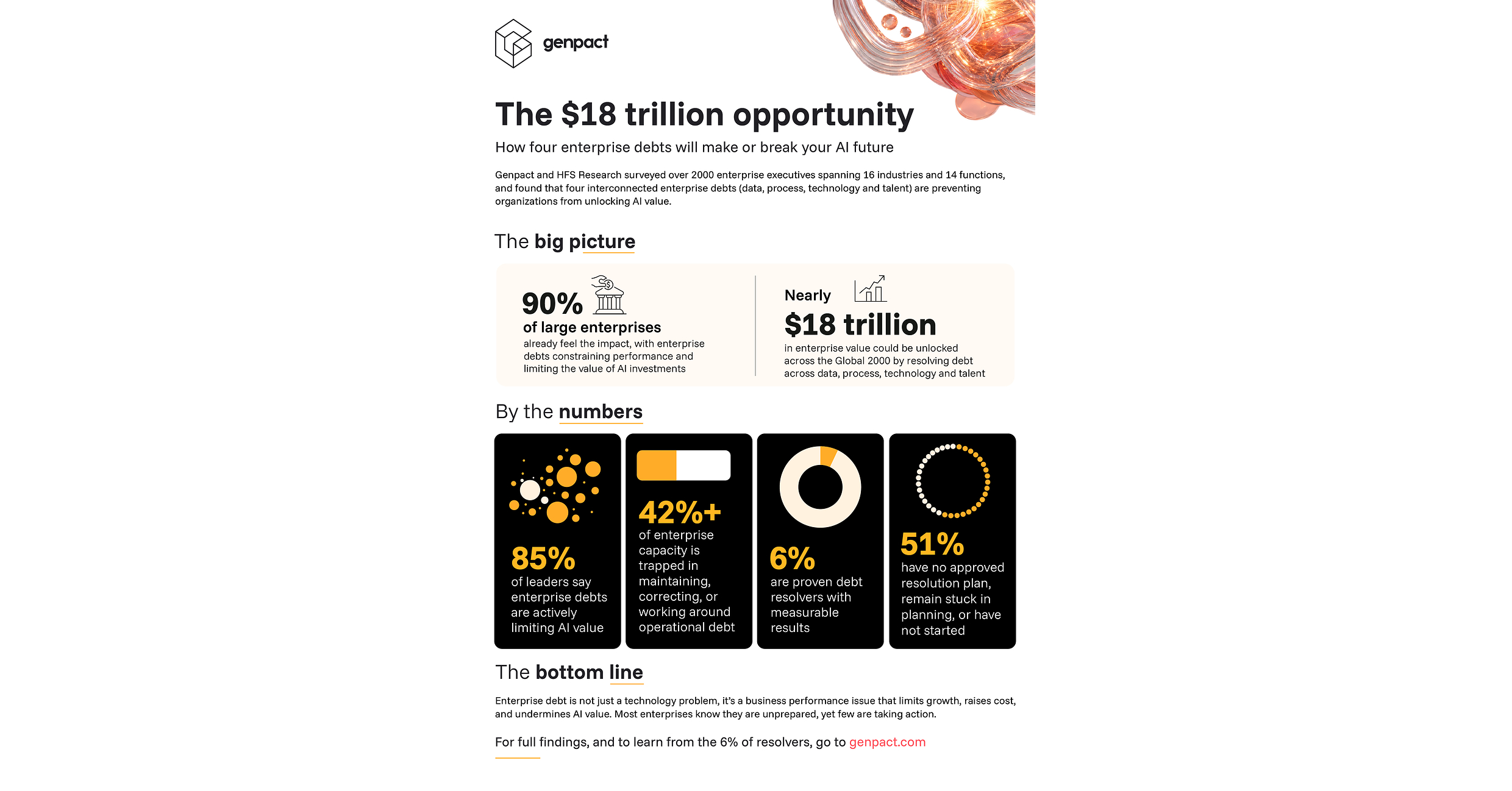
Enterprises Are Sitting on $18 Trillion in Trapped AI Value. New Research Shows How to Unlock It
Global 2000 companies are missing out on nearly $18 trillion in recoverable value because of four interconnected enterprise debts: data, process, technology, and talent. A June 2026 study by Genpact and HFS Research, which surveyed over 2,000 executives across 16 industries, reports that 85% of leaders believe these debts are actively obstructing their artificial intelligence initiatives. While organizations are currently directing roughly 13% of their functional budgets toward AI, the research indicates that failure to address these foundational weaknesses limits potential annual revenue growth by 8% and prevents a possible 16% reduction in annual costs.
Did You Know? Only 6% of the organizations surveyed have successfully established and measured results from programs designed to resolve these enterprise debts at scale.
The Four Constraints on AI Performance
The research defines enterprise debt as the cumulative performance drag caused by outdated technology, ineffective processes, poor data quality, and underprepared staff. These four categories are not isolated issues but rather compounding factors that create a structural limit on business performance.
Data debt represents the most significant barrier, with only 33% of enterprise data currently considered AI-ready. This lack of quality is cited as the primary reason for failure in 42% of analytics and AI projects. Simultaneously, process debt—defined as manual and ungoverned work flows—results in the loss of approximately 40% of employee time each week. When AI is applied to these inefficient processes, it typically executes flawed steps at a faster rate rather than improving output.
Technology debt acts as a tax on innovation, as core systems average 10 years in age and consume 42% of developer capacity just for maintenance. Finally, talent debt, where only 32% of the workforce is deemed AI-ready, acts as a force multiplier that slows down every effort to address the other three categories.
Why Foundation Matters More Than Spend
The financial stakes are distributed unevenly across sectors, with manufacturing and healthcare identified as having the largest potential for value recovery. Financial services firms, meanwhile, face the highest concentration of data debt. According to Balkrishan “BK” Kalra, CEO of Genpact, businesses cannot “out-innovate broken foundations,” noting that there is “no artificial intelligence without process intelligence.”

Expert Insight: The disconnect between the 6% of “proven debt resolvers” and the rest of the market suggests that the barrier to success is not a lack of diagnostic tools, but a failure of execution. The current trend of “masking” structural weaknesses with additional technology spending may be creating a false sense of progress while the underlying operational debt continues to grow, according to Phil Fersht, founder and CEO of HFS Research.
What May Happen Next
As organizations continue to pour capital into AI, the gap between those who resolve their enterprise debts and those who do not is expected to widen. Analysts anticipate that companies that prioritize process intelligence over raw technology spend could gain significant market share. Conversely, those that continue to ignore these foundational gaps may find that their AI investments act as a net negative on productivity, as they essentially automate existing inefficiencies. Future adoption cycles will likely favor firms that treat debt resolution as a funded, permanent operational mandate rather than a one-time IT project.
Frequently Asked Questions
What are the four enterprise debts?
The four debts are data, process, technology, and talent. Each contributes to an accumulated drag on business performance that limits the effectiveness of AI implementation.
How much value is at risk?
The research identifies nearly $18 trillion in recoverable enterprise value that is currently locked within Global 2000 companies due to these unresolved debts.
Why is talent debt considered a major issue?
Talent debt refers to the gap between the current workforce and the human-agent operating model required by AI. Because only 32% of the workforce is currently AI-ready, this debt slows down the resolution efforts for all other enterprise debts.
How do you believe your organization prioritizes foundational process improvement compared to new technology acquisition?