
Environmental damages of the top ten percent consumers exceed global climate and biodiversity funding gaps
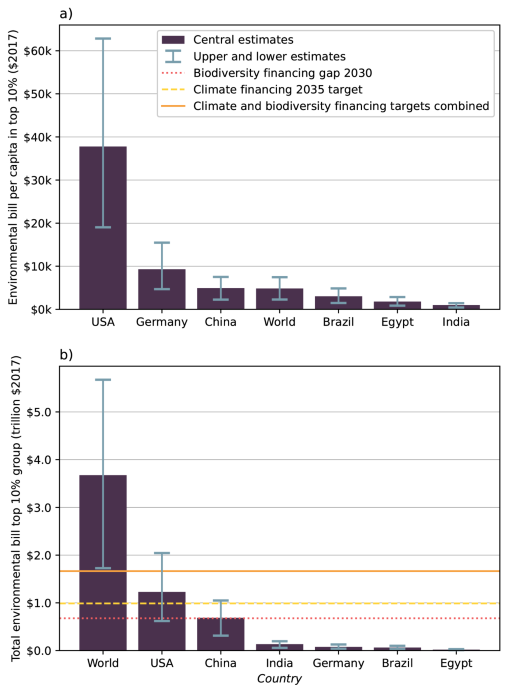
Environmental damage costs for the top 10% of global consumers range from $2.3k to $7.5k per person annually, totaling between $1.7 trillion and $5.7 trillion worldwide, according to 2017 data. The United States recorded the highest per capita costs, ranging from $19k to $63k per person.
How do environmental costs differ between the USA and India?
The environmental bill for top consumers in the USA is consistently the highest globally. These costs represent 6% to 20% of their income or 0.8% to 3% of their wealth, according to the report.
In contrast, the bill for top consumers in India ranges from $410 to $1.4k. This equals 0.8% to 2.8% of their income or 0.2% to 0.5% of their wealth.
What are the primary drivers of the global environmental bill?
Biodiversity loss and climate change are the two main components of the total damage. Biodiversity loss constitutes 47% to 56% of the global bill, while climate change accounts for 36% to 45%.
Nitrogen contributes 6% to 8% of the total. Water and phosphorus both account for less than 2% of the damages.
How could these costs fund climate and biodiversity targets?
The potential revenue from environmental taxes on the top 10% is high. Lower estimates for the USA and China each cover the $675 billion biodiversity financing gap needed by 2030.
The central estimate for the USA surpasses the $993 billion per year required for climate action by 2035. The report suggests these funds could be used to finance necessary transitions.
What happens next for environmental taxation?
Policy focus may shift toward the top 10% of consumers to improve equity. In low-income countries, any carbon tax is likely to be progressive.
In high-income nations, uniform taxation could be regressive unless revenues are recirculated. Taxes targeting luxury consumption rather than basic goods may reduce inequality and emissions more effectively, though they might generate less total revenue.
A wealth tax on the top 1% could be a possible next step to finance climate investments. Such a move may decrease wealth inequality while addressing the burden of climate damages on lower-income communities.
Frequently Asked Questions
- What are the biggest contributors to the global environmental damage bill? Biodiversity loss (47–56%) and climate change (36–45%) are the largest contributors.
- How does the environmental bill of the USA top 10% compare to their wealth? The cost ranges from $19k to $63k per person, which is 0.8% to 3% of their wealth.
- Why is biodiversity pricing more uncertain than carbon pricing? Biodiversity valuation depends on specific ecosystem types, locations, and recreational values, whereas CO2 prices are constant across countries.
Would you support a luxury-specific environmental tax if the revenue funded green government investments?