
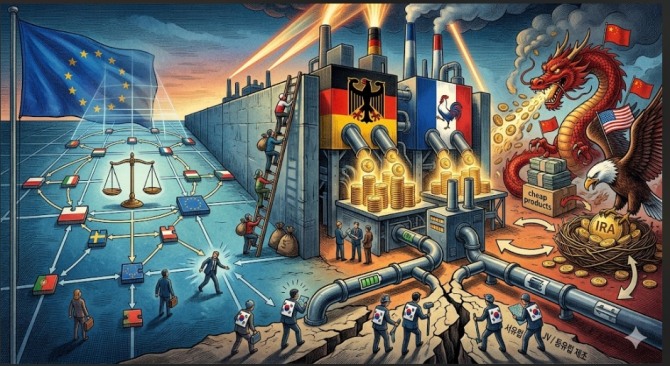
EU Shifts to State-Led Economy: Redrawing the Global Investment Map
The Death of the Single Market? How Europe’s Subsidy War is Redrawing the Global Investment Map
For decades, the European Union’s “Single Market” was the gold standard of economic cooperation. The rules were simple: no state aid, no unfair subsidies, and a level playing field where the most efficient company won. But that era is officially over.
In a sudden and dramatic pivot, the EU is abandoning its long-held taboo on state subsidies. Driven by the fear of losing out to the U.S. Inflation Reduction Act (IRA) and China’s state-backed industrial dominance, Europe has entered a phase of “Subsidy Synchronization.” We are witnessing the birth of a state-led economic system in the heart of Europe.
The Fiscal Divide: A Game of ‘Who Has the Deepest Pockets’
The most alarming trend of this new regime is the emergence of a two-tier Europe. When the rules of the Single Market are relaxed, the advantage shifts from the most efficient producer to the most wealthy government.
Germany and France, with their massive fiscal reserves, are now the primary magnets for global investment. Data shows that Germany alone accounts for nearly 25% of all EU state aid. For a global corporation, the question is no longer “Where is the best place to build a factory?” but “Which government can write the biggest check?”
The ‘Squeeze’ on Smaller Member States
This shift is creating a dangerous vacuum in Eastern and Southern Europe. Countries like Poland, Hungary, and Portugal—once the go-to hubs for low labor costs and strategic access—are finding themselves priced out of the competition. When France offers to cover 60% of a project’s cost through subsidies, a smaller nation’s competitive advantage in labor costs becomes irrelevant.
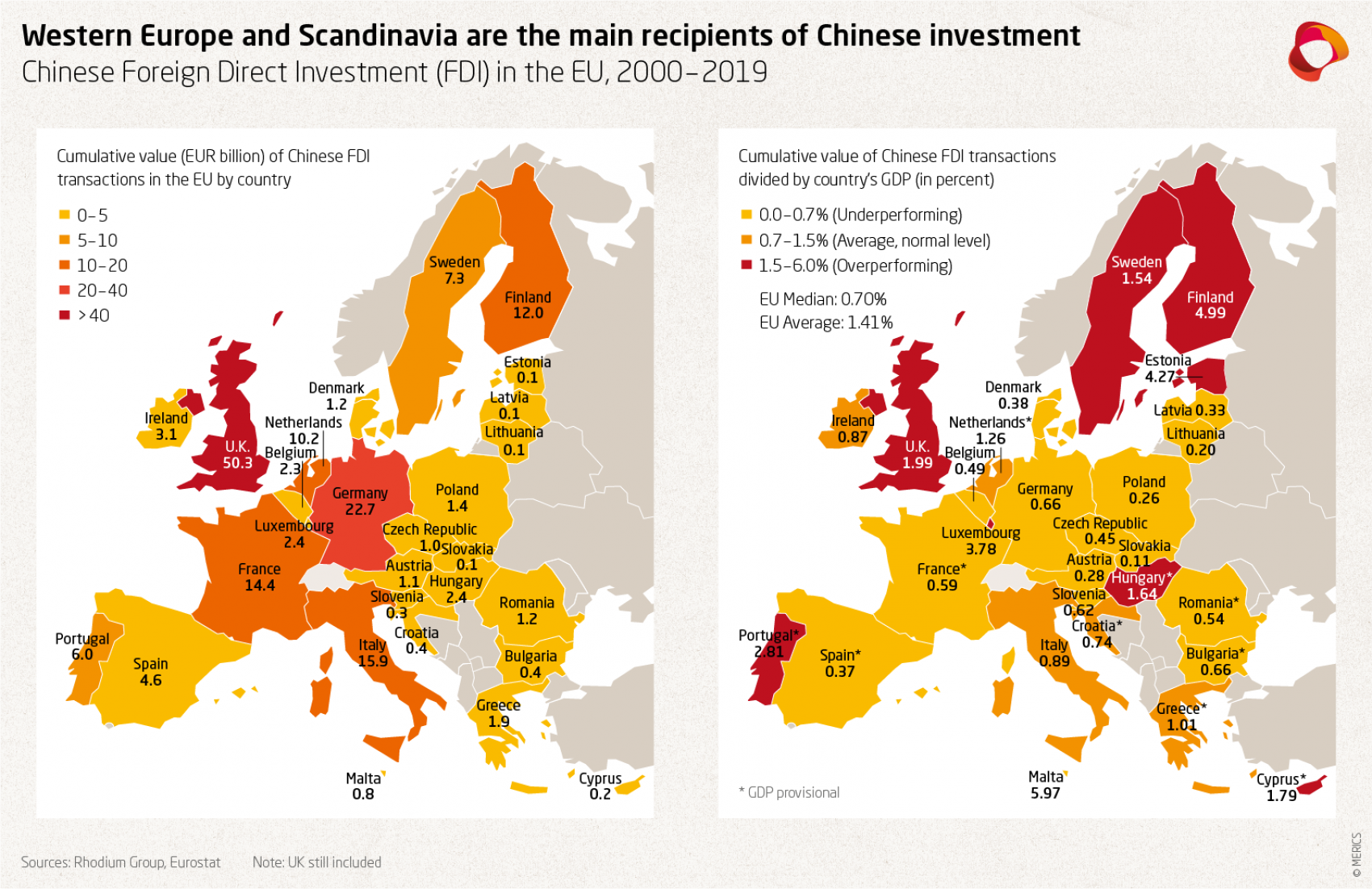
Take the example of the green steel industry. Companies are now weighing their options not based on the quality of the local energy grid or workforce, but on the sheer volume of government grants available in Western Europe. This is effectively dismantling the EU’s greatest strength: its unified, open market.
The New Playbook for Global Investors: The Dual Strategy
For industry giants—particularly in the battery, automotive, and green steel sectors—the old “East European Hub” model is breaking. The combination of rising energy costs in the East and massive OPEX (operating expense) subsidies in the West is forcing a strategic rethink.
We are seeing the rise of the “Dual-Track Investment Strategy.” Here is how the most successful firms are pivoting:
- The Subsidy Hub (West): Establishing Joint Ventures (JVs) in Germany or France to maximize CAPEX (capital expenditure) grants and secure long-term operating subsidies.
- The Production Base (East): Maintaining existing facilities in Eastern Europe for lean manufacturing, but limiting new, massive capital injections unless matched by local government incentives.
The Hidden Risks: Zombie Companies and Market Distortion
While subsidies look great on a balance sheet today, they carry a long-term systemic risk. By pumping billions into specific sectors, the EU may be creating “zombie companies”—firms that are only viable because of state support, not because they produce a superior product.
Critics argue that this “race to the bottom” in subsidy competition will stifle innovation. When a company is guaranteed 50% of its costs by the state, the incentive to optimize processes or innovate for efficiency vanishes. This mirrors the very “Chinese model” that Europe claims to be fighting against.
the implementation of the Carbon Border Adjustment Mechanism (CBAM) adds another layer of complexity. Companies must now balance state subsidies with the rising cost of carbon, making the “Green Transition” a high-stakes financial gamble.
Future Trends to Watch
As we look ahead, three key indicators will determine the stability of the European industrial landscape:
1. The Evolution of OPEX Subsidies
Until now, most aid focused on building the factory (CAPEX). However, if the EU begins to allow widespread subsidies for operating costs (electricity, wages), the migration of industry from East to West will accelerate violently.
2. The ‘Industry Electricity Price’ Battle
Keep a close eye on Germany’s energy price caps for industry. If these are extended indefinitely, it creates an artificial price floor that could crush competitors in neighboring countries who don’t have the budget to subsidize their power grids.
3. Asset Revaluation in Eastern Europe
Investors should prepare for a potential devaluation of assets in Eastern European hubs. If the “fiscal magnet” of the West becomes too strong, the strategic value of these older bases may diminish, requiring a sharp write-down or a pivot in usage.
Frequently Asked Questions
A: Primarily to compete with the U.S. Inflation Reduction Act (IRA) and China’s state-led industrial policies. Europe fears that without subsidies, its green tech and battery industries will migrate to the US or be undercut by Chinese imports.
A: It changes the investment math. Companies can no longer rely on a “single market” strategy. They must now negotiate country-by-country, leveraging their technology to win the best possible subsidy package from the wealthiest member states.
A: Not dead, but deeply wounded. While trade in goods remains free, the competitive conditions are no longer equal. We are moving toward a “fragmented union” where fiscal power dictates industrial success.
Join the Conversation
Is the EU’s shift toward state-led economics a necessary survival tactic or a fatal mistake that will destroy its internal unity?
Share your thoughts in the comments below or subscribe to our newsletter for weekly deep dives into global industrial shifts.