
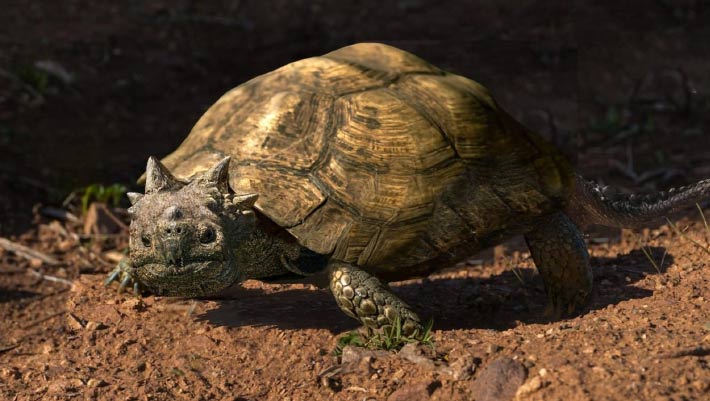
Fossil Discovery in Patagonia Reveals New Species of Horned Turtle
Paleontologists identified a new species of meiolaniform turtle, Patagoniaemys aeschyli, in northern Patagonia, Argentina. According to a study published March 26, 2026, in Acta Palaeontologica Polonica, this species lived between 72 and 67 million years ago and provides evidence that some turtle lineages survived the end-Cretaceous mass extinction.
What are the physical characteristics of Patagoniaemys aeschyli?
The specimen, recovered from the Los Alamitos Formation in the Río Negro province, includes limb bones, vertebrae, shell fragments, and the base of the skull. Dr. Federico Agnolin, a paleontologist at the Museo Argentino de Ciencias Naturales ‘Bernardino Rivadavia,’ and his colleagues estimate the turtle’s shell measured approximately 80 cm (2.6 feet) in length.

The researchers describe the shell as broad and relatively low. This differs from the more strongly domed shells found in some later relatives. The shell’s external surface features small grooves and pits, while the base of the peripheral plates contains a series of robust, thick bumps, particularly in the posterior marginal areas.
How did these turtles survive the mass extinction?
The discovery of Patagoniaemys aeschyli suggests the end-Cretaceous extinction event 66 million years ago did not severely impact turtles in Patagonia. By analyzing fossil diversity in the region, Agnolin and his team found taxonomic continuity between the Maastrichtian and Danian assemblages.
The researchers concluded that at least two meiolaniform lineages persisted across the boundary separating the Cretaceous and Paleogene periods. This indicates a scenario of lineage persistence with limited faunal turnover among southern chelonians, contrasting with the total extinction of non-avian dinosaurs during the same period.
Comparing Meiolaniform Lineages
While Patagoniaemys aeschyli shared a lineage with the horned Niolamia argentina, its morphology shows a distinct evolutionary path. The broad, low shell of P. aeschyli represents a different structural approach to protection than the high-domed shells seen in later meiolaniforms. According to the research team, these turtles were distributed across southern landmasses, including New Caledonia, Australia, and South America, from the Early Cretaceous to the Pleistocene.

Why does the Los Alamitos Formation matter?
The Los Alamitos Formation is a primary source of data for understanding the Late Cretaceous ecosystem. Because the P. aeschyli specimen includes multiple skeletal elements, it is one of the most informative meiolaniform fossils found in the region. This level of preservation allows scientists to map the evolutionary transition of turtles more accurately than fragmented finds allow.
.png/250px-Patagoniaemys_aeschyli_(holotype_shell%2C_MPMIK_1839-P-33).png "Why does the Los Alamitos Formation matter?")
Frequently Asked Questions
Where was the new turtle species found?
The fossils were unearthed from the Los Alamitos Formation in Argentina’s Río Negro province, located in northern Patagonia.
When did Patagoniaemys aeschyli live?
It lived during the Maastrichtian age of the Late Cretaceous epoch, specifically between 72 and 67 million years ago.
Did the asteroid impact kill these turtles?
According to the study in Acta Palaeontologica Polonica, evidence suggests the extinction event did not severely impact Patagonian turtles, as several lineages persisted into the Paleogene period.
Want to stay updated on prehistoric discoveries? Share your thoughts on these ancient survivors in the comments below or subscribe to our newsletter for more deep dives into paleontology.