
French Navy Submarine Schools: ENSM Brest and Toulon’s Training Programs
The French Navy’s École de navigation sous-marine (ENSM) in Brest trains crews for nuclear-powered ballistic missile submarines (SNLE), while its Toulon branch focuses on attack submarines (SNA) and aircraft carrier propulsion specialists, according to Captain of Frigate Maxime, who commands the Brest site since August 2025.
The ENSM in Brest, which hosts 800 trainees annually, uses full-scale simulators for SNLE crews, including those for the second-generation Triomphant-class submarines. These vessels, part of the Force océanique stratégique (Fost), have operated continuously at sea since 1972, with at least one always on patrol to deter nuclear threats. The SNLEs carry 16 intercontinental ballistic missiles, each armed with nuclear warheads, and are based at Île Longue in Brest harbor.
The Toulon-based SNA fleet, currently being replaced by the Suffren-class, includes attack submarines capable of covert operations, targeting surface ships, and launching naval cruise missiles. These SNA also support special operations and provide security for the SNLEs, according to Maxime.
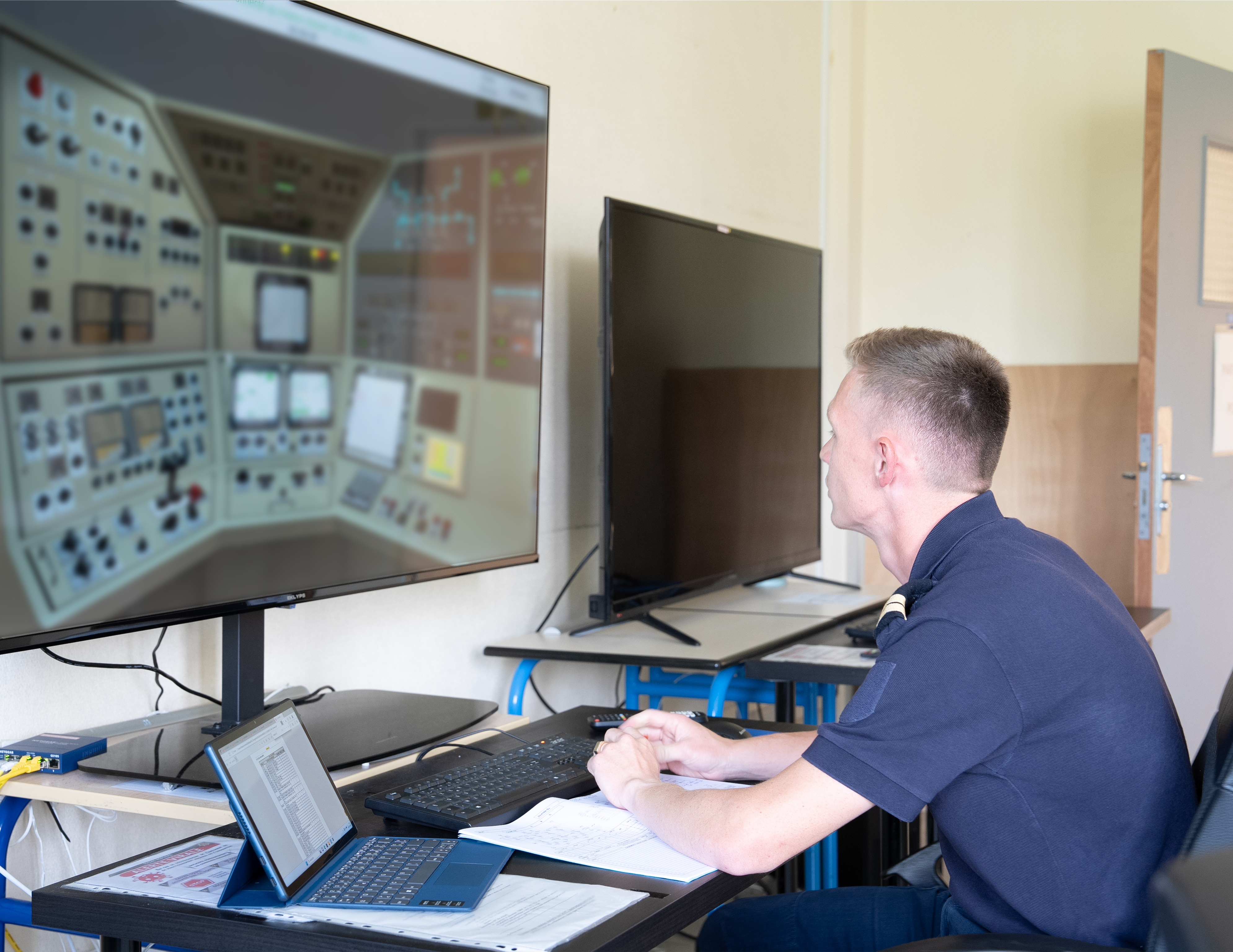
Trainees at ENSM Brest undergo four weeks of generic training before specializing in roles such as acoustic surveillance or propulsion systems. Advanced training includes simulators with virtual reality elements, designed to replicate submarine control stations. Full-scale simulators at the nearby SNLE escadrille allow trainees to practice maneuvers like “reprise de vue,” which involves surfacing to deploy sensors.
Future upgrades include simulators for the third-generation SNLEs, starting in 2033, as the first of these, L’Invincible, is under construction for deployment by 2036. The ENSM also partners with civilian institutions to train “apprenti militaire” students in nuclear maintenance, with the first cohort starting in 2025.
The ENSM’s curriculum emphasizes technical mastery and teamwork, with trainees learning to interpret acoustic data and manage submarine safety protocols. Graduates may pursue specialized certifications through institutions like the École des applications militaires de l’énergie atomique (EAMEA), which handles nuclear propulsion training.
Trainees like Erwan, a cybersecurity graduate, and Guillaume, a former university student, describe the role as demanding but mission-critical. “It’s a sacrifice, but the importance of the work justifies it,” Guillaume said.
As the SNLE fleet transitions to third-generation vessels, the ENSM’s focus on advanced simulators and interdisciplinary training aims to prepare crews for evolving threats and technological shifts.
What is the role of the ENSM in Brest?
The École de navigation sous-marine in Brest trains crews for nuclear-powered ballistic missile submarines (SNLE), focusing on operations, safety, and navigation for vessels like the Triomphant-class. It also provides generic training for all submarine personnel before specialized roles.

How do SNA contribute to France’s military strategy?
Submarines nuclear d’attaque (SNA) support the SNLE fleet by conducting surveillance, protecting against underwater threats, and executing covert missions. They can also launch cruise missiles against land targets, expanding France’s tactical reach.
What changes are planned for SNLE training?
The ENSM will introduce simulators for third-generation SNLEs by 2033, ahead of the first unit, L’Invincible, entering service in 2036. These simulators will incorporate virtual reality to enhance training for new reactor systems and combat technologies.
What is the significance of the SNLEs in France’s defense? The SNLEs form the core of France’s nuclear deterrent, ensuring a continuous at-sea presence to respond to existential threats, as mandated by the 1972 strategic patrol policy.
How long does submarine training last? Initial training at ENSM lasts four weeks, followed by specialized programs lasting weeks to months. Additional certifications may take years, depending on the role.
What is the role of civilian partnerships in submarine training? Partnerships with institutions like EAMEA and civilian universities enable “apprenti militaire” programs, blending military and technical education for nuclear maintenance and propulsion roles.
How will the transition to third-generation SNLEs reshape France’s maritime strategy in the coming decade?