
Gene Therapy for Parkinson’s Disease: Clinical Advances and Challenges
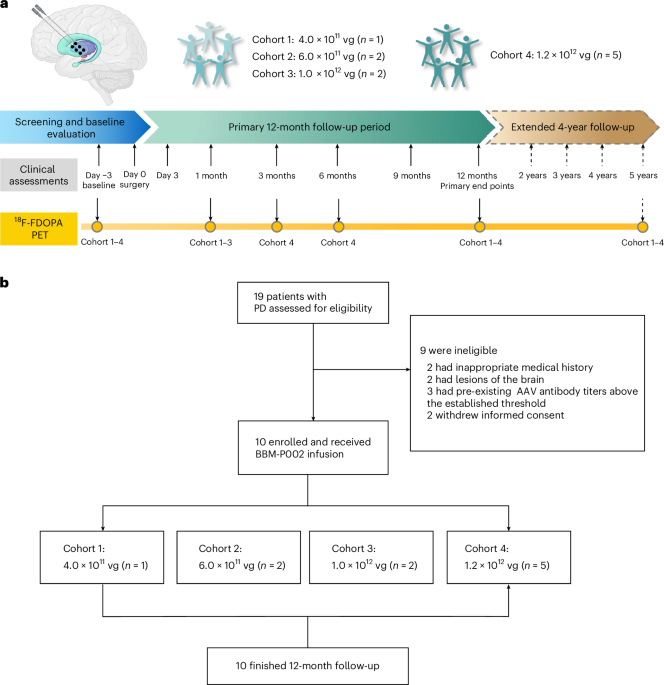
Gene therapy for Parkinson’s disease uses viral vectors, such as adeno-associated virus serotype 2 (AAV2), to deliver therapeutic genes directly into brain regions like the putamen. According to Winston et al. (2025) and Gao et al. (2024), these treatments aim to restore dopamine production or protect existing neurons, though researchers continue to evaluate long-term safety and delivery precision.
Clinical trials have tested several different genetic targets to manage the disease. AADC gene therapy focuses on the enzyme aromatic L-amino acid decarboxylase. According to Nutt et al. (2020), this approach enhances the patient’s response to levodopa.
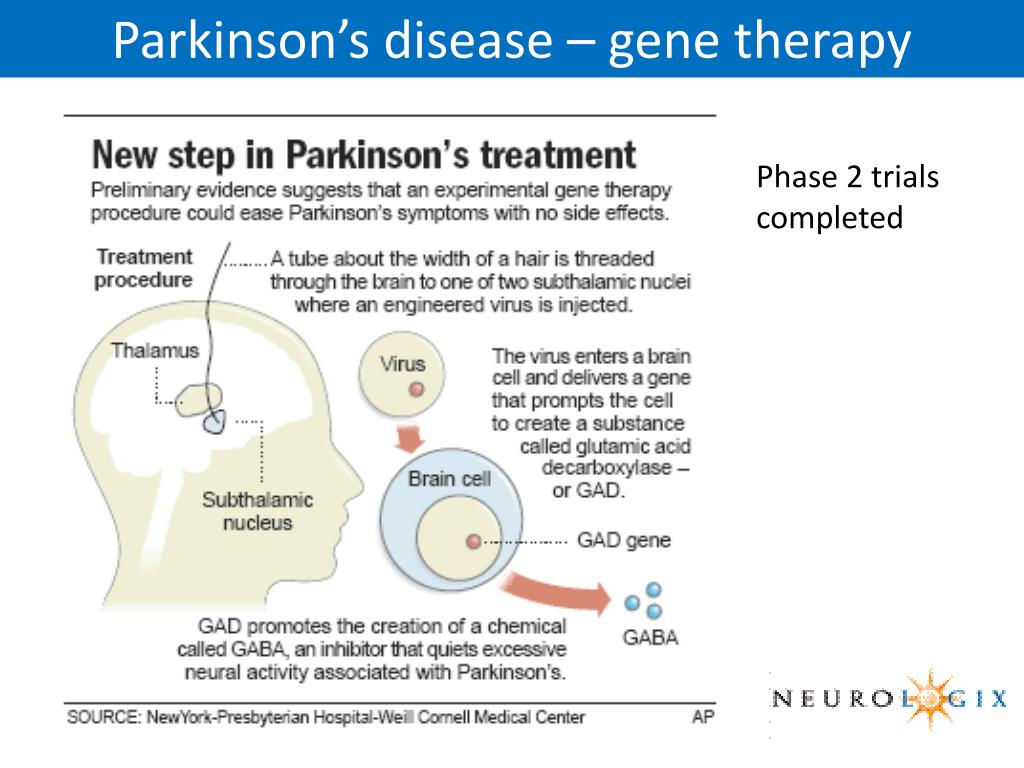
Other researchers have targeted the glutamic acid decarboxylase (GAD) gene. LeWitt et al. (2011) and Niethammer et al. (2018) report that AAV2-GAD gene therapy can reduce symptoms by reorganizing functional brain connectivity.
How do neurotrophic factors work in gene therapy?
Neurotrophic factors are proteins that support the survival and growth of neurons. Marks et al. (2008, 2010) and Warren Olanow et al. (2015) conducted trials using AAV2-neurturin (CERE-120) delivered to the putamen and substantia nigra to test safety and tolerability.
Recent research has expanded into other factors. Van Laar et al. (2025) investigated the intraputaminal delivery of AAV2-glial cell line-derived neurotrophic factor (GDNF) for patients with mild or moderate Parkinson’s disease.
Huttunen et al. (2023) also performed a phase 1 trial focusing on cerebral dopamine neurotrophic factor (CDNF) delivered to the putamen.
What are the safety risks of viral vectors?
Most CNS gene therapies use AAV vectors because they generally do not integrate into the host genome. However, lentiviral vectors, which do integrate, have been used in trials like the ProSavin study. Palfi et al. (2014, 2018) reported on the long-term safety and tolerability of this lentiviral approach.
Integration carries specific risks. Duncan et al. (2024) reported cases of hematologic cancer following lentiviral gene therapy for cerebral adrenoleukodystrophy. Williams (2024) further noted the occurrence of myelodysplasia after similar lentiviral treatments.
What happens next for CNS gene therapy?
Researchers may focus on improving the precision of delivery. Heiss et al. (2019) and Christine et al. (2019) have already utilized magnetic resonance imaging (MRI) to guide the delivery of gene therapies into the putamen.

Future efforts could expand beyond Parkinson’s disease. Tang et al. (2025) have explored hippocampus-targeted BDNF gene therapy to rescue cognitive impairments in mouse models of Alzheimer’s disease.
Clinical applications may also shift toward earlier intervention. Van Laar et al. (2025) suggest that targeting mild or moderate stages of Parkinson’s disease is a possible path for future trials.
Frequently Asked Questions
What is the primary goal of AADC gene therapy?
According to Nutt et al. (2020), AADC gene therapy is designed to enhance the response to levodopa in patients with Parkinson’s disease.
Which viral vectors are most commonly used in these trials?
The sources, including Gao et al. (2024) and Winston et al. (2025), frequently cite adeno-associated virus serotype 2 (AAV2) and lentiviral vectors.
What risk is associated with lentiviral vectors?
Duncan et al. (2024) and Williams (2024) report that lentiviral gene therapy has been linked to hematologic cancer and myelodysplasia.
Do you believe the potential for symptom reduction outweighs the risks of permanent genetic modification in the brain?