
HERMES: HiERarchical Modelling for Exoplanet Science
Beyond the Discovery Phase: The New Era of Exoplanet Characterization
For decades, the hunt for exoplanets was a numbers game. Astronomers focused on the “how many” and “where”—cataloging thousands of distant worlds and confirming their existence. But the narrative is shifting. We are moving from the era of discovery to the era of characterization.
The goal is no longer just to find a planet, but to understand what it is actually made of. This is where the European Space Agency’s (ESA) Ariel Space Mission comes into play. By analyzing the atmospheres of approximately 1,000 exoplanets, Ariel aims to move beyond individual “celebrity” planets and instead uncover the broad, population-level trends that govern how planetary systems form.
Decoding the Cosmic Recipe: Stellar vs. Planetary Metallicity
One of the most enduring questions in astrophysics is the relationship between a star and its planets. Specifically, does the chemical composition of a star (its metallicity) dictate the composition of the planets that orbit it?
In astronomy, “metallicity” refers to any element heavier than hydrogen and helium. If a star is rich in metals, does that mean its planets will have atmospheres thick with heavy elements? The answer isn’t a simple “yes.” Nature is messy, and “intrinsic scatter”—the random variation caused by different formation histories—often masks the underlying signal.
The Power of HERMES
To solve this, researchers have introduced HERMES (HiERarchical Modelling for Exoplanet Science). This isn’t just another piece of software; it’s a multidimensional Bayesian framework designed to find patterns in the noise.
HERMES allows scientists to probe correlations across multiple axes—such as planetary mass, stellar metallicity, and atmospheric composition—simultaneously. By using hierarchical modelling, it can separate the “true” cosmic trend from the measurement noise and the natural chaos of planetary birth.
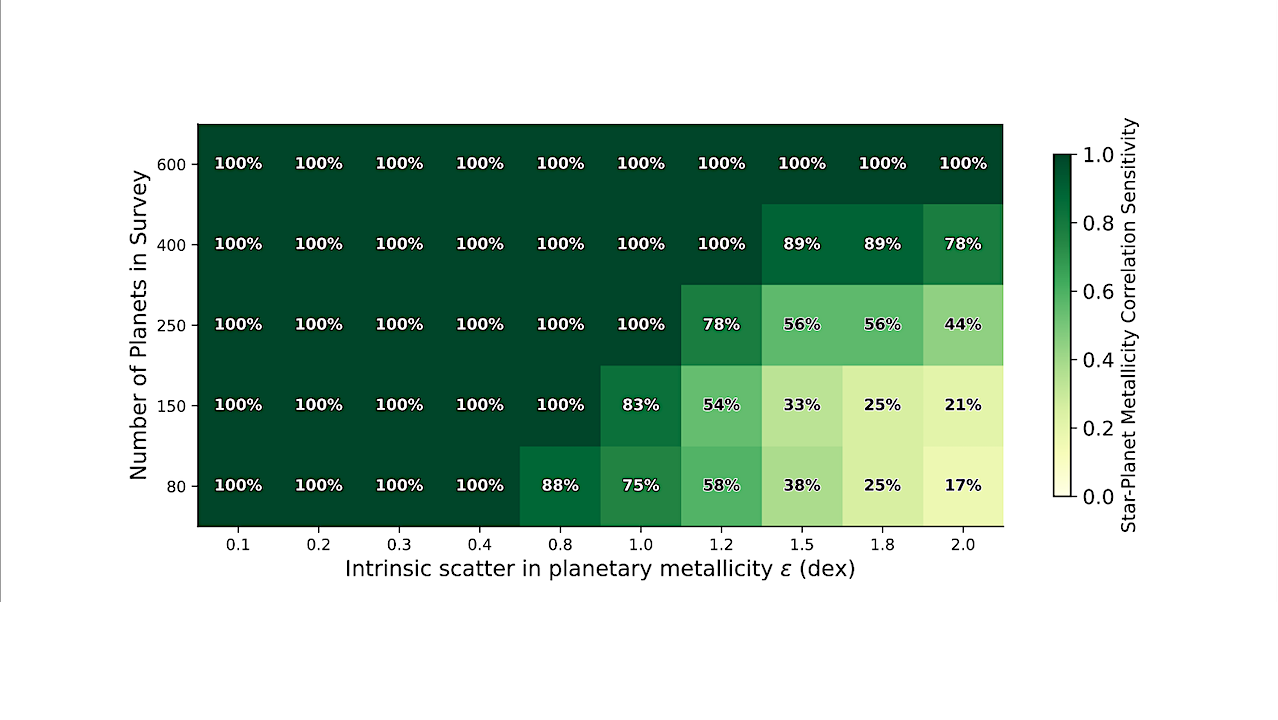
The data is clear: while small surveys often lose the signal when the scatter becomes too large, Ariel-scale samples (specifically those with 400 or more planets) can robustly recover these correlations. This suggests that the secret to understanding planetary evolution lies in scale.
Future Trends: Where Exoplanet Science is Heading
The implementation of tools like HERMES signals a broader trend in astrophysics: the marriage of Big Data and Bayesian statistics. Here is where the field is moving:
1. From Individual Case Studies to Statistical Populations
We are moving away from the “James Webb Telescope approach” of looking deeply at one planet and moving toward a “Census approach.” By analyzing a thousand worlds, we can determine if our Solar System is a cosmic fluke or a standard blueprint.
2. Predictive Planetary modelling
As Bayesian frameworks improve, we will eventually be able to predict a planet’s atmospheric composition simply by observing its host star and the planet’s mass. This will allow astronomers to “triage” targets, focusing the most powerful telescopes on the worlds most likely to harbor life-sustaining chemistry.
3. Integrating Machine Learning with Hierarchical Models
The next evolution will likely see HERMES-like frameworks integrated with neural networks. While Bayesian models are great for understanding why a correlation exists, AI can scan millions of data points to find where the correlation is hidden, speeding up the discovery of “Earth 2.0.”
For more on how these technologies are evolving, check out our deep dive into the future of space-based spectroscopy.
Frequently Asked Questions
What is the Ariel Space Mission?
Ariel is an ESA mission designed to survey the chemical composition of about 1,000 exoplanets, focusing on how their atmospheres relate to the stars they orbit.
Why is “metallicity” important in exoplanet science?
Metallicity tells us about the raw materials available during the formation of a planetary system. It helps scientists understand if a planet formed via core accretion or other gravitational processes.
What makes HERMES different from other models?
HERMES uses a hierarchical Bayesian approach, which allows it to handle “intrinsic scatter”—the natural variation between planets—without losing the overall statistical trend.
Can HERMES find life on other planets?
Not directly. HERMES is a statistical tool for population trends. However, by defining what a “normal” planet looks like, it helps scientists identify “anomalies” that could be signatures of biological activity.
Join the Conversation
Do you think we will find a twin of Earth within the next decade, or are we looking for something that doesn’t exist? Share your thoughts in the comments below or subscribe to our newsletter for the latest updates from the frontiers of space!