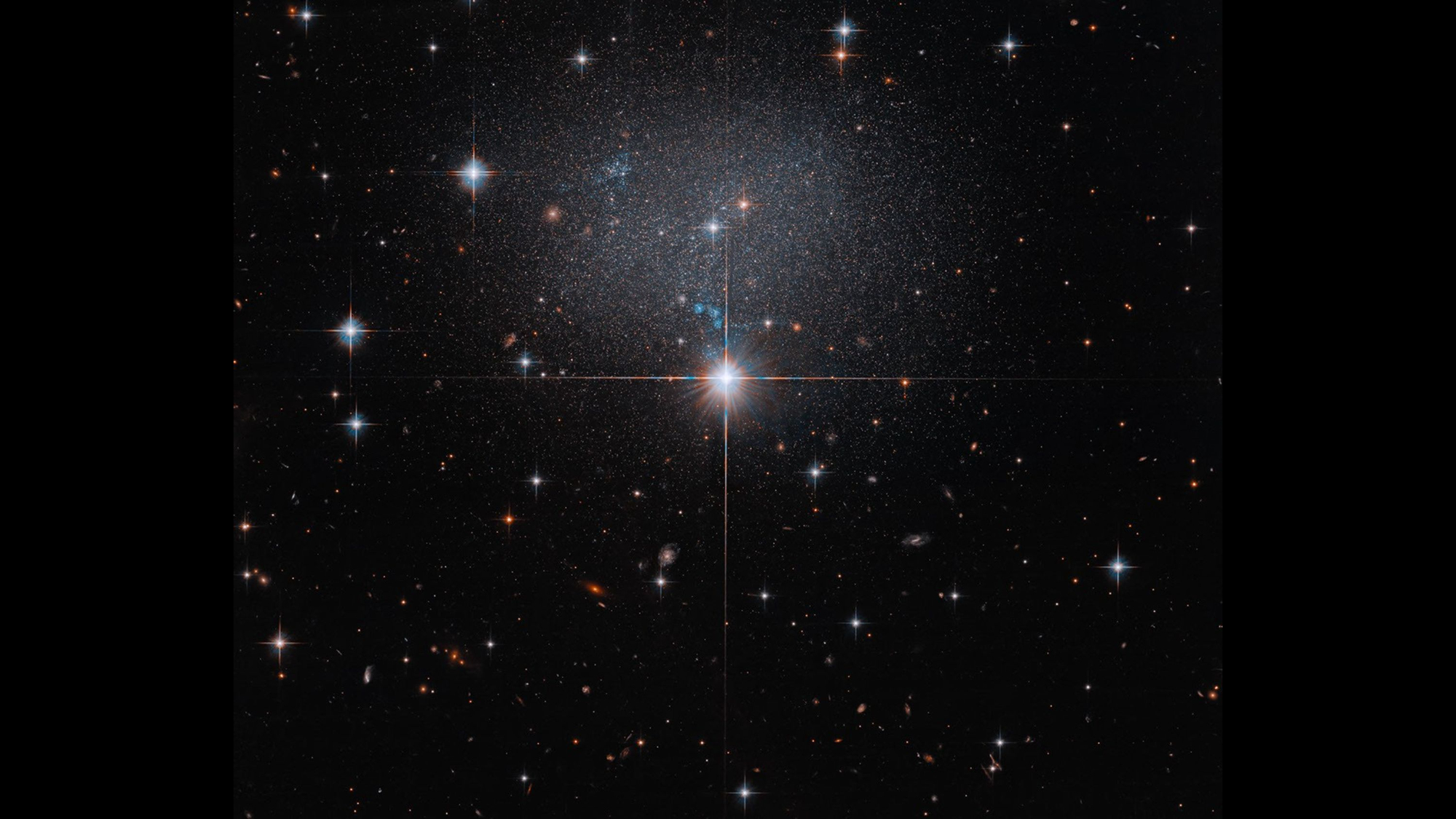
Hubble spies a swarm of stars in a strange, irregular galaxy photo of the day for 15, 2026
The Hubble Space Telescope has captured a high-resolution image of ESO 490-017, an irregular dwarf galaxy located 23 million light-years from Earth in the constellation Canis Major. According to NASA, the observation is part of a broader scientific initiative to map the “cosmic flow” of galaxies and measure how massive structures move across the universe.
Why Is ESO 490-017 Significant to Astronomers?
ESO 490-017 serves as a vital data point for mapping the large-scale structure of the cosmos. While its diameter spans only 12,000 light-years—dwarfed by the Milky Way’s 100,000-light-year expanse—its position provides context for local galactic movement. According to researchers at the University of Hawaii, studying these smaller, low-surface-brightness galaxies allows scientists to refine models of how gravitational forces influence galactic distribution. Unlike massive spiral galaxies, dwarf irregulars like ESO 490-017 often act as “tracers” that reveal the underlying dark matter currents pulling on visible matter.
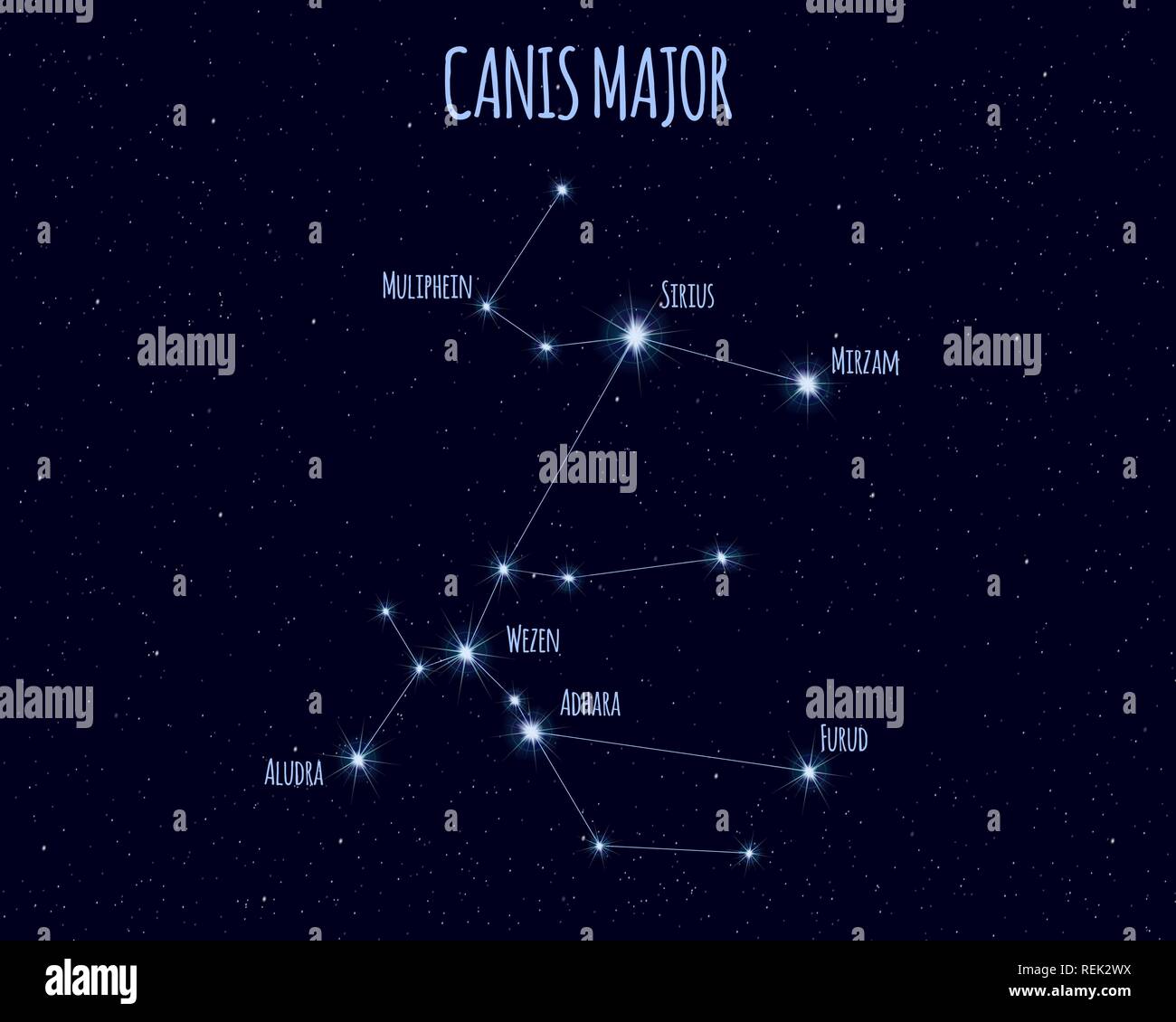
The constellation Canis Major is home to Sirius, the brightest star visible in our night sky. While Sirius is a mere 8.6 light-years away, ESO 490-017 sits significantly further, appearing in the same patch of sky from our perspective on Earth.
How Does Hubble Capture Distant Dwarf Galaxies?
Hubble captures these faint targets by utilizing long-exposure imaging that isolates light from distant, low-brightness objects against the backdrop of deep space. NASA image processor R. Kober notes that the telescope’s sensitivity allows it to distinguish the hazy, diffuse light of the dwarf galaxy from the sharp, diffraction-spiked foreground stars within our own galaxy. The background of the image also reveals distant, colorful galaxies, appearing as small red, orange, and beige smudges, which provide a “cosmic backdrop” for further extragalactic study.
What Are the Future Trends in Galactic Mapping?
Future research is shifting toward high-precision surveys that combine Hubble’s legacy data with upcoming missions like the Nancy Grace Roman Space Telescope. According to NASA, the objective is to move beyond static portraits of galaxies to create a dynamic “movie” of cosmic flow. While Hubble has provided the foundational imagery for decades, upcoming observatories are designed to scan wider swaths of the sky, allowing astronomers to see how thousands of galaxies—not just individual dwarfs—interact within the gravitational web of the universe.
Comparison: Hubble vs. Next-Generation Surveys
| Feature | Hubble Space Telescope | Upcoming Wide-Field Telescopes |
|---|---|---|
| Primary Strength | High-resolution, deep-field detail | Broad, large-area sky surveys |
| Data Focus | Individual galaxy dynamics | Large-scale cosmic structure mapping |
Frequently Asked Questions
- What defines a dwarf galaxy?
A dwarf galaxy is a small galaxy containing only a few billion stars, significantly fewer than the Milky Way’s 200–400 billion. - Why does the galaxy look hazy?
The “hazy” appearance is due to low surface brightness, meaning the stars are spread out over a large area rather than concentrated in a bright core. - How far is ESO 490-017?
It is approximately 23 million light-years away from Earth.
Have you ever tried to spot deep-space objects with a backyard telescope? Share your experiences or questions about galactic movement in the comments section below.