
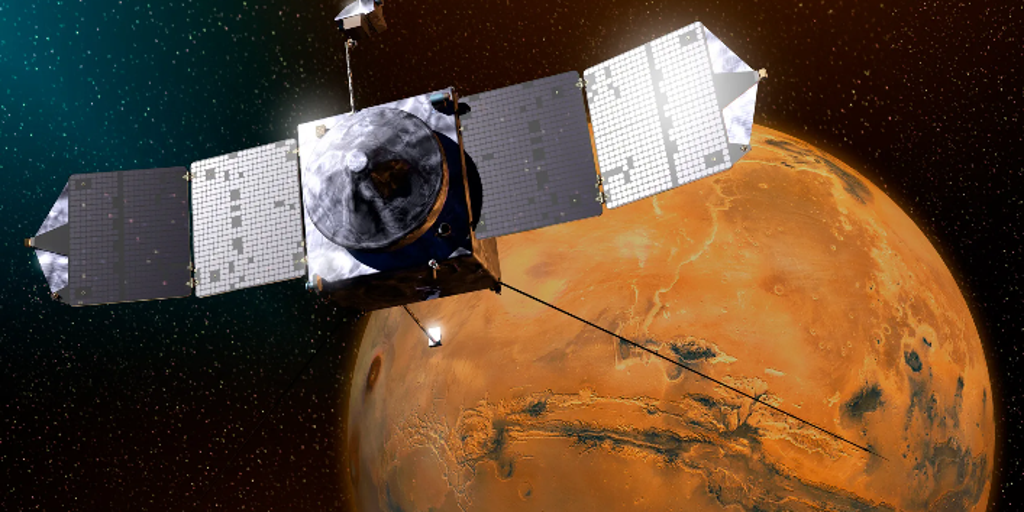
Iconic NASA spacecraft orbiting Mars declared dead after months of radio silence
NASA has concluded the MAVEN Mars mission after the spacecraft became unrecoverable following a loss of signal on Dec. 6. Launched in 2013, the Mars Atmosphere and Volatile Evolution mission provided 11 years of critical data on the Martian upper atmosphere to inform the safety of future human exploration.
Why did the MAVEN spacecraft fail?
The spacecraft experienced an unexpected loss of signal while passing behind Mars. According to NASA, the Deep Space Network (DSN) observed a brief fragment of data indicating the craft was in safe mode and rotating at an unusually high rate.

Officials concluded that this high rotation rate drained the batteries. This caused the communications system to lose power, rendering the spacecraft unusable. While the root cause is still being investigated, all systems were working normally leading up to the anomaly.
What is the significance of the MAVEN data?
MAVEN was the first mission dedicated to understanding the Martian upper atmosphere. NASA teams used the craft to observe how solar storms continually strip away the planet’s atmosphere.
This research explains how the Martian climate shifted from a potentially habitable world to the cold, dry landscape seen today. Louise Prockter, director of the Planetary Science Division at NASA Headquarters in Washington, stated that this science is key to determining radiation protection and safety measures for humans.
What may happen next for Mars exploration?
Scientists have begun standard procedures to archive the full mission data set. This information could provide valuable insights into Mars for decades to come.
Future efforts may rely on this data to aid in the human conquest and the possible establishment of a colony on Mars. The archived findings are likely to remain a foundation for developing safety protocols for astronauts.
Frequently Asked Questions
When did the MAVEN spacecraft launch?
The spacecraft launched on Nov. 18, 2013, via an Atlas V rocket from Cape Canaveral Air Force Station, Fla.
What caused the loss of communication with MAVEN?
According to NASA, a high rate of rotation drained the spacecraft’s batteries, which caused the communications system to lose power.
What was the primary goal of the MAVEN mission?
It was the first mission devoted to understanding the Martian upper atmosphere and observing how solar storms strip it away.
Do you believe the data gathered by MAVEN will be sufficient to ensure human safety on a future Mars colony?