
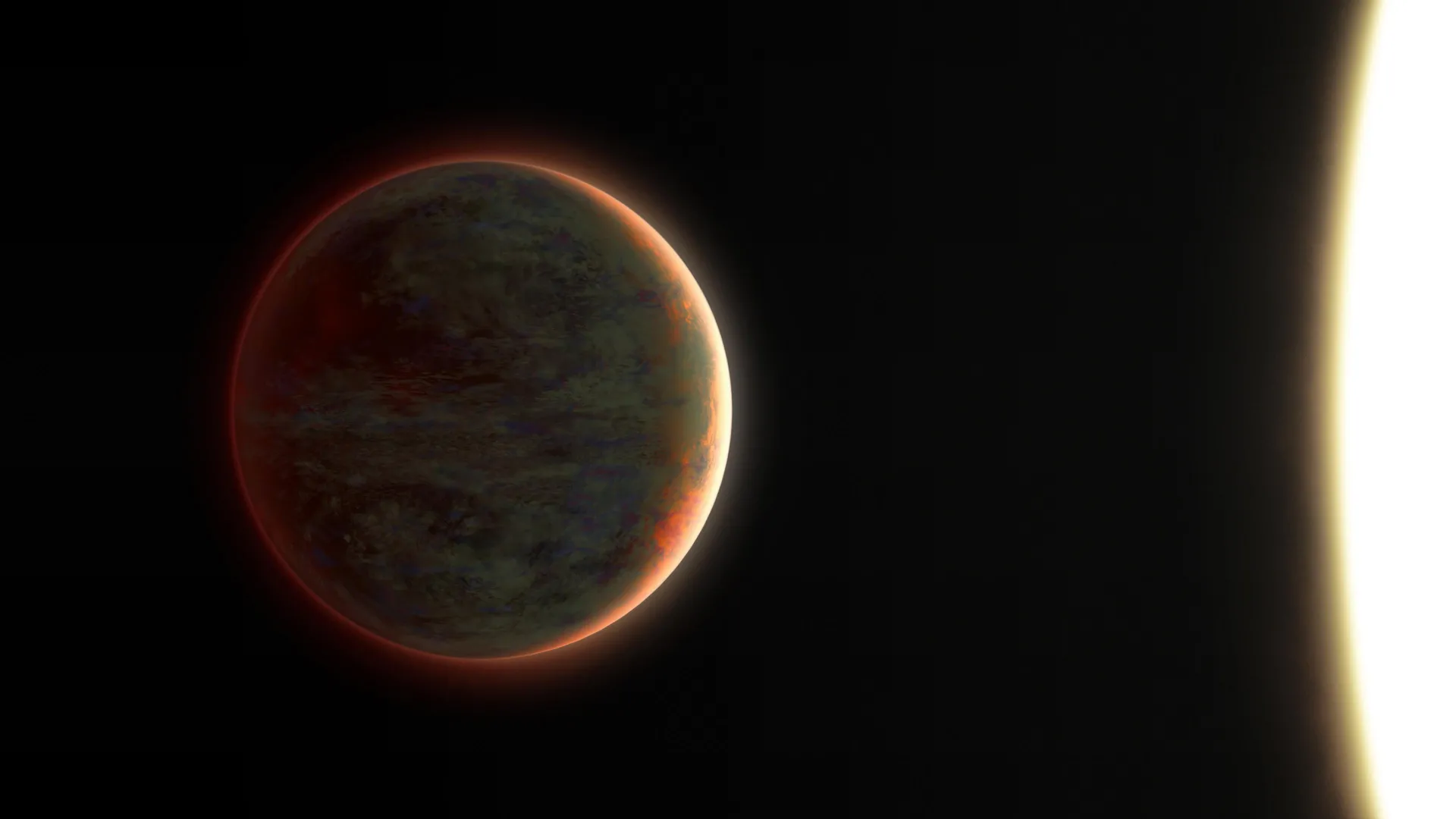
James Webb reveals two completely different twilights on an alien world
Astronomers using the James Webb Space Telescope (JWST) have confirmed significant temperature and chemical differences between the dawn and dusk regions of the ultra-hot exoplanet WASP-121 b. By analyzing infrared starlight as the planet transited its host star, researchers identified an atmospheric asymmetry caused by intense heat-transporting winds, providing the first clear observational evidence of distinct morning and evening terminators on a gas giant.
How JWST Maps Exoplanet Atmospheres
Researchers map the atmosphere of WASP-121 b by measuring how starlight absorption changes as the planet rotates during its transit. According to Cyril Gapp of the Max Planck Institute for Astronomy (MPIA), this technique allows scientists to probe the atmosphere longitude by longitude. Because the planet rotates roughly 30 degrees during a transit, instruments like the NIRSpec spectrograph can distinguish between the leading morning terminator and the trailing evening terminator. Data indicated the evening side absorbs more light than the morning side, a result that aligns with theoretical models of eastward-moving atmospheric winds.
Why Does WASP-121 b Have Different Temperatures?
The temperature disparity between the two sides of the planet is a direct result of tidal synchronization. Co-author Tom Evans-Soma of the University of Newcastle notes that WASP-121 b is an “extreme” case, with the permanent day side reaching approximately 2,770 Kelvin (2,500 degrees Celsius) and the night side hovering near 1,000 Kelvin (725 degrees Celsius). Powerful winds carry heat from the day side toward the evening terminator, causing the atmosphere to expand. This expansion increases the planet’s cross-section, which explains the heightened light absorption observed by the NIRSpec instrument.
Are Clouds Changing the Data?
While computer simulations successfully reproduced the general asymmetry, the observed effect was stronger than initial models predicted. Researchers, including those from the University of Queensland and Johns Hopkins University, suggest that mineral-based clouds—likely composed of silicates—may be creating a cooling effect on the morning terminator. These clouds could block infrared radiation from hotter, deeper layers of the atmosphere. When the team adjusted their models to include approximate cloud physics, the simulated data aligned more closely with the JWST observations.
Future Trends in Exoplanet Research
The success of the JWST observations on WASP-121 b establishes a new standard for characterizing ultra-hot Jupiters. Astronomers have already identified a catalog of similar gas giants with rotation rates and temperatures suitable for this transit-mapping technique. Future research will focus on expanding this sample size to compare atmospheric diversity across different worlds. By moving beyond average signals to time-resolved spectroscopy, the scientific community aims to create comprehensive three-dimensional models of exoplanet weather systems.
Frequently Asked Questions
What is a terminator on an exoplanet?
The terminator is the boundary zone that marks the transition between the permanent day side and the permanent night side of a tidally locked planet.

Why is WASP-121 b considered an “ultra-hot” planet?
It is classified as an ultra-hot Jupiter because its day-side temperatures reach approximately 2,500 degrees Celsius, caused by its extremely close proximity to its host star.
How does the JWST distinguish between the dawn and dusk sides?
As the planet transits its star, it rotates slightly. By analyzing the light absorption at the start versus the end of the transit, researchers can isolate signals from different longitudes, specifically the morning and evening terminators.
What role do clouds play in these observations?
Mineral clouds may be responsible for “extra cooling” on the morning side of the planet, which helps explain why some atmospheric models did not perfectly match the JWST data until cloud physics were accounted for.
Interested in the latest discoveries from the James Webb Space Telescope? Subscribe to our newsletter for updates on exoplanet research and deep-space exploration. Have questions about how we map distant worlds? Leave a comment below.