
James Webb Space Telescope discovers ‘galaxy-killing’ wind that may explain why some early galaxies lived fast and died young
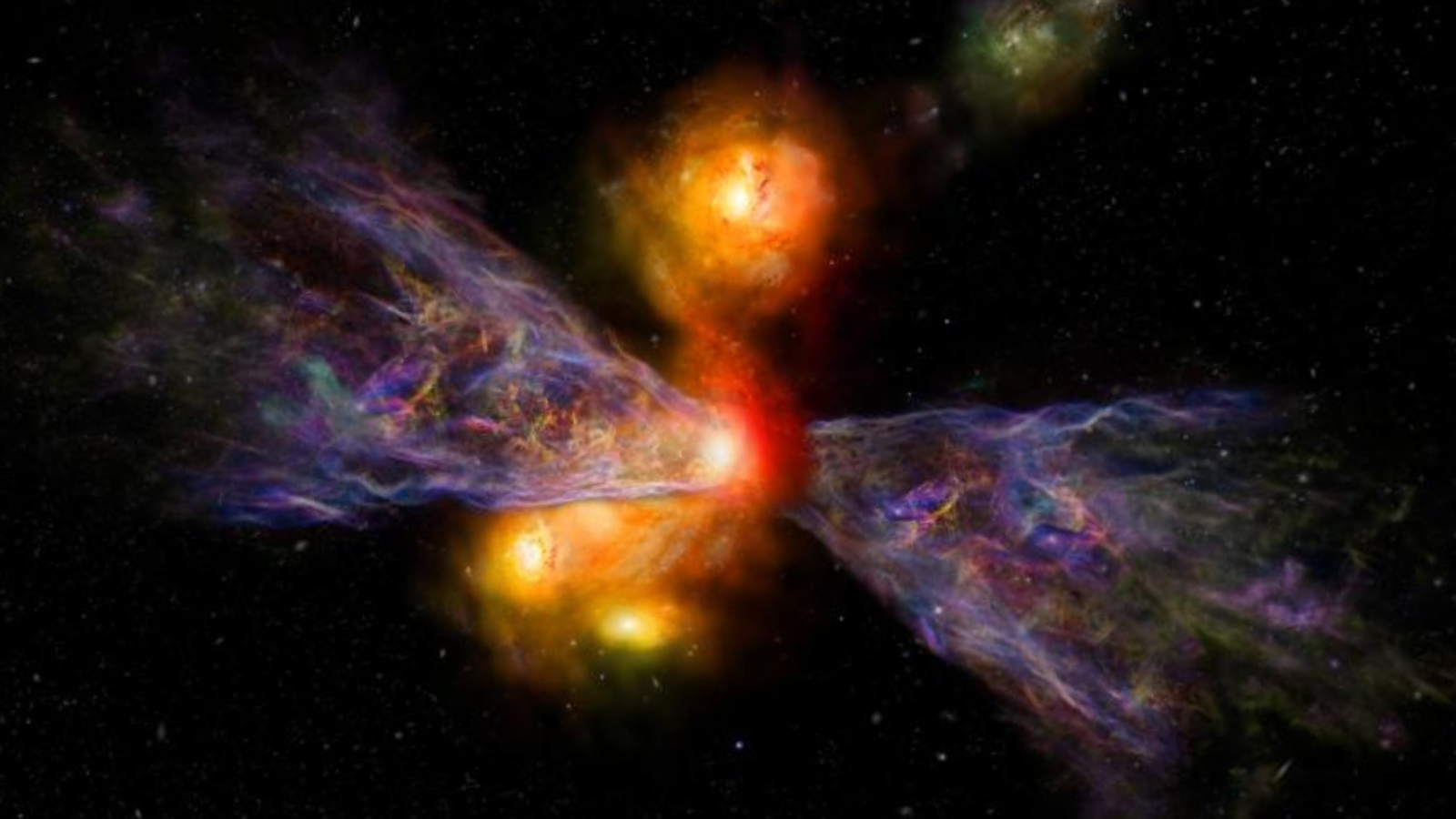
Astronomers using the James Webb Space Telescope (JWST) and the Atacama Large Millimeter/submillimeter Array (ALMA) have identified a “galaxy-killing” wind in the distant galaxy CRISTAL-02, offering a potential explanation for why many massive galaxies in the early universe ceased star formation prematurely. The discovery, reported by the Royal Astronomical Society, suggests that powerful gas outflows triggered by galaxy mergers may have stripped these ancient galaxies of the material needed to form stars, leading to their rapid “death.”
CRISTAL-02, observed as it appeared one billion years after the Big Bang, is forming stars at twice the rate of similar galaxies from the same era. However, JWST and ALMA detected a plume of cold gas being ejected at twice the speed of star formation, according to the study. This outflow, driven by supernova explosions following intense starbursts, could render the galaxy “dead” in less than 50 million years, a timescale consistent with the prevalence of “dead” galaxies in the early universe.
The research highlights that CRISTAL-02 is not a single galaxy but a merging system of multiple galaxies. Such collisions funnel gas into galactic centers, sparking star formation bursts that eventually lead to supernova-driven winds. Observations suggest that nearly half of massive early-universe galaxies interacted with companions, implying that galaxy-killing winds may have been widespread. This mechanism could explain the paradox of “live fast, die young” galaxies in the cosmos’ youth.
Did You Know? CRISTAL-02 was observed one billion years after the Big Bang, a period when the universe was less than 10% of its current age.
Expert Insight: The findings align with theories that galaxy mergers play a critical role in regulating star formation. By removing gas, these events may have shaped the structural evolution of the universe, influencing the distribution of “dead” and “alive” galaxies in the cosmic timeline.
The study, published June 10 in the Monthly Notices of the Royal Astronomical Society: Letters, underscores the interplay between star formation, supernova activity, and galactic evolution. If galaxy-killing winds were common in the early universe, they could have significantly altered the trajectory of cosmic history, limiting the growth of massive galaxies and reshaping the large-scale structure of the cosmos.
Analysts suggest future observations may confirm whether similar outflows occurred in other early-universe galaxies. If so, the findings could refine models of galaxy evolution, providing a clearer picture of how cosmic structures formed and matured over billions of years.

Frequently Asked Questions
- What is a “galaxy-killing” wind?
- The term refers to high-speed gas outflows from galaxies, driven by supernova explosions, that strip away the raw material needed for star formation.
- How was CRISTAL-02 observed?
- Researchers used the James Webb Space Telescope (JWST) and the Atacama Large Millimeter/submillimeter Array (ALMA) to detect gas ejections and star formation rates in the galaxy.
- Why is this discovery significant?
- It offers a potential explanation for the prevalence of “dead” galaxies in the early universe, suggesting that mergers and supernova-driven winds may have halted star formation in many massive galaxies.
Could the same processes that killed CRISTAL-02 have shaped other regions of the early universe? What might this mean for our understanding of cosmic evolution?