
Jets and Superrotation in Deep and Shallow Planetary Atmospheres
Unlocking the Secrets of Planetary Winds: Why Alien Atmospheres Spin Differently
When you look up at Jupiter through a telescope, those iconic, swirling bands aren’t just clouds—they are the visible signature of a planetary-scale engine. Across our solar system and beyond, planets are governed by massive, invisible currents known as zonal flows and jets. But why do some planets, like Venus and Saturn, exhibit “superrotation”—a phenomenon where the atmosphere whips around the planet faster than the planet itself rotates?
A recent study by atmospheric physicists Geoffrey Vallis, Loren Matilsky, and Quentin Nicolas sheds new light on these celestial weather patterns. By utilizing advanced numerical models, researchers are finally beginning to decode the “antidiffusion” of momentum—the mysterious process that keeps these high-speed jets alive.
On Venus, the atmosphere circles the entire planet in just four Earth days, despite the planet taking 243 days to complete a single rotation. What we have is the definition of a superrotating atmosphere in extreme form.
The Physics of ‘Antidiffusion’: How Jets Defy the Norm
In standard fluid dynamics, you would expect momentum to spread out and dissipate. However, in the chaotic environment of a planetary atmosphere, the opposite often happens. Through wave-mean-flow interactions, momentum is transported “upgradient,” effectively feeding the jet rather than letting it fade.
This is where the beta-effect comes into play. Variations in the Coriolis force, driven by a planet’s curvature and rotation rate, act as a structural framework that organizes chaotic convection into these concentrated, high-velocity streams. Whether it’s a deep gas giant or a shallow Earth-like world, these geometric constraints are the silent architects of planetary weather.
Deep Convection vs. Shallow Weather Layers
One of the most debated topics in planetary science is the depth of these flows. On gas giants like Jupiter, jets may extend thousands of kilometers deep, driven by massive convective heat transfer from the interior. On terrestrial planets, jets are typically confined to the thin, shallow “skin” of the atmosphere. Understanding the transition between these two regimes is critical for exoplanet research, where we often have to infer atmospheric depth from limited light-curve data.
The Exoplanet Connection: Tidal Locking and Global Winds
As we discover more “Hot Jupiters” and Earth-sized worlds orbiting M-dwarf stars, the study of superrotation becomes essential. Many of these worlds are tidally locked, meaning one side always faces the star. This creates an extreme temperature gradient between the day and night sides.
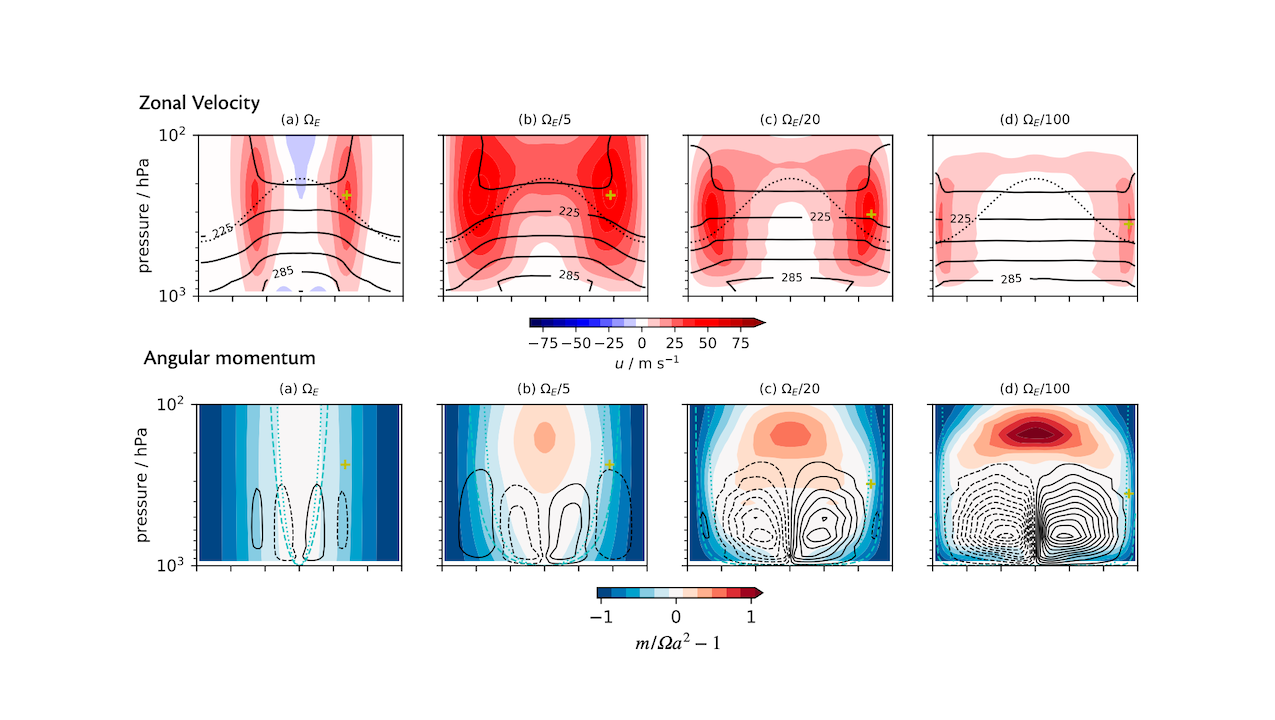
The resulting atmospheric circulation isn’t just a local breeze; it is a global heat-distribution system. If a planet is a fast rotator, the Coriolis effect dominates, breaking the flow into multiple bands. If it’s a slow rotator—common for tidally locked planets—the atmosphere often forms a single, massive equatorial jet that carries heat to the dark side. This determines whether an exoplanet could actually support liquid water or if it’s destined to be a frozen wasteland.
When reading about exoplanet habitability, look for mentions of “Rossby waves.” These planetary-scale waves are the primary drivers of heat redistribution on tidally locked worlds.
FAQ: Understanding Planetary Atmospheres
Q: What does “superrotation” actually mean?
A: It refers to an atmosphere that rotates faster than the solid body of the planet itself at the equator. It’s essentially a “wind” that never stops blowing in the direction of the planet’s rotation.

Q: Why are jets important for finding life?
A: Jets regulate the climate. By moving heat from the equator to the poles (or the day side to the night side), they prevent extreme temperature swings, potentially creating more stable environments for biological processes.
Q: Can Earth have a superrotating atmosphere?
A: Earth’s atmosphere is influenced by its rotation rate and surface topography. While we have powerful jet streams, we don’t exhibit global superrotation like Venus, largely because of our different rotation speeds and atmospheric composition.
Looking Ahead: The Future of Atmospheric modelling
The next decade of astronomy will rely heavily on high-fidelity Global Circulation Models (GCMs). As we gather more data from the James Webb Space Telescope (JWST) and future observatories, we will be able to test these models against real-world observations of distant storms and wind belts. Bridging the gap between idealized “math-heavy” physics and observable planetary data is the final frontier in understanding how worlds are made.
Want to keep up with the latest in space exploration and planetary physics? Subscribe to our newsletter for weekly updates on the most groundbreaking research in the cosmos.