
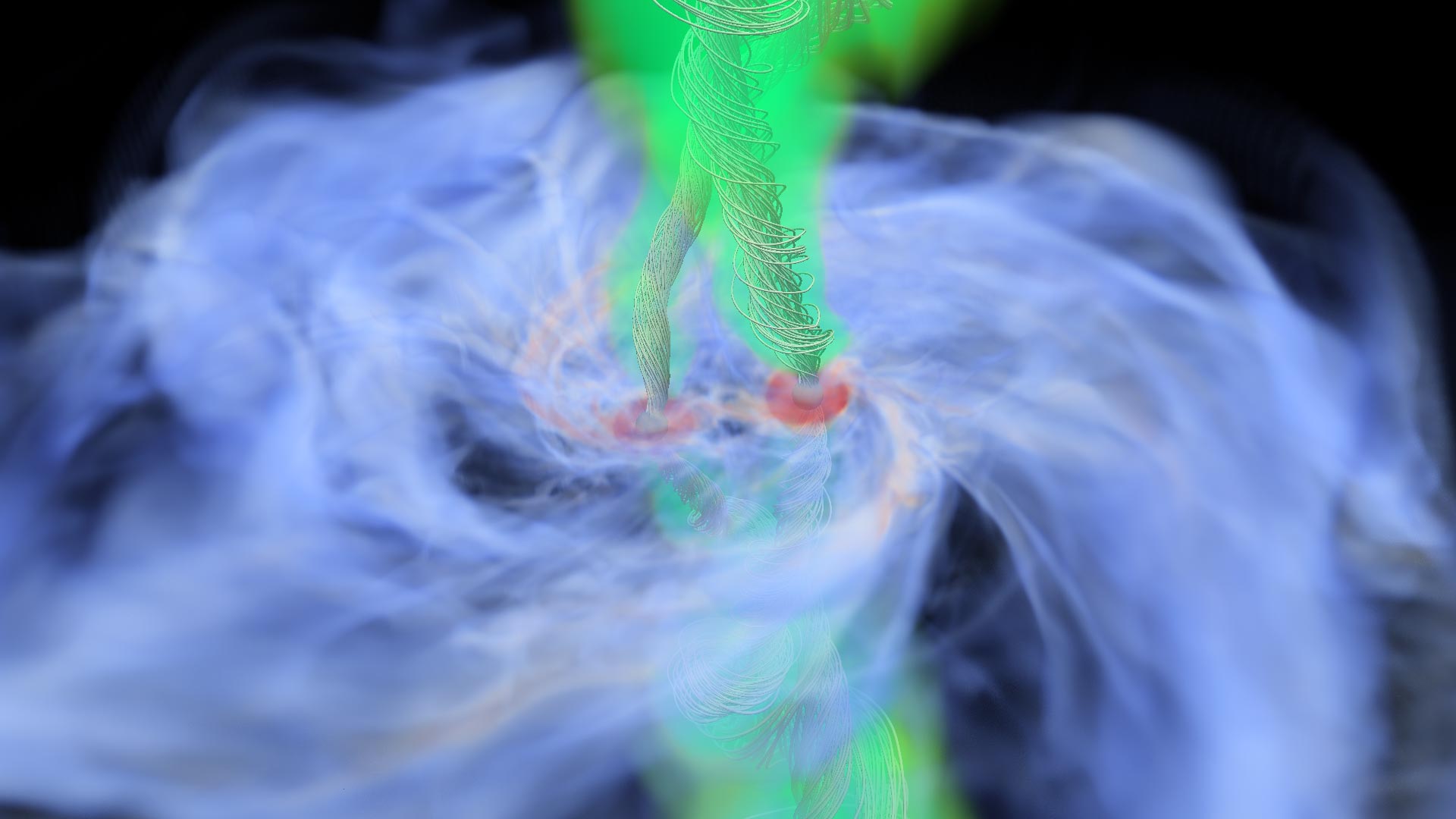
Magnetic Fields May Solve a Longstanding Binary Star Mystery
New computer simulations led by researchers at the National Astronomical Observatory of Japan suggest that magnetic fields act as the invisible architects of the cosmos, forcing newborn stars and supermassive black holes to pair up. By removing angular momentum from surrounding gas, these fields allow celestial objects to spiral inward, solving a long-standing mystery in astrophysics regarding how binary systems form and evolve.
How Do Magnetic Fields Drive Binary Star Formation?
Magnetic fields regulate the birth of binary star systems by acting as a cosmic brake. According to research published in the Monthly Notices of the Royal Astronomical Society (April 2026), these fields interact with gas clouds, effectively stripping away the angular momentum that would otherwise keep protostars apart. When researchers compared simulations with and without magnetic influence, the difference was stark: without magnetism, protostars drifted further away from each other, failing to form a stable binary pair.
+Masahiro+N.+Machida+(NAOJ).jpg "How Do Magnetic Fields Drive Binary Star Formation?")
The ATERUI III supercomputer, used by researchers like Tomoaki Matsumoto and Kenta Hotokezaka, performs complex fluid dynamics calculations that allow us to visualize, for the first time, how gas flows in green, red, and blue patterns around developing stars.
Why Does This Matter for Supermassive Black Holes?
The discovery that magnetic fields influence binary protostars provides a potential blueprint for understanding how supermassive black holes merge. In the dense, gas-rich centers of galaxies—often formed after galactic collisions—the same magnetic mechanisms likely facilitate the inward spiral of binary black holes. While simulating these massive events over millions of years remains a computational challenge, the current findings suggest that magnetism is the missing link in explaining how black hole binaries overcome the “final parsec problem,” where they would otherwise stall before merging.
Comparing Protostars and Black Holes
| Feature | Binary Protostars | Binary Black Holes |
|---|---|---|
| Driving Force | Magnetic gas interaction | Magnetic gas interaction (hypothesized) |
| Outcome | Stable stellar orbit | Potential merger |
What Are the Future Trends in Galactic Evolution Research?
The next frontier in this field involves high-resolution observational data to confirm what these simulations suggest. Astronomers are currently looking toward the next generation of space telescopes to capture real-time gas flows around young stars. By matching these visual patterns with the ATERUI III models, scientists aim to create a universal theory of binary formation that applies from small-scale stellar nurseries to the massive, violent centers of active galaxies.
If you want to track the latest updates on these simulations, keep an eye on the Royal Astronomical Society’s monthly publications, which frequently feature the latest breakthroughs in high-energy computational astrophysics.
Frequently Asked Questions
How do magnetic fields remove angular momentum?
Magnetic fields create a “bridge” between the rotating gas disk and the surrounding space. As gas is expelled from the system along these magnetic field lines, it carries away the angular momentum that would otherwise prevent the objects from moving closer.
Are most stars in the Milky Way part of binary systems?
Yes, a significant portion of stars in our galaxy are either binary or part of multi-star systems. Understanding their formation is essential to understanding the distribution of stars in the galaxy.
Could this research help us find more black holes?
By identifying the specific magnetic signatures associated with merging binary systems, researchers hope to better predict where and when massive black hole mergers might occur, aiding in the detection of gravitational waves.
What do you think about the hidden power of magnetic fields in space? Share your thoughts in the comments below, or subscribe to our newsletter for more deep dives into the latest astronomical discoveries.