
Modernizing the global economy with industrial robotics is needed but not inevitable
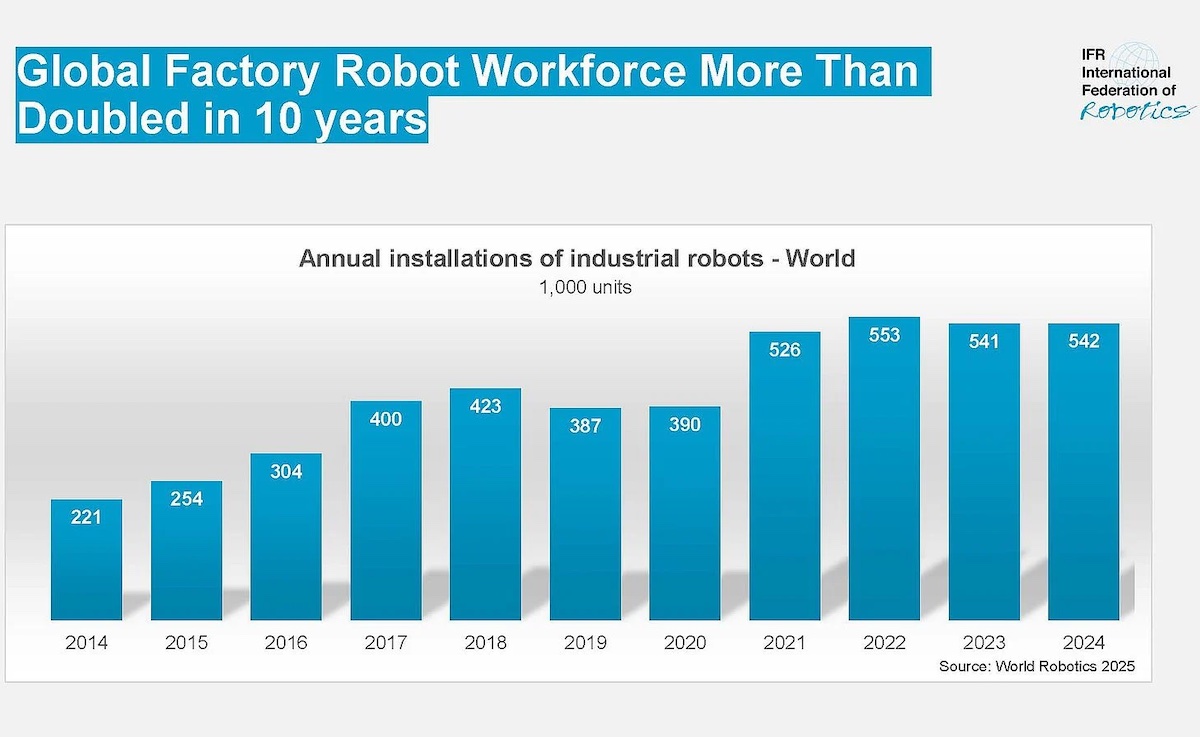
229,000 industrial robotic systems were sold globally in 2024, according to the International Federation of Robotics (IFR). Five countries—Japan, China, the U.S., Germany, and the Republic of Korea—accounted for 70% of these sales, with growth primarily driven by the automotive and electronics sectors.
Why is the industrial robotics market expanding?
The automotive industry remains the primary engine of growth, representing approximately 43% of all robot sales, according to IFR data. Production modernization in automobile-producing countries saw investment increase by 34%, reaching 48,400 units.

Electronics manufacturing is the second largest driver. The demand for AI-related hardware has specifically boosted robot density in Taiwan. According to the IFR, Taiwan now ranks fifth globally with 138 robots per 10,000 workers.
Beyond these core sectors, sales in other industrial categories grew by 21% in 2025. This follows a long-term average growth rate of 17% between 2010 and 2025.
Which countries dominate robotics adoption?
China currently stands as the largest market for industrial robots globally. However, the trajectory varies by region. Japan, once the undisputed leader, has seen a decline from its 2005 peak of 44,000 units, though it remains one of the world’s largest markets by annual sales with 29,300 units sold recently.
The U.S. approach differs from its peers. While Japan, China, and Germany rely heavily on government programs to support robotics strategies, the U.S. relies more on private capital than federal funding, according to the IFR.
What hurdles are slowing robotics growth?
Despite rising sales, the industry faces structural bottlenecks. The IFR identifies a lack of qualified robotics specialists and outdated training programs as primary obstacles.
Economic and bureaucratic frictions also persist. These include:
- Small domestic venture capital markets in several regions.
- Complexities in exporting and importing technological components.
- A lack of transparent mechanisms for research funding.
- Insufficient understanding of international market demand.
How are service robots evolving?
The robotics market is splitting into professional and personal segments. Last year, 4.7 million service robots for personal use were sold, contributing to a 28% total revenue increase and sales volumes of $2.2 billion, according to the IFR.
Professional service robots accounted for 11.5% of total sales, with 24,207 units sold. A significant portion of this segment is shifting toward defense; military and special-purpose robots made up 45% of professional sales, totaling 11,000 units.
The IFR and the Association for Advancing Automation (A3) identify healthcare, autonomous vehicles, and security as the most promising future areas for service robotics.
What is the projected market value by 2030?
Myria Research projects the market for robotics and intelligent operating systems could exceed $380 billion by 2030. This estimate includes comprehensive hardware and software systems.
The IFR provides more granular forecasts for specific segments:
- Industrial robots: Expected to reach 400,000 units.
- Professional service robots: Projected at 152,375 units with a value of $19.6 billion.
- Personal service robots: Estimated to hit 35 million units with a value of $12.2 billion.
Future Technological Frontiers
Innovation is moving toward “flexible production modules.” The IFR highlights several emerging areas of development, including swarm intelligence, self-repairing robots, and energy harvesting from external environments.
As these technologies integrate, the workforce will likely shift. Experts suggest the emergence of a mixed workforce where humans, AI, and robots collaborate closely, potentially creating new executive roles dedicated solely to robot supervision.
Frequently Asked Questions
Which industry uses the most robots?
The automotive industry is the largest user, accounting for roughly 43% of total industrial robot sales according to the IFR.
What is “robot density”?
The IFR defines robot density as the number of multifunctional robots per 10,000 workers employed in automotive, manufacturing, or complex automated industries.
Why are personal service robot sales so high?
With 4.7 million units sold last year, personal robots have seen mass-market adoption, driving a total revenue increase of 28% in that segment.
Is your business ready for the automation shift? Share your thoughts on the future of human-robot collaboration in the comments below or subscribe to our newsletter for the latest industrial tech updates.