
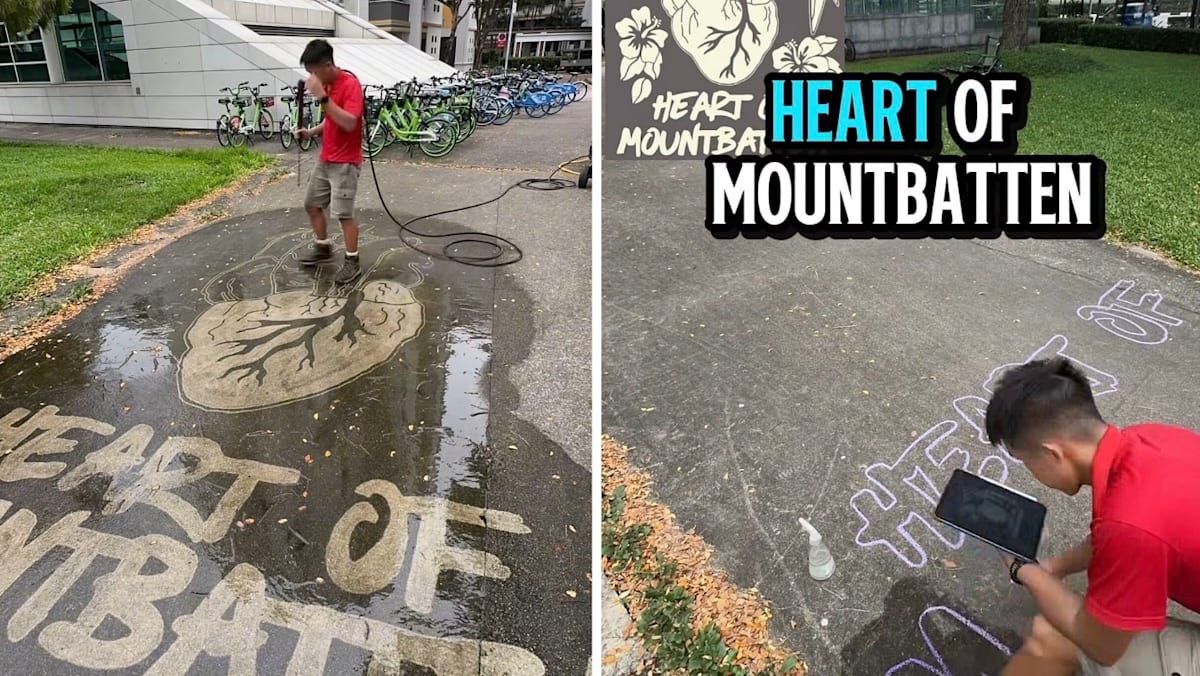
Mountbatten pavement art removed by SMRT raises larger questions on public spaces and expression: MP Gho Sze Kee
SMRT staff recently removed a power-washed art piece titled “Heart of Mountbatten” from a pavement outside Mountbatten MRT station following a public complaint. Mountbatten MP Gho Sze Kee said the incident raises larger questions about the tension between artistic creativity, free expression, and the rules governing shared public spaces.
How was the “Heart of Mountbatten” art removed?
Power-washing artist Marcus Pang created the artwork by jetting a design onto the pavement using rainwater. According to a Friday Instagram post by Pang, SMRT staff stopped him five hours into the process after a member of the public complained that he was spraying chemicals onto the grass.
Pang explained that he used rainwater to clean the dirty concrete, though he noted the perceived “chemical” was likely gasoline from his machine. Staff detained him because he lacked a permit for the artwork, a requirement Pang claimed was not necessary.
While police officers later told Pang that “no wrong was done” and suggested he seek a letter of endorsement from the area’s MP, the outcome remained the same. Upon returning the next day, Pang found the pavement had been “whitewashed,” effectively erasing the piece.
Why does this incident raise concerns about public space?
MP Gho Sze Kee stated in a Facebook post on Sunday (Jun 7) that the removal of the art stirs up larger societal questions. She noted that there is an inherent tension between free expression and the rules that maintain shared spaces.
The incident also highlighted a lack of public awareness regarding urban jurisdiction. Ms. Gho clarified that the walkway in question is controlled by SMRT and does not fall under the town council’s purview. She noted that many such jurisdictions intersect within neighborhoods, which can complicate how public spaces are managed.
What may happen next in this dispute?
The Land Transport Authority (LTA) and the police may provide further clarification on the matter. MP Gho Sze Kee has indicated that it is the prerogative of SMRT and the police to respond to the public regarding the facts of the engagement.
Future attempts at similar public art projects could see artists seeking formal endorsement from local MPs to avoid similar detentions. There is also a possibility that the intersection of jurisdictions between SMRT and town councils may be further discussed to clarify rules for public installations.
Frequently Asked Questions
Who was responsible for cleaning the artwork?
According to MP Gho Sze Kee, the work was cleaned off by SMRT staff, not the town council.
What was the reason given for stopping the artist?
SMRT staff stopped Marcus Pang after a public complaint regarding the use of chemicals on the grass and because he did not have a permit.
What was the police response to the incident?
Police took Pang’s statement and informed him that “no wrong was done,” though they encouraged him to obtain an endorsement letter from the MP.
Do you believe public art should require official permits even when it uses non-permanent methods like power-washing?