

Mysterious cosmic particle may reveal where the universe’s most extreme rays are born
Researchers have determined that the universe’s most powerful cosmic rays may consist of ultraheavy nuclei heavier than iron, according to a study published in Physical Review Letters. Led by B. Theodore Zhang of Kyoto University and Kohta Murase of Pennsylvania State University, the findings suggest these particles can survive long-distance intergalactic travel from violent sources like colliding neutron stars.
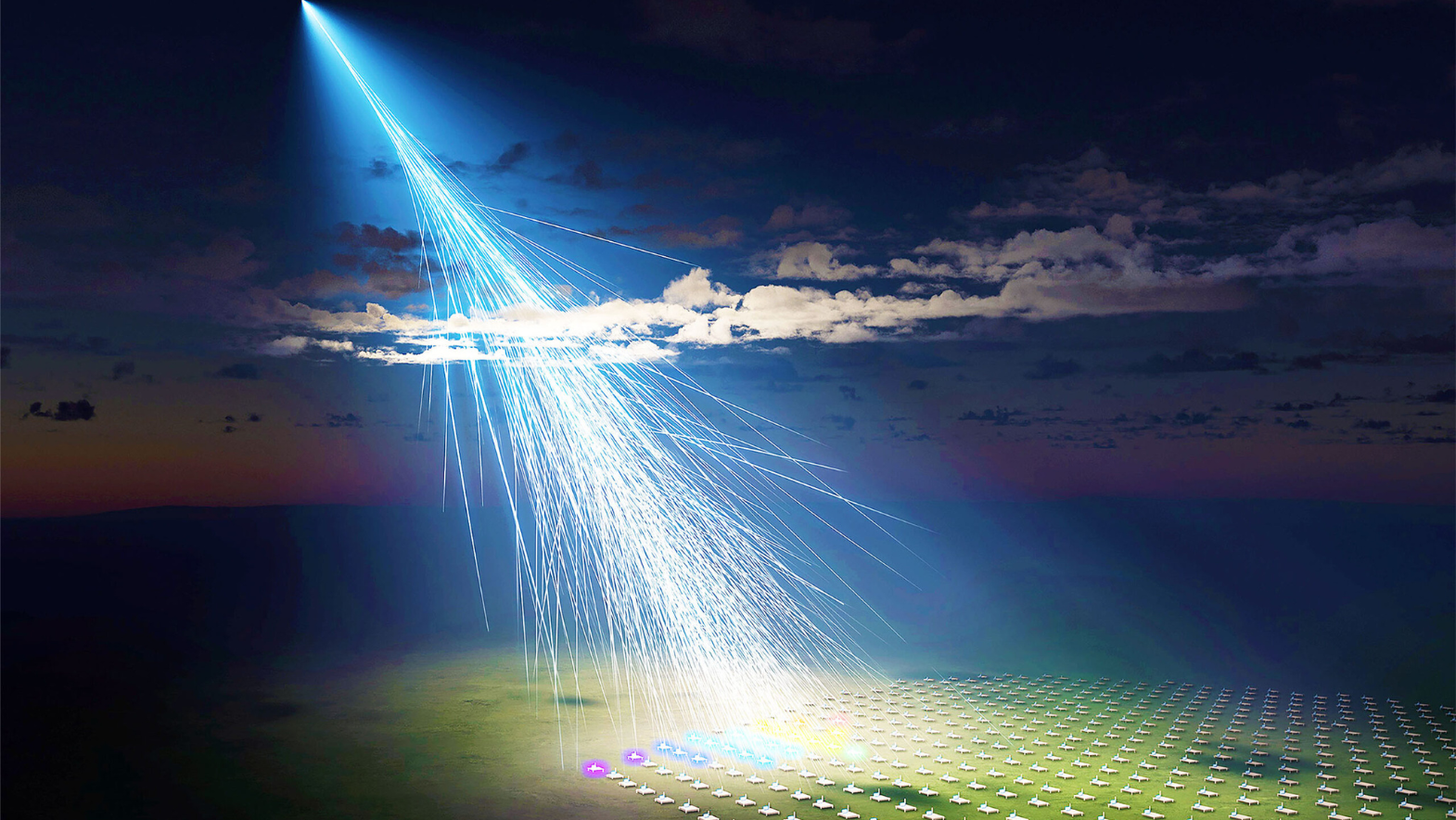
In 2021, the Telescope Array in the Utah desert detected a single cosmic ray that produced a particle shower in the upper atmosphere. This “Amaterasu particle” possessed energy roughly 40 million times greater than the capacity of the most powerful human-made atom smasher.
The particle’s trajectory initially puzzled physicists because it appeared to originate from the Local Void. This region is a nearly empty pocket of space that lacks the violent activity required to launch such high-energy particles.
How do ultraheavy cosmic rays survive space?
Physicists previously assumed that any particle heavier than iron would shatter while crossing the gulfs between galaxies. They believed collisions with the microwave glow left over from the Big Bang would crack these nuclei apart.

B. Theodore Zhang and his colleagues at Kyoto University’s Yukawa Institute for Theoretical Physics developed new simulation software to track the breakdown of nuclei heavier than iron. Their results showed that below a specific energy threshold, heavy nuclei lose energy more slowly than protons.
This discovery suggests ultraheavy particles can remain intact over distances once considered impossible. Because heavier nuclei carry more electric charge, cosmic accelerators can drive them to higher energies than lighter particles.
Where are these particles created?
According to Kohta Murase, the most likely “factories” for these particles are the deaths of massive stars and neutron star collisions. These events are rare and spectacularly violent.
The study identifies two specific catastrophes capable of forging these nuclei: the collapse of a massive star into a black hole and the merger of two neutron stars. These are the same processes believed to create the universe’s heaviest elements, including gold, platinum, and uranium.
When the research team calculated the energy released by these events, the figures matched the requirements for the highest-energy cosmic rays detected on Earth.
What happens next for cosmic ray detection?
The research establishes that the heaviest cosmic rays can survive intergalactic crossings and aligns their energy with the output of colliding stars. This connects the origin of the most energetic particles with the origin of the heaviest elements.
A separate analysis also links these particles to colliding neutron stars. This creates a testable prediction for the scientific community.
Next-generation detectors may find that the most energetic cosmic rays are indeed heavier than iron. Current lighter models expect almost no particles of this weight at such high energies, meaning future data could either confirm or refute these simulations.
Frequently Asked Questions
What is the Amaterasu particle?
It is a high-energy cosmic ray detected in 2021 by the Telescope Array in Utah, possessing energy 40 million times greater than the most powerful atom smasher.
Why was the origin of the Amaterasu particle a mystery?
Traced backward, it seemed to come from the Local Void, an empty region of space where nothing violent enough to launch such a particle exists.
What are the suspected sources of ultraheavy cosmic rays?
According to the study, the most likely sources are the collapse of massive stars into black holes or the merger of two neutron stars.
Do you think the discovery of ultraheavy cosmic rays will fundamentally change our map of the Local Void?