
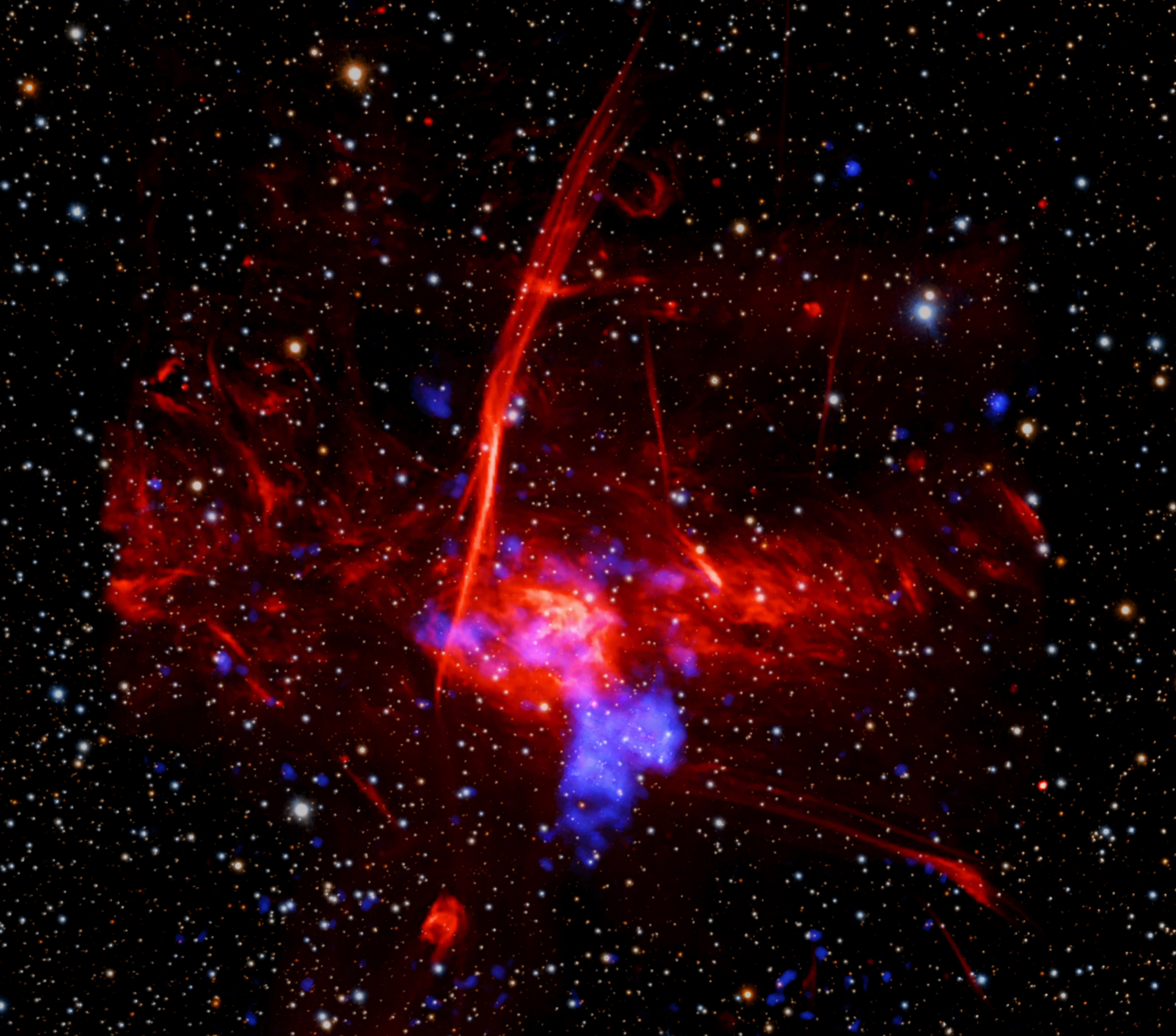
NASA’s Chandra Discovers Possible Supernova Remnant in Galactic Center
Astronomers using NASA’s Chandra X-ray Observatory may have discovered a supernova remnant 26,000 light-years away near the Milky Way’s central black hole. According to a study published in The Astrophysical Journal, the remnant is expanding at roughly two million mph and is at least 1,700 years old.
Why is the Sagittarius C region significant?
The suspected remnant sits within Sagittarius C, a “bubble” of gas known as an H II region. In these regions, electrons have been stripped away from hydrogen, often surrounding young, massive stars. This area is a volatile neighborhood located in the Galactic Center, a region crammed with dense gas clouds and magnetic fields orbiting a supermassive black hole.
Researchers used a combination of data to map this area. They layered X-ray data from Chandra and the ESA’s XMM-Newton mission with radio data from the MeerKAT telescope in South Africa and optical imagery from Hawaii’s Pan-STARRS telescopes. This multi-wavelength approach allows astronomers to see different physical processes—from high-energy X-rays to cold gas—simultaneously.
How did researchers identify the supernova remnant?
The evidence centers on a “blob” of X-ray emission. According to the study’s authors—Zhenlin Zhu and Mark Morris of UCLA, Gabriele Ponti of Italy’s National Institute for Astrophysics, and Ping Zhou of Nanjing University—this emission likely comes from a massive star that self-destructed.

The team considered an alternative: that the hot gas comes from a cluster of massive stars. However, they found the X-ray blob is more than ten times brighter than the emission typically seen in large stellar clusters. This brightness suggests a more violent origin, like a supernova.
This finding builds on prior data from NASA’s retired SOFIA (Stratospheric Observatory for Infrared Astronomy) mission. SOFIA previously detected an expanding shell of gas around Sagittarius C, which provided the initial hint that a stellar explosion had occurred in that specific location.
What happens to the elements created in these explosions?
Stars act as nuclear fusion engines, creating heavy elements from the hydrogen and helium present at the start of the universe. When these stars explode, they blast these elements into interstellar space.
The research team searched for increased levels of these key elements within the remnant. While they didn’t find a specific enhancement, the authors suggest the stellar debris may have already mixed with the surrounding gas. This mixing process is how the “seeds” of future solar systems are distributed throughout the Milky Way.
What does this mean for the future of galactic mapping?
The use of the James Webb Space Telescope (JWST) alongside Chandra and MeerKAT signals a shift toward “multi-messenger” astronomy. By adding JWST’s infrared capabilities, astronomers can see through the dense dust of the Galactic Center to identify the relationship between H II regions and supernova remnants.
Mapping these remnants helps scientists understand the life cycle of stars in extreme environments. The Galactic Center is far more crowded than the neighborhood around our Sun, meaning stellar interactions and explosions happen more frequently and with different dynamics.
Comparing Observation Methods
| Telescope | Data Type | Key Contribution to this Study |
|---|---|---|
| Chandra / XMM-Newton | X-ray | Identified the high-energy “blob” of the remnant. |
| MeerKAT | Radio | Mapped expanding gas and magnetic filaments. |
| JWST | Infrared | Revealed the gas structure of the H II region. |
Frequently Asked Questions
What is a supernova remnant?
It is the structure resulting from the explosion of a star in a supernova. It consists of ejected star material expanding into the surrounding interstellar medium.

How far is the Galactic Center from Earth?
The suspected remnant in this study is located approximately 26,000 light-years from Earth.
Why are X-rays used to find these objects?
Supernova remnants heat gas to millions of degrees. This superheated gas emits X-rays, which can penetrate through the thick dust clouds that block visible light in the center of the galaxy.
Want to explore more about our galaxy’s mysteries? Browse our latest articles on deep space exploration or subscribe to our newsletter for weekly cosmic updates.
Do you think we will find more remnants near the supermassive black hole? Let us know in the comments below.