
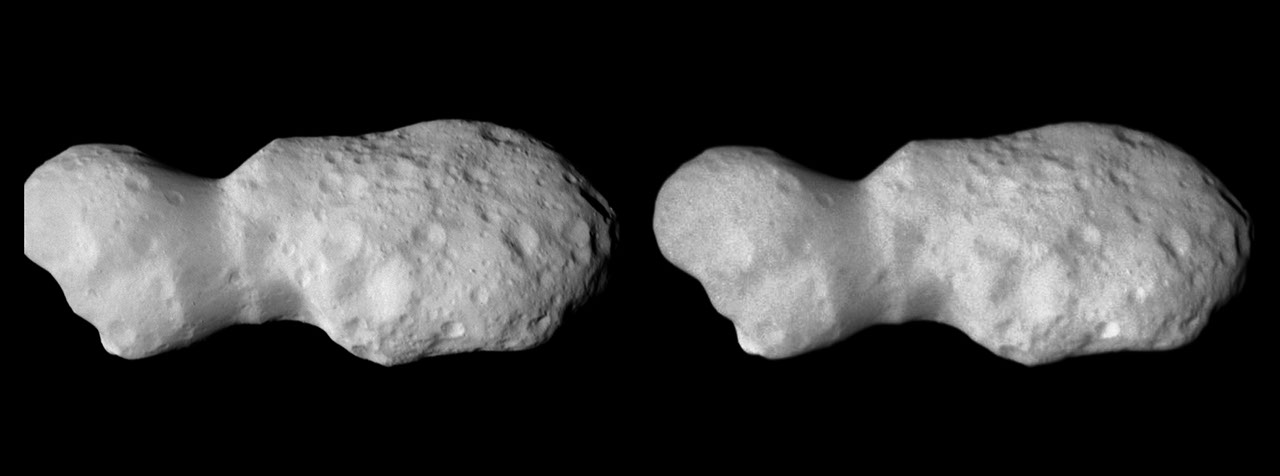
NASA’s Lucy Reveals Wobbling, Peanut-Shaped Asteroid
NASA’s Lucy spacecraft discovered that asteroid Donaldjohanson is a peanut-shaped body with a wobbly rotation and evidence of brief liquid water exposure, according to a June 18 report in the journal Science. The findings, based on an April 20, 2025 flyby, provide a baseline for comparing asteroid evolution across the solar system.
The spacecraft passed within 650 miles of the asteroid at 30,000 mph. Data revealed that Donaldjohanson doesn’t spin on a single axis. Instead, it rotates end-over-end every 10.5 Earth days while wobbling back and forth around its long axis every 26.5 days.
Why does asteroid Donaldjohanson wobble?
The asteroid’s irregular rotation is driven by the YORP effect, a phenomenon where solar heating creates a tiny recoil force as the surface radiates infrared light. Because Donaldjohanson isn’t symmetric, this radiation acts as a net torque that twists the body. According to the Science paper authors, this effect likely slowed the asteroid’s rotation over the last 20 to 60 million years.
As the spin slowed, the balance between gravity and centrifugal force shifted. This caused loose rocky material to slide down slopes, which created the worn-down appearance of craters seen in Lucy’s images.
How does Donaldjohanson differ from Bennu and Ryugu?
Donaldjohanson is significantly younger and has a different water history than other well-studied asteroids. While Bennu (NASA’s OSIRIS-REx target) and Ryugu (JAXA’s Hayabusa2 target) formed 1 to 2 billion years ago, Donaldjohanson is only 155 million years old.
The chemical composition of the surface also tells a different story. Lucy recorded iron-rich clay minerals, which indicate a brief presence of liquid water. In contrast, Bennu and Ryugu contain magnesium-rich clays. According to the research team, magnesium-rich clays suggest water lingered for millions of years, whereas iron-rich clays disappear quickly if water stays too long.
| Feature | Donaldjohanson | Bennu / Ryugu |
|---|---|---|
| Age | 155 Million Years | 1-2 Billion Years |
| Clay Type | Iron-rich (Brief water) | Magnesium-rich (Long water) |
| Orbit | Main Asteroid Belt | Earth-crossing orbits |
Simone Marchi, Lucy deputy principal investigator at the Southwest Research Institute, stated that these subtle differences provide clues to the solar system’s origin story. The data suggests the parent bodies of these asteroids may have formed in different regions or at different times before moving to the main belt.
What happens next for the Lucy mission?
The encounter with Donaldjohanson served as a dress rehearsal for the mission’s primary goals. NASA confirmed that the spacecraft’s instruments performed as expected during the flyby. The mission is now heading toward the Jupiter Trojan asteroids.
The first primary encounter is scheduled for Aug. 12, 2027, when Lucy will fly by the Trojan asteroid Eurybates. According to Marchi, studying the Trojans—a population of primitive space rocks—will likely challenge current understandings of how planets formed and migrated in the early solar system.
The mission is managed by NASA’s Goddard Space Flight Center and the Discovery Program, with the spacecraft built by Lockheed Martin Space.
Frequently Asked Questions
What is the YORP effect?
The YORP effect is a change in an asteroid’s rotation caused by the absorption of sunlight and the subsequent emission of infrared heat, which creates a tiny recoil force on the asteroid’s surface.
Why is the peanut shape important?
A bilobate or peanut shape suggests the asteroid is a “rubble pile” formed when two separate fragments from a collision coalesced under their own gravity rather than being a single, solid rock.
What are Jupiter Trojan asteroids?
Trojans are asteroids that share an orbit with Jupiter, staying trapped in stable points called Lagrange points. They are considered “time capsules” from the early solar system.
Want to track Lucy’s journey to the Trojans? Share your thoughts on the mission in the comments below or subscribe to our space exploration newsletter for updates on the 2027 Eurybates flyby.