
NASA’s Webb Reveals Black Hole That Formed Before Its Galaxy
The Cosmic Chicken and Egg: Did Black Holes Actually Create Galaxies?
For decades, the narrative of our universe followed a predictable sequence: first came the stars, then the galaxies, and eventually, the supermassive black holes that anchored them. The logic was simple. Massive stars would die, collapse into black holes, and these “seeds” would slowly merge and feast on surrounding gas until they became the behemoths we see today.
But the James Webb Space Telescope (JWST) just threw a wrench into that timeline. Recent data suggests we might have had the order completely backward.
The Paradigm Shift: Meeting the “Little Red Dot”
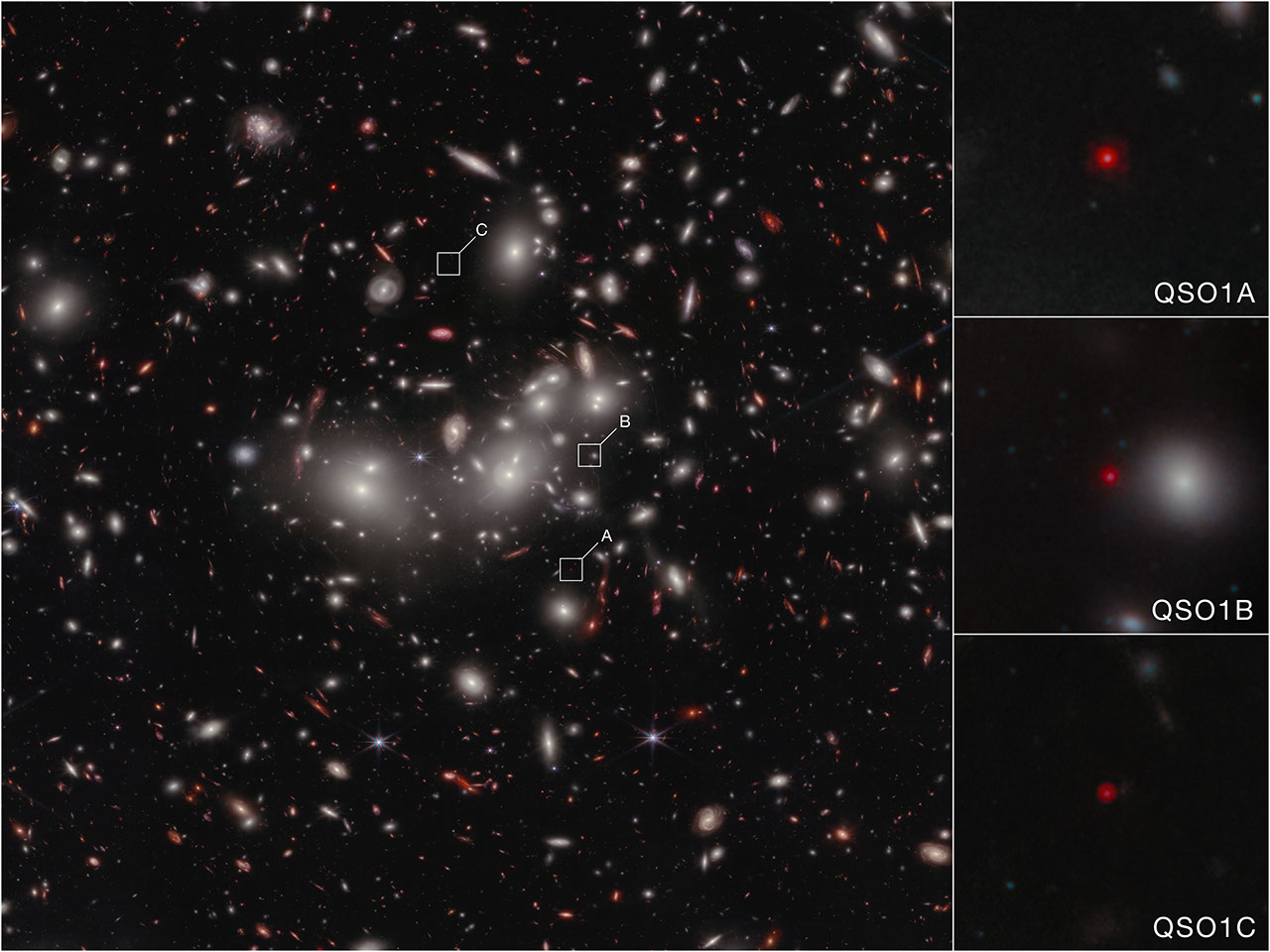
The discovery centers on a specific object known as Abell2744-QSO1 (QSO1). Located just 700 million years after the Big Bang, this object is essentially a “Little Red Dot” in the sky. While it looks small, its gravitational influence is staggering.
Using the Near Infrared Spectrograph (NIRSpec), researchers discovered that QSO1 is roughly 1,300 light-years across. However, it harbors a black hole with a mass of approximately 50 million Suns. Here is the part that is keeping astronomers awake at night: the black hole makes up at least two-thirds of the total mass of the entire system.
In our local neighborhood, supermassive black holes are tiny fractions of their host galaxies’ mass. In QSO1, the black hole isn’t just the anchor—it’s the main event. This suggests that the black hole didn’t grow *inside* a galaxy; it may have existed first, potentially acting as the seed around which a galaxy eventually formed.
Direct Collapse: Skipping the Stellar Phase
If these black holes didn’t start as dying stars, how did they get so big, so fast? The answer likely lies in a theory called Direct Collapse Black Holes (DCBH).

Rather than waiting for a star to live and die, massive clouds of primordial hydrogen and helium gas may have collapsed directly into a black hole under their own gravity. This “heavy seed” approach allows a black hole to start its life already massive, bypassing millions of years of stellar evolution.
The evidence for this in QSO1 is compelling. The gas surrounding the black hole is “pristine”—it consists almost entirely of hydrogen and helium with very little oxygen or heavier elements. Since heavy elements are only forged inside stars, the lack of them suggests that very few stars ever existed in QSO1 before the black hole took over.
Future Trends: Mapping the Primordial Universe
This discovery isn’t just about one weird object; it’s a roadmap for the future of astrophysics. As JWST continues to peer deeper into the infrared spectrum, we can expect several key shifts in our understanding of the cosmos:
1. Redefining Galactic Evolution
We are moving toward a “Black Hole First” model. Future research will likely focus on how these primordial seeds attracted gas and dust to eventually build the spiral and elliptical galaxies we see today. You can read more about JWST’s ongoing missions to see how they are targeting these early structures.
2. Hunting for Primordial Black Holes
If direct collapse is common, there may be a population of “dark” black holes scattered throughout the universe that never formed galaxies. Detecting these could provide a missing link in our understanding of dark matter and the total mass of the universe.
3. Testing the Limits of Gravity
By observing “Keplerian motion”—where gas orbits a center point like planets orbit a sun—scientists can now weigh black holes in the early universe with direct precision. This removes the guesswork and allows us to build a more accurate timeline of the Big Bang’s aftermath.
Frequently Asked Questions
Q: Does this mean galaxies don’t form stars first?
A: Not necessarily. It suggests that some galaxies started with a supermassive black hole seed, while others may have followed the traditional stellar-collapse route. We are likely seeing two different paths to galaxy formation.
Q: How did scientists “weigh” a black hole billions of light-years away?
A: They used the James Webb Space Telescope to measure the rotation velocity of the surrounding gas. Because the gas follows Keplerian motion (simple laws of gravity), the speed of the orbit reveals the mass of the object pulling on it.
Q: What is a “Little Red Dot”?
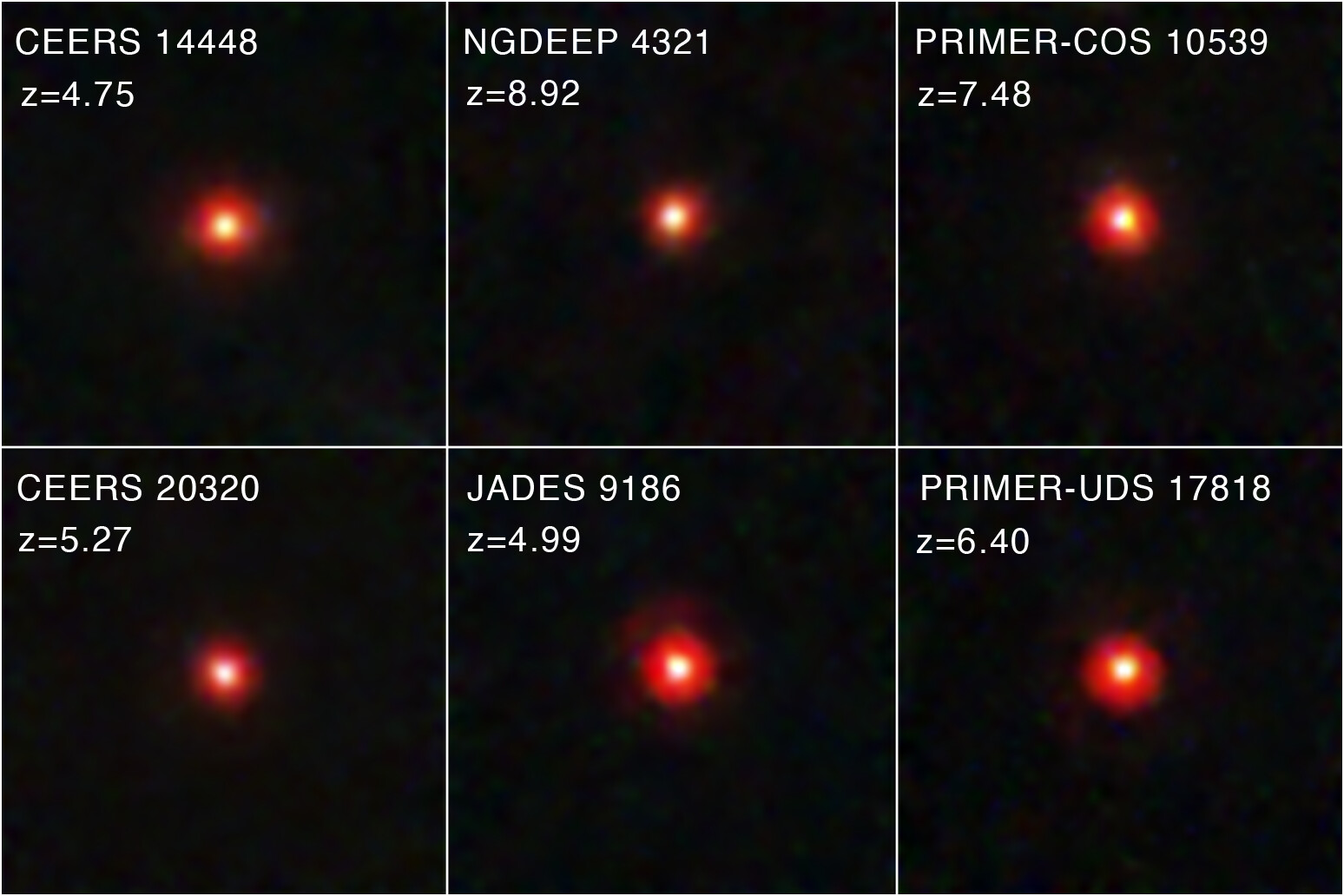
A: These are compact, reddish objects found in the early universe. They were initially mysterious, but JWST has revealed they are often supermassive black holes surrounded by dense clouds of gas.
Join the Cosmic Conversation
Do you think black holes are the architects of the universe, or just lucky scavengers? We want to hear your theories!
Leave a comment below or subscribe to our newsletter for the latest breakthroughs in deep-space exploration.