
Never Cross a River Four Feet Deep on Average
Sasha Putilin, a 2024 ACX grantee, failed to replicate a 2023 study claiming that flashing lights tuned to individual brain-wave rhythms accelerate perceptual learning. According to Putilin’s findings, the original study’s reported three-fold increase in learning rates likely stemmed from a few bored participants in the control group rather than a genuine cognitive boost from brain-wave entrainment.
Why did the brain-wave entrainment replication fail?
The original 2023 study, “Learning at your brain’s rhythm: individualized entrainment boosts learning for perceptual decisions,” claimed that flashing white light at a person’s peak alpha frequency (typically 8–12 Hz) helped them learn to distinguish complex patterns faster. Specifically, the authors, Elizabeth Michael and Zoe Kourtzi, found that “T-match” participants—those receiving stimuli at the trough of their alpha rhythm—learned significantly faster than others.
Putilin’s replication found no such acceleration. While the original study reported a 3x difference in learning rates, Putilin’s data showed no significant difference between the groups. Putilin attributes this discrepancy to “cargo-cult statistics,” where the original result was driven by a small number of participants in the P-match group who showed sharply negative learning rates. According to Putilin, these participants likely became bored or tired, which artificially inflated the relative success of the T-match group.
Can consumer-grade EEG hardware replace laboratory equipment?
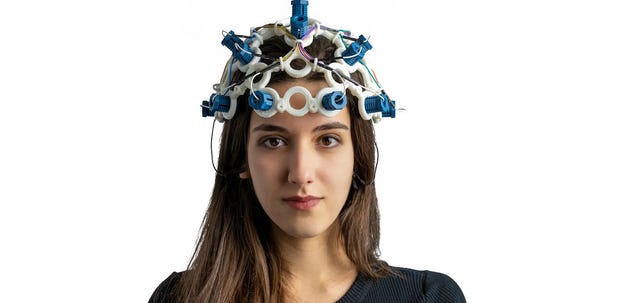
A major point of contention in neurotech is whether expensive clinical hardware is necessary for meaningful data. The original 2023 study used a 63-channel EEG system estimated to cost between $50,000 and $100,000. Putilin conducted the replication using an OpenBCI Ultracortex “Mark IV” headset and a Cyton Board, costing approximately $2,000.
Despite the price gap, Putilin found the consumer hardware sufficient for estimating the individual alpha frequency (IAF). The replication used three channels at the back of the head to isolate the alpha peak, similar to the subset of channels used in the original study. This suggests that the “learning helmet” concept—a device that reads brain waves to optimize learning—could theoretically be built using affordable, off-the-shelf components rather than institutional-grade machinery.
Comparison: Original Study vs. Replication
| Feature | Original Study (2023) | Putilin Replication |
|---|---|---|
| Sample Size | 80 participants | 12 participants |
| EEG Hardware | 63-channel ($50k-$100k) | 8-channel OpenBCI (~$2k) |
| Key Result | 3x faster learning (T-match) | No significant learning boost |
What is ‘cargo-cult statistics’ in neuroscience?
Putilin references Stark and Saltelli to describe “cargo-cult statistics”—the mechanical application of statistical rituals without understanding the underlying assumptions. In this case, Putilin argues the original authors performed the “ceremony” of computing p-values but failed to inspect the raw data for anomalies, such as the extreme negative learning rates of a few individuals.
The lack of transparency compounded the issue. Putilin reports that the original study did not release the original analysis code or the full per-block accuracy data. This forced the replication effort to recreate approximation charts from incomplete CSV files. This lack of open data prevents other researchers from quickly validating or debunking claims, effectively turning scientific publishing into a “priesthood” where readers must trust the authors’ conclusions without seeing the machinery.
How is AI changing the future of scientific auditing?
The gap between professional scientists and the public is closing due to Large Language Models (LLMs). Putilin notes that while the replication took hundreds of hours, initial data wrangling and chart creation that previously required an expert now take a few weekends using AI tools. This shift enables a “democratic science” model where independent analysts can audit published claims.

Future trends in neurotechnology and meta-science likely include:
- Crowdsourced Replication: Small-scale, distributed tests of published claims using consumer hardware.
- AI-Driven Data Audits: Using LLMs to scan published datasets for “fishy” patterns or statistical anomalies that humans might miss.
- Real-time Open Data: A move toward publishing raw data streams simultaneously with findings to prevent “analytic flexibility” (p-hacking).
FAQ: Brain-Wave Entrainment and Learning
Can flashing lights actually make you learn faster?
While some studies suggest a link between alpha rhythms and visual excitability, the recent replication by Sasha Putilin suggests that the reported “3x boost” from individualized entrainment may not be a real effect.

What is the difference between P-match and T-match?
P-match refers to flashing light that matches the alpha frequency but presents the stimulus at the peak of the wave. T-match presents the stimulus at the trough, which some theorists believe makes the brain more “open” to signals.
Is consumer EEG equipment accurate enough for research?
According to Putilin’s replication, $2,000 consumer headsets like the OpenBCI can effectively estimate individual alpha frequencies, making them viable for certain types of cognitive research.
Do you think scientific auditing should be crowdsourced? Share your thoughts in the comments or subscribe to our newsletter for more deep dives into neurotech.