
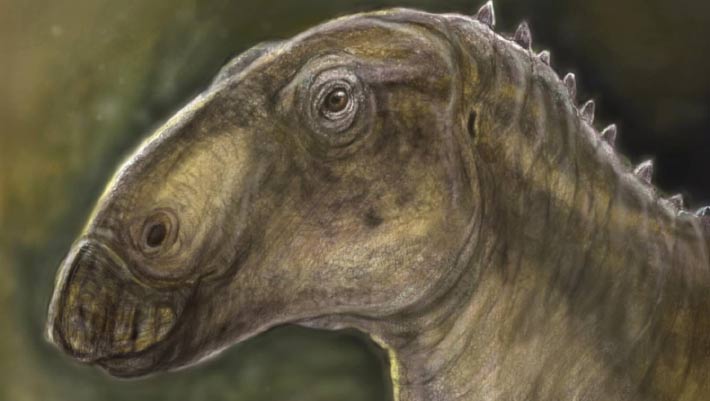
New Duck-Billed Dinosaur Unearthed in Romania
Paleontologists from Romania, Hungary, and Italy have identified Kryptohadros kallaiae, a new genus and species of duck-billed dinosaur discovered in Romania’s Hațeg Basin. According to a study published in the Journal of Systematic Palaeontology, this herbivorous hadrosauroid establishes a new endemic clade called Telmatosauridae, revealing complex migration patterns across the Late Cretaceous European Archipelago.
What is Kryptohadros kallaiae?
Kryptohadros kallaiae was a herbivorous hadrosauroid that lived approximately 70 million years ago during the Maastrichtian age of the Cretaceous period. Researchers unearthed the specimen at the Fântânele-3 vertebrate site near Vălioara village in Romania’s Hațeg Basin, specifically within the continental deposits of the Densuș-Ciula Formation.
The skeleton is partial. It consists of a skull, rib fragments, tail vertebrae, and a partial hindlimb. While fragmented, these remains provided enough data to distinguish the animal from all other known dinosaurs. Dr. Attila Ősi of ELTE Eötvös Loránd University noted that complete skeletons featuring cranial elements and limb bones are rare in the Hațeg Basin, where most finds are isolated bone elements.
How does it differ from Telmatosaurus?
For over a century, remains of this dinosaur group in the region were generally attributed to Telmatosaurus transsylvanicus. However, the discovery of Kryptohadros kallaiae proves that at least two closely related duck-billed dinosaurs shared the region.
János Magyar, a doctoral student at ELTE Eötvös Loránd University and the Hungarian Natural History Museum, stated that while the two species are close relatives and look similar, the differences are primarily found in the morphology of the skull elements.
The distinction is critical for understanding biodiversity. Instead of one generalist species, the Late Cretaceous SE European islands supported a more diverse array of hadrosauroids than previously recorded.
What is the Telmatosauridae clade and why does it matter?
The research identifies a new evolutionary group called Telmatosauridae. This endemic lineage includes three specific dinosaurs: Kryptohadros kallaiae, Telmatosaurus transsylvanicus, and Tethyshadros insularis from Italy.

This grouping suggests that these dinosaurs evolved specifically within the island environments of southeastern Europe. According to the phylogenetic analyses in the study, this discovery points to at least six separate dispersal events from Asia toward North America and Europe between 113 and 66 million years ago.
The data also supports a specific migration theory. The researchers found that certain later-arriving European hadrosauroid lineages are missing from southeastern European islands. This suggests a direct migration route existed between Asia and southwestern European islands that bypassed southeastern Europe entirely.
Comparing the Hadrosauroids of the European Archipelago
The study highlights a clear distinction between the endemic Telmatosauridae and later arrivals. While Telmatosauridae established themselves before the Campanian age (84 to 72 million years ago), later lineages took different routes.

By comparing Kryptohadros (Romania) with Tethyshadros (Italy), researchers can map how these animals moved across the fragmented landmasses of the Late Cretaceous. The similarity in skull morphology across these species confirms they belong to the same ancestral line, distinct from the larger hadrosaurids found in North America and Asia.
Frequently Asked Questions
When did Kryptohadros kallaiae live?
It lived during the Maastrichtian age of the Cretaceous period, roughly 70 million years ago.
Where was the dinosaur discovered?
The holotype specimen was found in the Hațeg Basin of present-day Romania, specifically at the Fântânele-3 site.
What is a hadrosauroid?
Hadrosauroids are a group of herbivorous ornithischian dinosaurs, commonly known as “duck-billed” dinosaurs due to their distinctive beak shape.
Why is this discovery significant?
It establishes the Telmatosauridae clade and provides evidence of specific migration routes from Asia to Europe, showing that SE Europe was bypassed by later dinosaur lineages.
Want to dive deeper into prehistoric discoveries? Leave a comment below telling us which Cretaceous dinosaur is your favorite, or subscribe to our newsletter for the latest updates from the field of paleontology.