
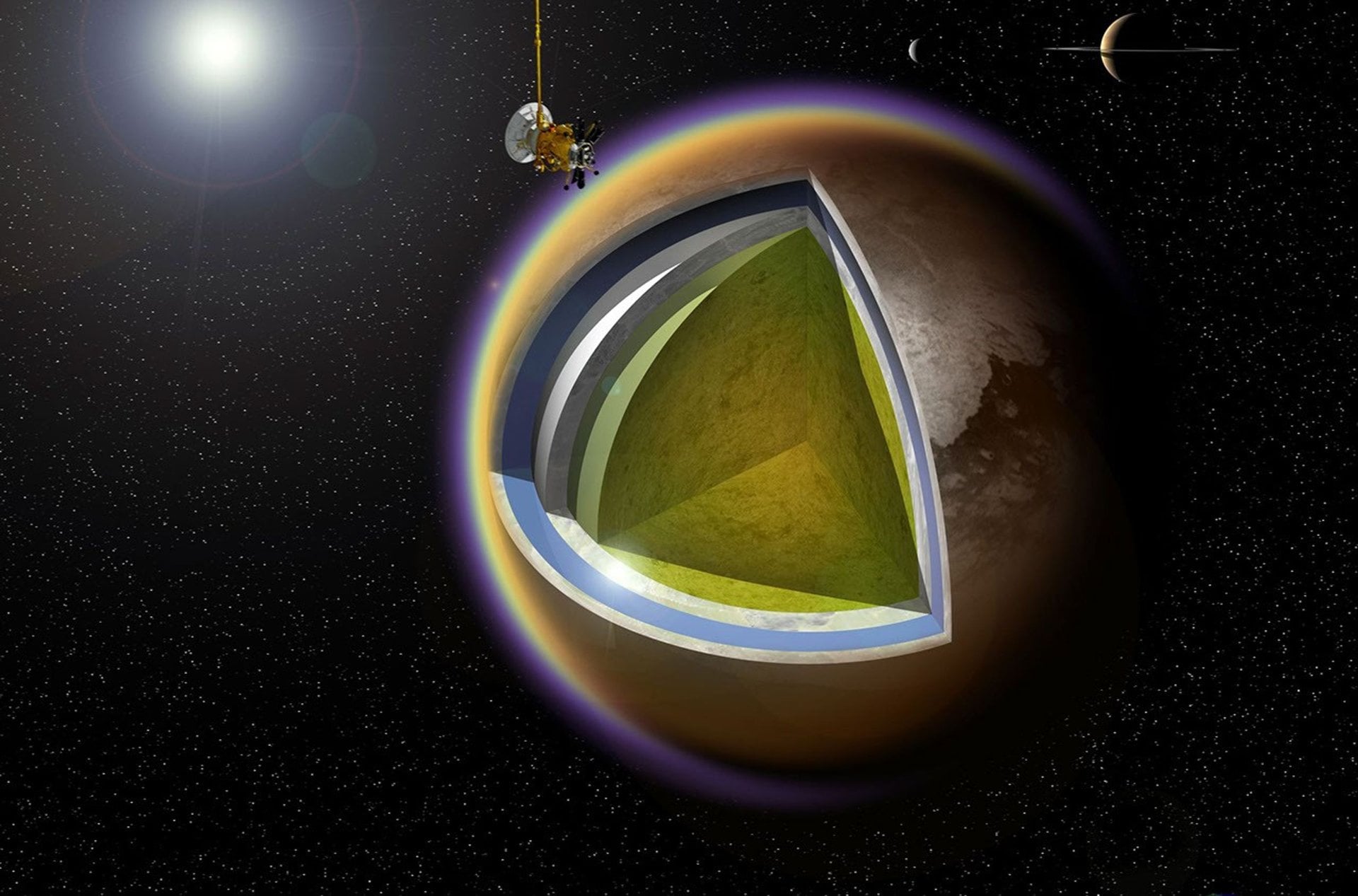
New Study Assesses Titan’s Resources and their Potential Uses
Titan, Saturn’s largest moon, possesses a dense, nitrogen-rich atmosphere and abundant surface hydrocarbons that could support permanent human settlement and serve as a refueling hub for the outer solar system, according to a NASA-supported study led by astronomer Conor A. Nixon. The research, authored by Nixon, Ye Lu, and Jennifer E. Ruliffson, identifies Titan as a unique resource base capable of providing fuel, food, and manufacturing materials far beyond the capabilities of the Moon or Mars.
Why is Titan called the “Persian Gulf” of the Solar System?
Titan’s massive reserves of hydrocarbons make it the most resource-rich destination for future industry in the solar system. Robert Zubrin describes the moon as a potential “Persian Gulf” in his book, Entering Space: Creating a Spacefaring Civilization, due to this chemical abundance.
Conor A. Nixon told Universe Today that Titan’s atmosphere contains about 5% methane, which humans use on Earth as liquefied natural gas (LNG) for heating and cooking. The surface holds heavier hydrocarbons including propane, butane, kerosene, and gasoline. These aren’t just for fuel; they provide the raw ingredients for plastics, synthetic rubber, solvents, pharmaceuticals, and even synthetic foods.
How does Titan compare to Mars and the Moon for settlement?
While most current In-Situ Resource Utilization (ISRU) research focuses on the Moon and Mars, Nixon’s team concludes that Titan’s potential is unrivaled. The primary trade-off is distance: reaching Titan requires nuclear propulsion to make the transit feasible, whereas the Moon and Mars are significantly closer.
| Feature | Moon/Mars | Titan |
|---|---|---|
| Atmosphere | Thin or negligible | Dense, nitrogen-rich |
| Primary Resources | Regolith, water ice | Hydrocarbons, water ice |
| Manufacturing Potential | Basic structures/oxygen | Plastics, pharma, complex fuels |
“There is simply no other world (that we know of) like Titan,” Nixon said. He noted that it’s the only moon with an atmosphere and the only non-Earth body with hydrocarbons available both in the air and on the ground.
What resources can be harvested through ISRU on Titan?
Water makes up 50% of Titan’s mass. It exists as surface ice and as a liquid subsurface ocean kept fluid by ammonia and salinity. According to the researchers, this water can be processed into drinking water, oxygen gas, and liquid hydrogen (LH2) and liquid oxygen (LOX) propellants.
Beyond water, the hydrocarbon base allows for a sophisticated manufacturing economy. Nixon envisions stations that refine raw materials into feedstock for 3D printers, creating everything from spare parts and textiles to printer ink and nitrogen fertilizers. This creates a closed-loop system where a colony could endure for generations without Earth-based resupply.
How would Titan function as a space refueling hub?
The study suggests Titan could act as a gateway for exploring the outer solar system. Refueling stations on the surface or orbital depots—similar to the concepts SpaceX is exploring for Starship—could allow ships to top off their tanks before heading to Uranus or Neptune.
Titan also provides a logistical base for exploring other Saturnian moons, such as Enceladus and Mimas. Furthermore, the surrounding Saturnian atmosphere contains helium-3, a rare isotope that’s considered the ideal fuel for future fusion reactors and propulsion systems.
What are the next steps for Titan exploration?
NASA’s Dragonfly mission is the immediate priority, with a launch scheduled for no earlier than July 2028. This mission will explore the prebiotic chemistry of the surface. Additionally, a proposed Titan ISRU Sample Return (TISR) mission aims to bring these rich resources back to Earth for analysis.

While crewed missions remain a distant prospect, the preprint currently under review for Acta Astronautica provides the blueprint for how humanity could transition from visiting Titan to inhabiting it.
Frequently Asked Questions
Could humans breathe on Titan?
No. While Titan has a dense atmosphere, it is primarily nitrogen and methane. Humans would require oxygen and pressure suits, though the atmospheric pressure is actually more hospitable than that of Mars.
How long does it take to get to Titan?
Using current chemical rockets, it takes several years. The study emphasizes that nuclear propulsion is necessary to reduce transit times for human crews.
What is the primary goal of the Dragonfly mission?
Dragonfly will study Titan’s organic chemistry and prebiotic environment to understand how the building blocks of life behave in a non-Earth setting.
Do you think Titan is a better bet for humanity than Mars?