
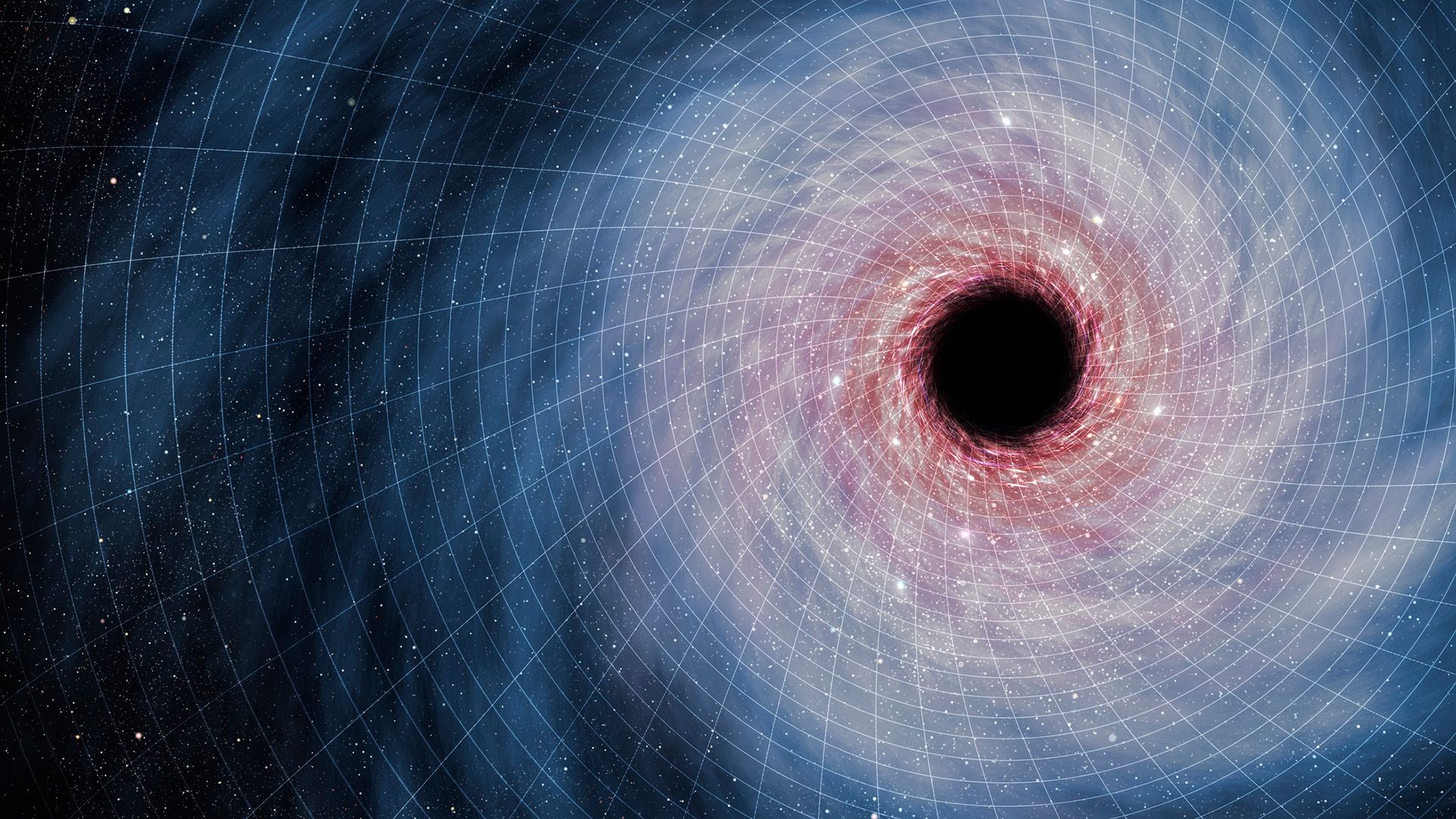
New Study Supports Existence of Naked Singularities and Microscopic Black Holes
A study published May 12 in the journal Physical Review Letters provides new mathematical support for the existence of microscopic black holes and naked singularities. The research describes how a specific mathematical pattern of ripples in space-time geometry, known as space-time crystals, could create these objects.
These findings advance a decades-long physics debate regarding whether singularities can exist without an event horizon. An event horizon is the point beyond which light and all other matter cannot escape, and its absence would make a singularity observable.
Why does the existence of naked singularities matter?
The possibility of naked singularities was the subject of a 1991 bet between Stephen Hawking and theoretical physicists Kip Thorne and John Preskill. Hawking originally doubted their existence but conceded defeat in 1997, admitting such objects could exist.
The evidence that swayed Hawking came from physicist Matthew Choptuik in 1993. Using a supercomputer to solve Albert Einstein’s general relativity equations, Choptuik showed that naked singularities could hypothetically occur under very specific conditions.
Choptuik found that fine-tuning the initial conditions of the gravitational collapse of matter, such as a field, could construct an unstable state. This state, the space-time crystal, contains a singularity with infinite curvature that is not hidden inside a black hole.
How did researchers solve the “numerical code” problem?
Previous research relied on computer simulations, but these had limitations. Christian Ecker, an astrophysicist at Goethe University in Germany, noted that numerical code can only represent a finite number of digits, making inaccuracies unavoidable.
To get a deeper understanding, researchers Daniel Grumiller and Christian Ecker used “pen and paper” analytical methods. This approach uses algebra and calculus to describe the formation of space-time crystals and microscopic black holes more precisely.
Grumiller, an astrophysicist at the Institute for Theoretical Physics, Vienna University of Technology, explained that the team injected a “small parameter” into the equations. They used one over the number of dimensions, letting that number be huge, to make the tough equations manageable through standard perturbation theory.
What may happen next in space-time research?
The current mathematical solution is exact when the number of dimensions is infinite, which is unrealistic for our universe. As the researchers lower the dimensions to more realistic numbers, the expressions become increasingly complicated.
There is currently a gap in the data. Grumiller stated that the lowest dimension they can consistently connect with is 52, while numerical data only extends up to dimension 14.
A possible next step involves extending numerical simulations to higher dimensions to bridge this gap. If the two methods connect, it could provide a compelling case that naked singularities and space-time crystals are mathematically possible in a universe like ours.
Frequently Asked Questions
What is a naked singularity?
It is an object similar to a black hole but without an event horizon, which means it does not have a point beyond which light and matter cannot escape, theoretically making it observable.
What are space-time crystals?
They are self-organized, repetitive mathematical patterns of ripples in space-time geometry that contain a singularity with infinite curvature.
Why is the current research still theoretical?
While the study provides a precise mathematical description, the researchers noted that this does not yet prove these objects actually exist in reality.
Do you think the discovery of observable singularities would fundamentally change our understanding of the universe?