
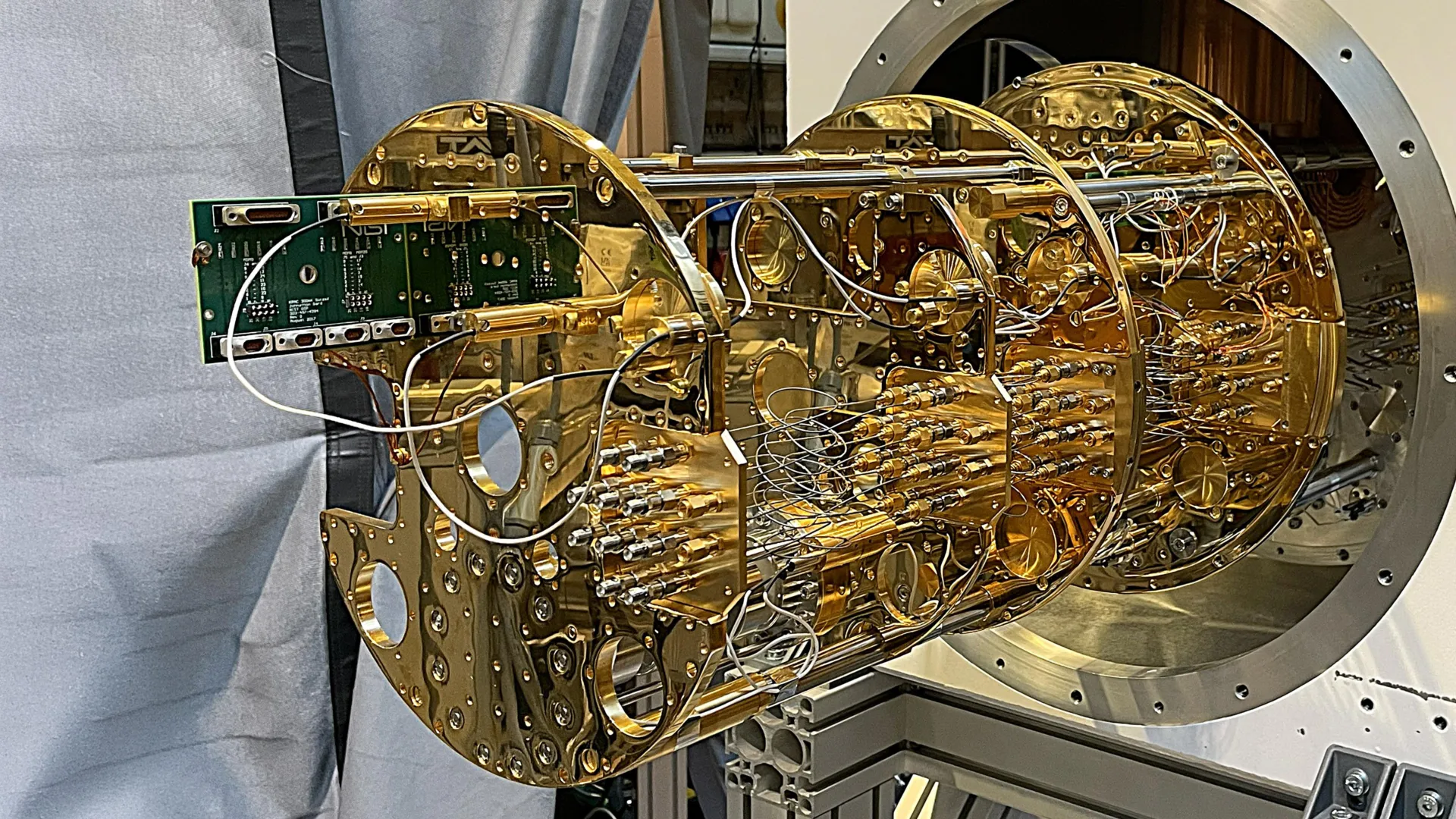
New superconducting X-ray detector is up to 1,000 times more sensitive
BESSY II has launched Europe’s first and only synchrotron-based Transition Edge Sensor (TES) spectrometer, developed through a collaboration between HZB, MPI-CEC in Germany, and NIST in the USA. According to HZB scientist Régis Decker, the instrument is 100 to 1,000 times more efficient at detecting photons than conventional wavelength-dispersive X-ray emission spectrometers.
The system allows researchers to analyze atomically thin materials, nanostructures, and highly diluted atomic and molecular samples. This capability shifts X-ray emission spectroscopy (XES) and Resonant Inelastic X-ray Scattering (RIXS) beyond their traditional limits of bulk materials and concentrated samples.
Why is the TES spectrometer more efficient?
Conventional spectrometers require large numbers of photons to produce useful measurements, which often restricts research to bulk materials. The TES array overcomes this by significantly increasing photon detection efficiency, according to Régis Decker.

This increased sensitivity can reduce data collection times from several hours to just a few minutes. The tool complements existing methods like ARPES, which is used to scan the electronic band structures of reduced-dimension systems.
How does the superconducting sensor technology work?
The instrument utilizes 248 sensors that achieve a superconducting state when cooled to 25 milli-Kelvin. To reach this temperature, the team uses a He4-He3 dilution refrigerator similar to those found in quantum computing systems.
When X-ray photons strike the sensors, they cause a brief temperature increase that disrupts the superconducting state. This change in electrical resistance is then measured using an array of Superconducting Quantum Interference Devices, known as SQUIDs.
What are the primary research applications?
Researchers intend to use the spectrometer to gain new insights into molecular biology and molecular chemistry. It is also designed to study the quantum properties of impurities, nanostructures, and atomic monolayers.
The system is installed at the BESSY II UE52-SGM beamline and features a custom ultra-high vacuum sample chamber. This chamber allows for precise temperature control between 10 K and room temperature.
What happens next for the BESSY II facility?
The research team is currently inviting proposals from the scientific community to utilize the new instrument. Planned upgrades may include enhanced capabilities for sample preparation.
Future developments could include the ability to study materials in magnetic fields. This would allow for X-ray Magnetic Circular Dichroism in both absorption (XMCD) and emission (RIXS-MCD).
Frequently Asked Questions
Who collaborated to develop the TES spectrometer?
The instrument was developed through a collaboration between HZB, MPI-CEC (Mühlheim-an-der-Ruhr, Germany), and NIST (Boulder CO, USA).
How does the TES spectrometer compare to conventional XES and RIXS spectrometers?
According to Régis Decker, the TES array is approximately 100 to 1,000 times more efficient at detecting photons than conventional spectrometers.
What temperature is required for the sensors to function?
The 248 sensors must be cooled to 25 milli-Kelvin to become superconducting.
How might the ability to study atomically thin materials impact the development of future quantum technologies?